

TL;DR:
- Effective inquiry handling involves structured workflows that leverage automation to respond quickly and accurately to tenant questions and requests. Property managers utilize tools like AI, CRM systems, and centralized dashboards to manage high inquiry volumes efficiently, ensuring proper routing and escalation. Balancing automation with human oversight—especially for legal, emergency, or complex issues—maximizes responsiveness and tenant satisfaction while reducing operational delays.
Effective inquiry handling is defined as the structured process of acknowledging, categorizing, and routing tenant and leasing questions through automated and human-assisted workflows to maximize response speed and occupancy outcomes. Property managers who master this process use tools like AppFolio, Buildium, and AI communication stacks to manage high inquiry volumes without sacrificing tenant experience. The gap between expectation and reality is stark: 62% of renters expect responses within an hour, yet the industry average sits at 24 hours. That gap costs leases. Understanding how property managers handle inquiries, from first contact to signed lease, is the single most operational lever available to landlords managing more than a handful of units.
How property managers handle inquiries: the core process
Property managers receive two fundamentally different types of inbound contact, and confusing them is where most operations break down. Leasing inquiries come from prospective tenants asking about availability, pricing, and unit features. Maintenance requests come from current tenants reporting problems that need resolution. Each requires a different workflow, a different tone, and a different urgency level.

The volume is higher than most landlords expect. Property managers field an average of 42 inbound calls daily, split roughly 60% maintenance requests and 40% leasing inquiries. That means a single manager handling a 50-unit portfolio is fielding nearly 300 contacts per week before accounting for emails, texts, and online form submissions. Without a structured property manager inquiry process, those contacts pile up, get lost, or receive inconsistent responses.
The table below shows how inquiry types differ in urgency, handling time, and appropriate response channel.
| Inquiry type | Urgency level | Typical handling time | Best response channel |
|---|---|---|---|
| Leasing question (availability, pricing) | Medium | Under 1 hour | Automated reply + human follow-up |
| Maintenance request (non-emergency) | Medium | Same day | Ticketing system + confirmation text |
| Emergency maintenance (flooding, gas) | Critical | Under 2 minutes | Automated escalation + on-call staff |
| Application status question | Low | 24 hours | Automated status update |
| Lease renewal inquiry | High | Same day | Human agent with CRM context |
Pro Tip: Audit your last 30 days of inbound contacts and categorize them by type before building any new workflow. Most managers discover that 70% of their volume falls into just two or three repeating categories, which is exactly where automation pays off fastest.
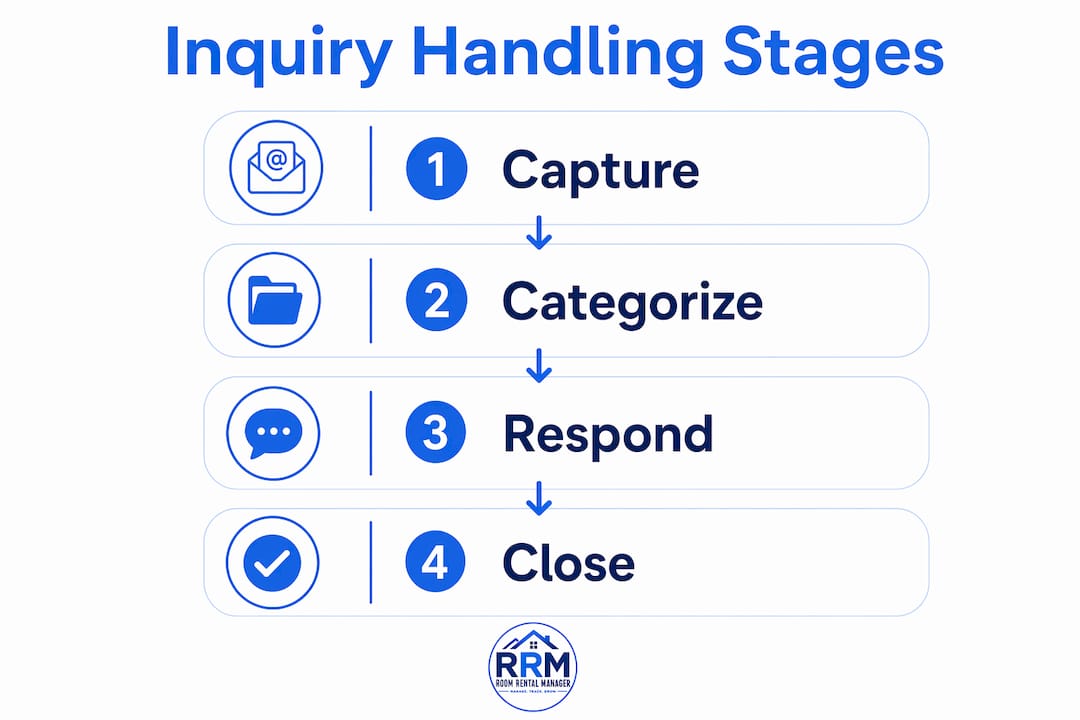
The core inquiry management workflow follows four stages: capture, categorize, respond, and close. Capture means every contact point, whether phone, email, web form, or text, feeds into one system. Categorize means the system or a staff member tags the inquiry by type and urgency. Respond means the right message goes out through the right channel within the expected timeframe. Close means the inquiry is marked resolved and logged for reporting. Skipping any stage creates invisible workflows where inquiries fall through without anyone noticing.
How can automation and AI improve inquiry handling for property managers?
Automation is not a replacement for property managers. It is a multiplier that lets one manager handle the volume that previously required three. The math is straightforward: up to 80% of routine tenant inquiries covering scheduling, FAQs, and status updates can be automated without any loss of tenant satisfaction. That frees your staff to focus on the 20% of contacts that actually require judgment, negotiation, or legal awareness.
Here is what a well-configured AI inquiry system handles without human involvement:
- Automated acknowledgments: Every inbound contact receives an instant reply confirming receipt, setting response time expectations, and providing basic property information. This alone closes the expectation gap that causes most tenant frustration.
- FAQ resolution: Questions about pet policies, parking, utilities, and lease terms are answered from a knowledge base without staff involvement. The system pulls the correct answer and logs the exchange.
- Tour scheduling: AI integrates with real-time calendar systems to offer available showing slots, confirm bookings, and send reminders. Tools like AI receptionists from vendors such as CoreIBytes book tours and log maintenance requests simultaneously without workflow collision.
- Maintenance ticket creation: Tenants describe the issue, the system creates a ticket, assigns it to the correct vendor or staff member, and sends a confirmation with an estimated response window.
- Emergency detection and escalation: Keyword detection combined with urgency selection triggers sub-2-minute acknowledgment and routes the contact to on-call staff with full context attached.
The setup phase matters more than most managers realize. Running AI in monitoring mode first, where the system drafts responses but a human approves them before sending, lets you audit accuracy and catch errors before they reach tenants. Running AI in monitoring mode during initial rollout prevents poor tenant experiences that are difficult to walk back. Most teams run monitoring mode for two to four weeks before switching to full automation.
Pro Tip: Set your escalation triggers before you go live. The four most reliable triggers are: detection of legal terminology in the message, an emergency keyword like "flood" or "gas leak," three or more unresolved tickets from the same tenant, and any message flagged as negative sentiment by the AI. Each trigger should route to a named human with full conversation context attached.
The 24/7 coverage benefit is underappreciated. Most leasing inquiries arrive outside business hours, particularly on evenings and weekends when prospective tenants are actively searching. An automated system that responds at 10 PM on a Saturday captures leads that a manual operation misses entirely. That is not a marginal improvement. It is a structural advantage in competitive rental markets.
You can learn more about rental advertising automation and how it connects to inquiry handling in the Room Rental Manager blog.
What processes help with pre-qualification and inquiry tracking?
Pre-qualification is the most underused tool in the property manager inquiry process. Most managers treat every inquiry as equal, spending the same time on a prospect who cannot meet basic income requirements as on a qualified applicant ready to sign. Pre-qualification fixes that by filtering unsuitable applicants before they consume staff time.
Structured inquiry handling reduces staff reactive firefighting and increases productivity by ensuring that only viable prospects advance to the showing stage. A basic pre-qualification sequence asks four questions upfront: move-in date, monthly budget, number of occupants, and whether the applicant has prior evictions. Prospects who do not meet your criteria receive a polite automated response. Prospects who qualify move to the next stage automatically.
The four-stage inquiry tracking workflow looks like this:
- Capture: Every inquiry, regardless of channel, enters a single dashboard or CRM. Phone calls are logged with a summary. Web form submissions auto-populate. Emails are forwarded or integrated via API. Nothing lives in a personal inbox or a messaging app thread.
- Qualify: The system or a staff member applies pre-qualification criteria. Unqualified inquiries are closed with a logged reason. Qualified inquiries are tagged and assigned.
- Nurture and respond: Qualified prospects receive timely, personalized follow-up. The CRM tracks every touchpoint so any staff member can pick up the conversation with full context.
- Close and report: Every inquiry is marked resolved, converted, or lost with a reason code. Monthly reports show inquiry volume by source, conversion rate by channel, and average response time.
The comparison below shows the difference between a scattered communication setup and a centralized one.
| Factor | Scattered setup (WhatsApp, email, texts) | Centralized CRM or dashboard |
|---|---|---|
| Message traceability | Poor. Threads buried across apps | Full. Every message logged with timestamp |
| Staff handoff | Broken. Context lost between team members | Smooth. Full history visible to any agent |
| Reporting | Manual and incomplete | Automated and accurate |
| Follow-up accountability | Relies on memory | System-triggered reminders |
| Missed inquiry rate | High | Low |
Messaging apps like WhatsApp are poor systems of record. Conversations get buried, threads split across devices, and there is no audit trail when a dispute arises. A centralized CRM or purpose-built rental inquiry tracking platform creates a single source of truth that protects both the manager and the tenant.
How do property managers balance automation with human interaction?
Not every inquiry belongs in an automated workflow. The 20% of contacts that require human judgment are also the 20% that carry the highest risk if handled poorly. Knowing when to hand off from automation to a human agent is the defining skill of effective inquiry management strategies.
The triggers that should always route to a human include:
- Legal language in the message: Any mention of attorneys, lawsuits, fair housing complaints, or lease disputes requires a human response reviewed by someone with legal awareness.
- Emergency situations: Flooding, gas leaks, fire, or security breaches need immediate human escalation even when the automated system sends the first acknowledgment.
- Complex lease questions: Questions about subletting, early termination penalties, or lease modification require interpretation, not just information retrieval.
- Repeated unresolved issues: A tenant who has submitted three maintenance tickets for the same problem is signaling frustration. Automation cannot read that signal. A human needs to call.
- Negative sentiment detection: AI systems that flag emotional language or distress in a message should route those contacts to a human immediately, not queue them for a standard response.
Automation configuration must include escalation triggers that route complex or emergency inquiries to humans with full conversation context attached. The context handoff is critical. When a human agent receives an escalated inquiry, they should see the full thread, the tenant's history, any open tickets, and the reason for escalation. Without that context, the human starts from scratch, which frustrates tenants and wastes the efficiency gains automation created.
The data on tenant acceptance of automation is more positive than most managers expect. Less than 12% of tenants choose human intervention after experiencing fast, accurate automated responses. Tenants do not inherently prefer talking to a person. They prefer getting a useful answer quickly. When automation delivers that, most tenants accept it without complaint. Transparency helps: telling tenants they are interacting with an automated system that will escalate if needed builds trust rather than eroding it.
The rental inquiry management process works best when automation handles volume and humans handle complexity. That division is not about cutting costs. It is about directing human attention where it creates the most value.
Key takeaways
Effective inquiry management requires automation for volume, pre-qualification for efficiency, and centralized communication for accountability, with human escalation reserved for legal, emergency, and complex lease situations.
| Point | Details |
|---|---|
| Automate routine inquiries | Up to 80% of tenant questions can be resolved automatically, freeing staff for high-value contacts. |
| Pre-qualify early | Filtering prospects before the showing stage eliminates low-value inquiry volume and reduces staff overload. |
| Centralize all communication | A single CRM or dashboard prevents lost messages, broken handoffs, and missed follow-ups across channels. |
| Set clear escalation triggers | Legal language, emergencies, and repeated unresolved tickets must route to a human with full context. |
| Monitor before full automation | Running AI in monitoring mode for two to four weeks prevents errors from reaching tenants during rollout. |
What I've learned from watching managers get inquiry handling wrong
I have reviewed enough property management operations to know that the failure mode is almost never technology. It is process. Managers invest in AppFolio or Buildium, configure the basics, and then continue routing inquiries through personal cell phones and WhatsApp groups because "it's faster." It is not faster. It is familiar. Those are different things.
The managers who handle inquiry volume well share one habit: they treat their communication system as infrastructure, not a convenience. They do not bypass it when it feels slow. They fix the slowness. That discipline is what separates a 50-unit operation that runs smoothly from one that is constantly reactive.
The other pattern I see repeatedly is under-investment in pre-qualification. Managers spend hours showing units to prospects who were never going to qualify, then wonder why their conversion rate is low. Pre-qualification is not about being selective to the point of discrimination. It is about respecting everyone's time, including the applicant's. A prospect who does not meet income requirements is not helped by a showing. They are helped by a clear, respectful message that explains the criteria and saves them the trip.
My honest recommendation for anyone starting from scratch: do not try to automate everything at once. Pick the single highest-volume inquiry category, which is usually maintenance request acknowledgment or availability questions, and automate that one workflow completely before touching anything else. Get it right, measure the results, then expand. Incremental implementation with proper staff training outperforms a full rollout every time. The technology is not the hard part. Getting your team to trust it is.
— JAMES
Manage every rental inquiry from one place with Room Rental Manager
Room Rental Manager gives landlords and property managers one clean dashboard to collect inquiries, track lead sources, and follow up without repeating the same information across texts, emails, and social media replies.
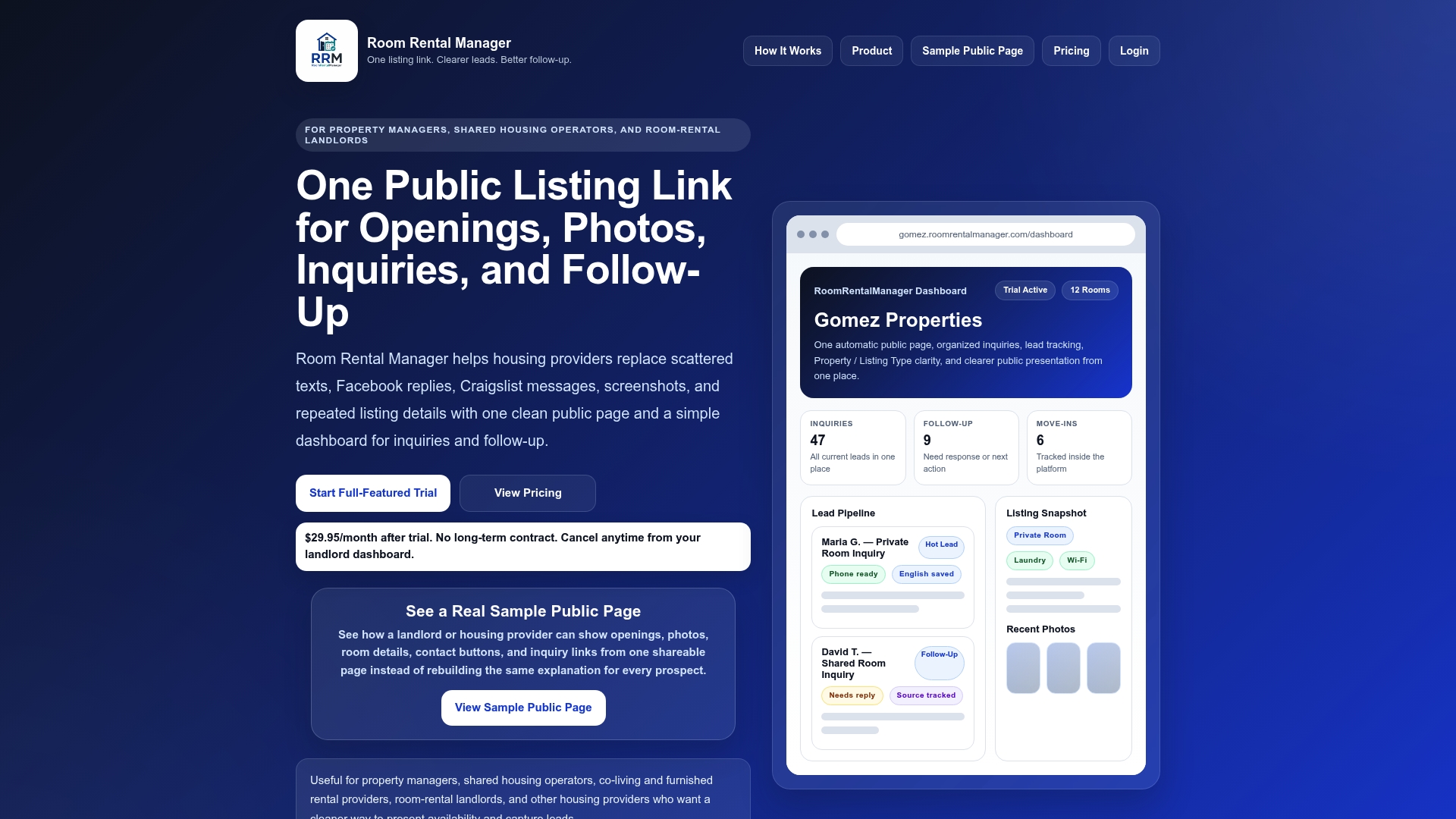
Instead of juggling Craigslist messages, Facebook replies, and email threads, you share one link. Prospective tenants see your listing, photos, and contact options in one place. You see every inquiry logged, tracked, and ready for follow-up. Room Rental Manager's inquiry tracking features are built specifically for room rental landlords and small housing operators who need professional-grade communication management without enterprise-level complexity. Explore the full room rental software to see how it fits your operation.
FAQ
How do property managers respond to high inquiry volumes?
Property managers handle high volumes by automating routine responses through AI systems and CRM platforms, which resolve up to 80% of standard tenant questions without staff involvement. The remaining contacts are triaged by urgency and routed to the appropriate team member.
What is the fastest way to respond to tenant inquiries?
Automated acknowledgment systems send instant replies to every inbound contact, closing the response gap that causes tenant frustration. The industry benchmark for first acknowledgment is under five minutes, achievable only through automation.
How do property managers pre-qualify rental inquiries?
Pre-qualification uses a short set of upfront questions covering move-in date, budget, occupancy, and rental history to filter out unsuitable applicants before they reach the showing stage. This reduces inquiry volume while keeping response rates high for qualified prospects.
What tools do property managers use to track inquiries?
Property managers use CRM platforms, purpose-built property management software like AppFolio and Buildium, and centralized dashboards to log, track, and report on every inbound contact. Messaging apps like WhatsApp are not reliable tracking systems because conversations get buried and lack audit trails.
When should a property manager escalate an inquiry to a human agent?
Inquiries involving legal language, emergency maintenance situations, repeated unresolved tickets, or strong negative sentiment should always route to a human agent with full conversation context. Automation handles volume. Human judgment handles risk.