

TL;DR:
- Most landlords overlook how their contact setup influences tenant quality and conversion rates.
- Using multiple, well-designed contact methods ensures communication continuity, speeds responses, and improves professionalism.
- Proper management and regular updating of contact information reduce legal risks and maximize inquiry response efficiency.
Most landlords underestimate how much their contact setup affects the quality of tenants they attract. Understanding how rental contact options work is not a back-office detail. It directly shapes whether a qualified prospect reaches out, how fast you respond, and whether that lead ever converts. The right mix of contact methods reduces missed inquiries, cuts your admin time, and gives renters a professional first impression. This guide breaks down every major option, explains how to design forms that actually work, and shows you how to keep your contact information current and legally sound.
Table of Contents
- Key takeaways
- How rental contact options work: the core types
- Designing rental contact forms that actually qualify leads
- Managing and updating your rental contact information
- How contact options affect tenant conversion and inquiry management
- My take on rental contact options after years of watching this play out
- How Roomrentalmanager simplifies your rental contact setup
- FAQ
Key takeaways
| Point | Details |
|---|---|
| Multiple methods reduce risk | Relying on one contact channel creates gaps; phone, email, and mail together protect communication continuity. |
| Form design affects lead quality | Concise forms with 5 to 7 inquiry categories improve routing speed and reduce prospect drop-off. |
| Contact info needs active management | Outdated contact details in lease agreements cause delays in rent collection and legal notice delivery. |
| Digital-first drives faster conversion | Structured digital contact options speed up responses and convert leads at a higher rate than informal methods. |
| Automation should complement personal outreach | Auto-replies set expectations, but personal follow-up closes the deal for quality tenants. |
How rental contact options work: the core types
Not every contact method serves the same purpose. Here is a practical breakdown of the main types of rental contact options landlords use, along with when each one earns its place in your workflow.
| Contact Method | Best Use Case | Key Limitation |
|---|---|---|
| Phone call | Urgent issues, complex negotiations | Hard to document; not scalable for high volume |
| Detailed correspondence, lease delivery | Slower response cycle; can get buried | |
| Text message | Quick updates, showing confirmations | Informal; limited for legal notices |
| Physical mail | Legal notices, formal lease documents | Slow delivery; no read confirmation |
| Online contact form | Inquiry routing, lead collection | Requires good design to avoid abandonment |
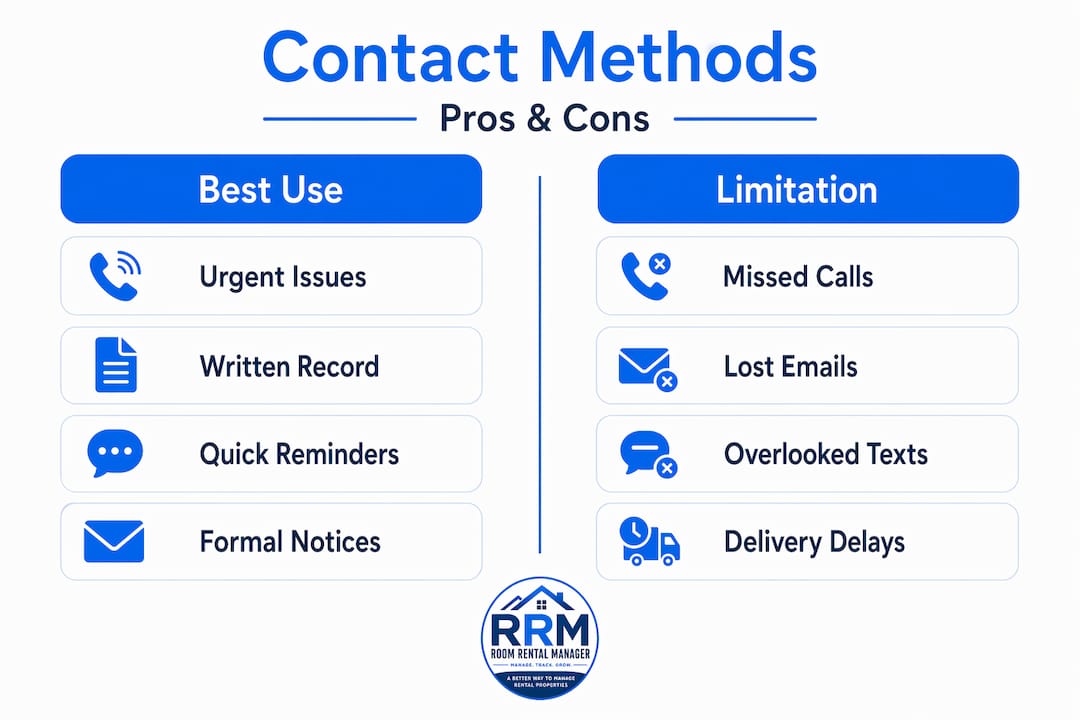
Phone calls work best for nuanced conversations. When a prospect has specific questions about lease terms or a current tenant has an urgent maintenance issue, voice communication resolves things faster than a back-and-forth email thread. The downside is documentation. Verbal agreements and informal confirmations create risk.
Email fills the gap between urgency and formality. It creates a written record, gives both parties time to think, and handles attachments like lease drafts or move-in checklists. The limitation is response time. Emails get buried, especially if a prospect is inquiring on multiple properties at once.
Text messages are fast and personal, which makes them effective for appointment reminders or quick status updates. But they are not appropriate for anything legally significant, and they scale poorly when you manage more than a handful of units.
Physical mail still has a role, particularly for formal legal notices where your jurisdiction requires documented delivery. Providing multiple contact methods in lease agreements, including a mailing address, protects you when digital systems fail or a tenant lacks reliable tech access.
Structured contact forms represent the most scalable option for landlords managing multiple vacancies. When designed correctly, they collect the right information upfront, route inquiries to the right person, and set clear response expectations without requiring you to be available around the clock.
Designing rental contact forms that actually qualify leads
A rental contact form explained simply is this: a structured set of fields that collects key information from a prospect before you invest time in a response. The problem is most landlords either ask too much or too little.
Here is what the research consistently shows about form design:
- Keep fields minimal upfront. A two-step inquiry process collects basic contact info first, then moves detailed questions like employment history and references into a secure application after the lead is qualified.
- Use 5 to 7 inquiry categories. The most effective rental forms limit categories to this range for both user ease and routing accuracy. Common categories include "Leasing Inquiry," "Maintenance," "Billing," and "General Question."
- Make phone number optional, not required. Some prospects will not complete a form that demands a phone number. If your workflow requires phone contact, collect it at the callback scheduling stage instead.
- Add a short data-use notice. One sentence explaining that their information will only be used to respond to their inquiry measurably improves form trust and submission rates.
- Set up an auto-reply. An immediate acknowledgment email confirms receipt and gives a realistic response window. It reduces follow-up messages asking "Did you get my inquiry?" and sets a professional tone.
Pro Tip: Test your form yourself from a mobile device before publishing it. Most rental inquiries now come from phones, and a form that is hard to tap or scroll on will cost you leads before you ever see them.
The goal, as the research on tenant inquiry form design makes clear, is to qualify leads without making the process feel like a bureaucratic obstacle. Your form is often the first real interaction a prospect has with your operation. Make it reflect the kind of landlord you are.
Category-based routing is worth emphasizing on its own. When a prospect selects "Leasing Inquiry" versus "Maintenance," their message goes directly to the right person or queue immediately. Without categories, every message lands in a general inbox and depends on someone reading it carefully before it gets forwarded. That extra step creates delays. In professional rental networks, incomplete inquiry submissions cause routing delays of five or more business days. Categories eliminate that friction entirely.
Managing and updating your rental contact information
Understanding rental contracts and the contact information embedded in them is one of the most overlooked parts of property management. Outdated phone numbers or email addresses in a lease agreement do not just cause inconvenience. They create legal exposure.
Here is a practical process for keeping your contact information current across every touchpoint:
- Audit your lease agreements annually. Check that the landlord contact name, phone number, email address, and mailing address are accurate. When you change property management companies or update your business email, the lease agreement needs to reflect that.
- Use a property management portal for centralized contact sharing. Rather than having tenants store your number in their personal contacts, a portal gives them one place to find current information at any time. Digital rent collection and communication both benefit when tenants know exactly where to go.
- Issue written notice for any contact changes. When your phone number or management office changes, send a written notice to all current tenants. Email is fine for most markets, but physical mail may be required depending on your lease terms or local regulations.
- Ask tenants to update their contact details at renewal. Build this into your renewal checklist. A tenant whose phone number changed six months ago and never told you is a problem waiting to surface at the worst possible time.
- Keep a secondary non-digital contact method on file. A mailing address as a backup contact method is not just good practice. It is legally required in some jurisdictions for specific types of notices.
Pro Tip: Create a one-page contact information sheet that gets updated every 90 days and attached to every new lease. It is a simple habit that eliminates most "I didn't know how to reach you" situations before they happen.
Understanding rental contracts means recognizing that they are living documents tied to real communication workflows, not static files. The contact section in a lease agreement is a legal record of how parties are expected to communicate. Treat it accordingly.
How contact options affect tenant conversion and inquiry management
The role of room rental contact options extends well beyond receiving messages. They shape how efficiently you convert a prospect into a signed tenant. That connection between contact strategy and conversion rate is where most landlords leave money on the table.
Digital-first communication consistently drives faster responses and stronger lead conversion. When a prospect can submit an inquiry at 10 PM and receive an auto-reply with a clear response window, they stay engaged. When they have to call during business hours or wait for a reply to an informal Facebook message, many of them move on to the next listing.
Here is what contact structure does to your pipeline:
- Structured forms speed up qualification. When you already know a prospect's move-in date, budget, and unit preference from their inquiry form, your first call or email is substantive rather than exploratory.
- Routing categories reduce handling time. Inquiry category routing sends messages to the right team member immediately, cutting the time between inquiry and response significantly.
- Phone outreach remains effective for certain segments. Older renters, non-native English speakers, and applicants with complex housing needs often prefer phone contact. Having a phone number visible in your listing signals accessibility.
- Incomplete or delayed inquiry processing loses leads. If your inquiry process has gaps where messages fall through, qualified tenants apply elsewhere. The cost of a missed inquiry is not just one lost applicant. It is another week or month of vacancy.
How room rental inquiries are managed at scale depends on having systems rather than habits. A single landlord with two units can get by on a phone number and a Gmail account. A property manager handling twenty rooms cannot. At that point, rental inquiry tracking becomes a functional requirement, not a luxury.
The most effective landlords treat their contact options as a conversion system. Every method has a role. Every touchpoint is deliberate. And the whole thing is set up so a qualified tenant encounters no friction from discovery to application.
My take on rental contact options after years of watching this play out
I have reviewed how hundreds of landlords handle tenant communication, and the pattern is frustratingly consistent. Most of them built their contact setup once, probably when they listed their first property, and never revisited it. The phone number is still a personal cell. The "email me" link goes to a Gmail account nobody monitors reliably. There is no form, no routing, and no auto-reply.
What I have learned is that the contact option you choose sends a signal about how you operate. A landlord who lists only a phone number tells prospects they need to catch you at the right moment. A landlord with a well-designed inquiry form tells prospects their time and information will be handled professionally. That signal matters to quality tenants more than you think.
The thing most articles on this topic miss is that redundancy is not about covering edge cases. It is about demonstrating reliability. When I see a listing with a phone number, an email address, and a contact form, I read that as a landlord who is organized and responsive. That perception attracts better applicants before a single conversation happens.
I am also skeptical of full automation. Auto-replies are great for setting expectations. But the landlords I have seen convert the most qualified tenants are the ones who follow up personally within a few hours of receiving a form submission. The form qualifies the lead. The personal outreach closes it.
The last thing I will say is this: if your contact information is not accurate and consistent across your listing, your lease, and any management portal you use, you are creating risk that compounds over time. Update it like your business depends on it. Because at some point, it will.
— JAMES
How Roomrentalmanager simplifies your rental contact setup
Managing rental contact options across texts, emails, Facebook messages, and Craigslist replies is where landlord time disappears. Roomrentalmanager was built to fix exactly that problem.
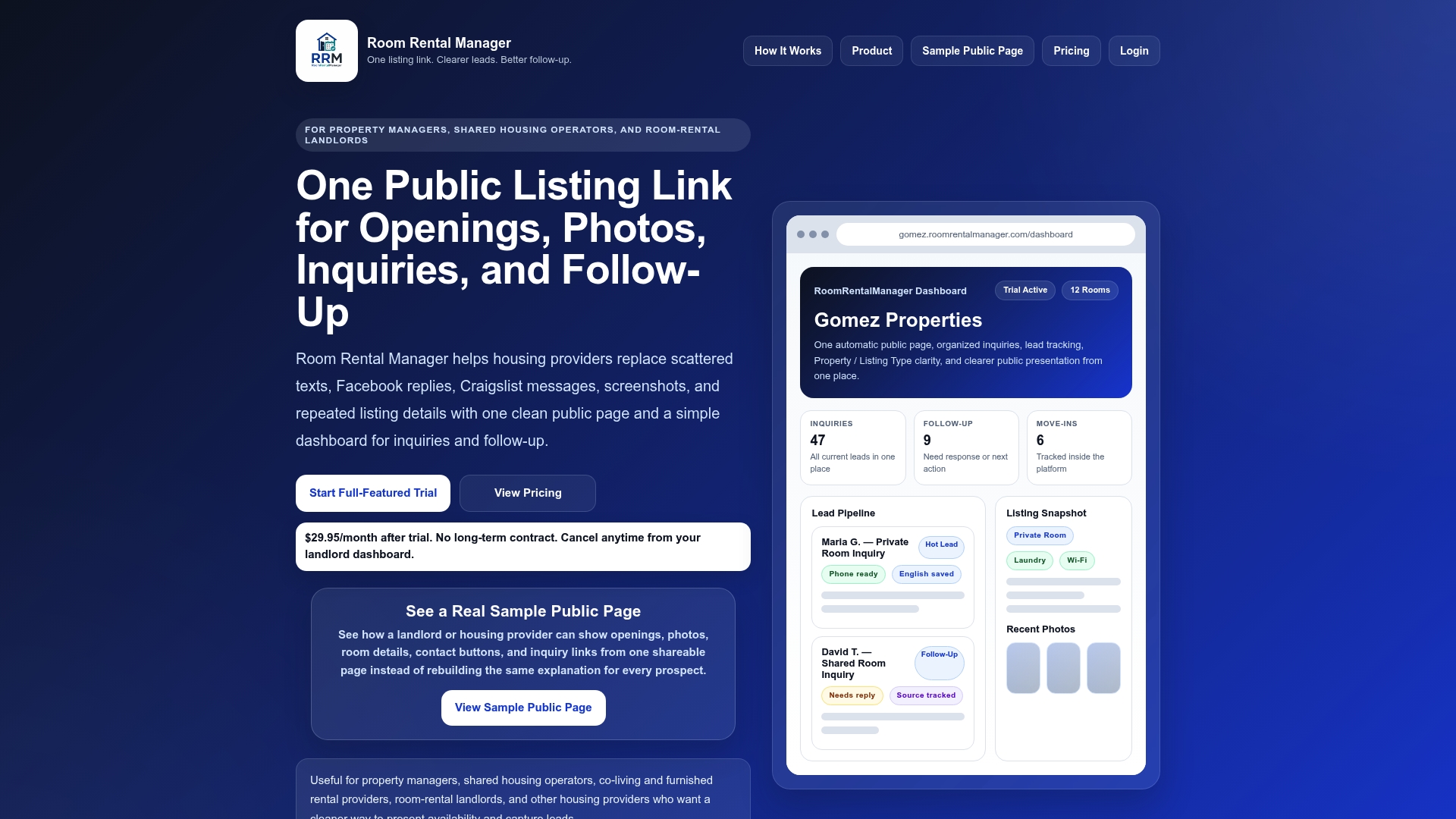
With Roomrentalmanager, you create one clean listing page that includes your photos, property details, contact options, and an inquiry form. You share one link. Prospects submit structured inquiries. You track every lead, see where it came from, and follow up from a single dashboard. No more piecing together conversations from five different apps. The platform's inquiry tracking tools and lead management features give you the structure to manage room rental inquiries at scale without losing the personal touch that converts good tenants. Explore the landlord resource library to see guides, templates, and tools built specifically for room rental operators.
FAQ
What are the main types of rental contact options?
The main types of rental contact options include phone calls, email, text messages, physical mail, and structured online contact forms. Each method serves a different communication need, from urgent tenant issues to formal legal notices.
How does a rental contact form work?
A rental contact form collects key prospect information through structured fields and routes inquiries to the appropriate team member or queue based on the selected category. Well-designed forms include 5 to 7 categories and use a two-step process to qualify leads without overwhelming applicants.
Why do landlords need multiple contact methods?
Providing multiple contact methods protects against communication gaps if one channel fails and supports legal compliance for formal notices. Secondary options like a mailing address remain critical even when digital communication handles most day-to-day contact.
How often should landlords update their rental contact information?
Landlords should audit contact details in lease agreements at least annually and issue written notice to tenants any time a phone number, email address, or management office changes. Building a contact update step into every lease renewal prevents outdated information from creating communication or legal problems.
How do contact options affect rental lead conversion?
Structured contact options speed up inquiry qualification, reduce response delays, and keep prospects engaged longer. Landlords who combine a clear inquiry form with prompt personal follow-up consistently convert higher-quality leads than those relying on informal or single-channel contact methods.