

Most landlords assume more leads means better advertising results. It's an easy trap. You run an ad, you watch the clicks roll in, and you feel like the money is working. But here's the problem: clicks don't pay rent. Leases do. Many property managers spend hundreds of dollars on advertising channels that generate plenty of interest but produce short-term tenants, high turnover, and months of vacancy that quietly erase every dollar gained. This guide breaks down what rental advertising ROI actually means, which metrics tell the real story, and how to build a system that produces profitable, durable leases instead of just raw lead volume.
Table of Contents
- What is rental advertising ROI and why is it tricky?
- Key metrics for tracking rental advertising ROI
- Beyond clicks: Why lease quality drives true ROI
- Solving edge-cases: Vacancy, turnover, and timing
- Framework for improving rental advertising ROI
- Why optimizing for lease quality, not volume, is the game-changer
- Take your rental ROI further with Room Rental Manager
- Frequently asked questions
Key Takeaways
| Point | Details |
|---|---|
| Lease quality matters | High-quality leases drive real ROI, not just high click or lead volumes. |
| Measure more than clicks | Tracking conversion rates and vacancy costs reveals the true impact of advertising. |
| Optimize targeting first | Upstream diagnostics help avoid wasted spend on poor ad targeting or low-quality creative. |
| Address vacancy timing | Misplaced ad spend during vacancy or turnover can severely reduce rental ROI. |
| Frameworks drive results | Using step-by-step strategies can systematically improve rental advertising outcomes. |
What is rental advertising ROI and why is it tricky?
Rental advertising ROI measures how much return you get from your ad spend relative to the leases you close and the revenue those leases generate over time. That sounds simple enough. But it's far more complicated than dividing revenue by spend and calling it a day.
Traditional ROI calculations used in other industries focus on a clean input-output relationship. Rental properties don't work that way. You're not selling a product once. You're generating recurring income that depends on tenant quality, lease duration, vacancy periods, and turnover costs. As Investopedia points out, rental property ROI is more complex than net income alone, with vacancy and frequent turnover reducing rental income while fixed expenses keep running regardless.
Think about what happens when a tenant leaves after six months. You lose rent for the weeks the unit sits empty. You pay to advertise again. You spend time screening applicants. You may need to repaint or repair. That cycle costs real money, and if your advertising channel was responsible for attracting that short-term tenant in the first place, your ROI from that channel is actually negative even if the initial CPL (cost per lead) looked great.
Here's what rental advertising ROI actually depends on:
- Ad spend across all channels (paid search, listing sites, social media, etc.)
- Lead volume and quality from each channel
- Lease conversion rate (how many leads become signed tenants)
- Lease duration and tenant retention
- Vacancy days between tenancies
- Turnover costs including cleaning, repairs, and re-advertising
You can explore more frameworks and context in the room rental resources library to see how these elements connect in practice.
"ROI for rental properties is more complex than net income alone and highlights the role of vacancy and the costs of frequent vacancies, including advertising for new tenants, screening, and repairs, which reduce rental income while fixed expenses continue." — Investopedia
Key metrics for tracking rental advertising ROI
With a clear ROI framework, it's time to break down which metrics actually inform real-world rental success.
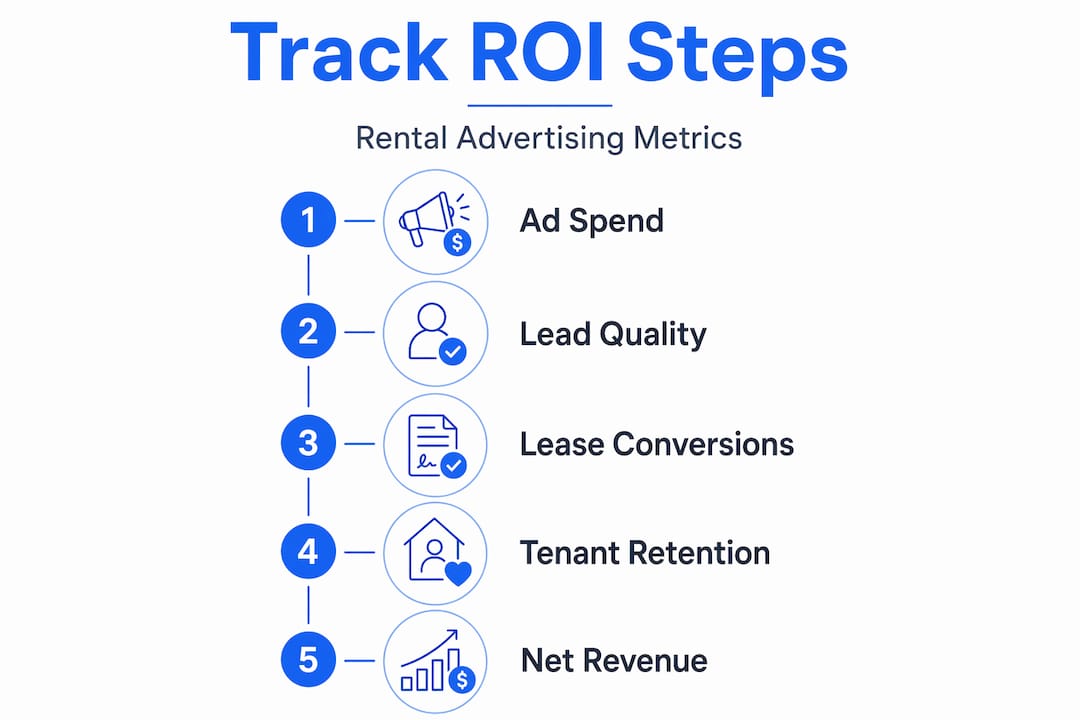
Not every metric deserves equal attention. Some tell you about the top of your funnel. Others reveal what's happening at the point of lease signing. You need both, but you need to understand what each one actually means before acting on it.
| Metric | Definition | What it reveals |
|---|---|---|
| Cost per lead (CPL) | Ad spend divided by number of leads | Efficiency of attracting interest |
| Cost per click (CPC) | Ad spend divided by number of clicks | Traffic cost from paid channels |
| Return on ad spend (ROAS) | Revenue generated divided by ad spend | Direct revenue efficiency |
| Lease conversion rate | Leads that become signed leases | Quality of leads and listing appeal |
| Vacancy rate | Percentage of time a unit sits empty | Revenue loss from gaps in tenancy |
| Turnover cost | Total cost to re-rent after a tenant leaves | Hidden drag on advertising ROI |
Each of these metrics needs context. A high CPL isn't automatically bad. If a channel with a $120 CPL consistently delivers tenants who stay for two years, that cost is easily justified. Meanwhile, a channel with a $30 CPL that produces tenants who leave after four months is costing you far more in the long run.
RentVision makes an important point here: CTR and CPC are indicators, but evaluating performance requires confirming that traffic is qualified and leading to actual leasing actions, not just clicks. CPC also varies significantly based on competition and keyword intent, so a rising CPC in a competitive market may still be worth paying if the downstream lease quality holds up.
Key metrics to monitor consistently:
- Lease conversion rate by channel to identify which sources produce real tenants
- Average lease duration by source to compare long-term value across channels
- Vacancy days per turnover to understand the true cost of tenant churn
- Revenue per channel over a rolling 12-month window for a complete picture
Pro Tip: Don't just track where leads come from. Track where signed leases come from. Those are two very different numbers, and the gap between them is where your advertising budget is leaking.
Using a dedicated rental inquiry tracking system makes this kind of channel-level analysis much easier to maintain without building complex spreadsheets from scratch. Pairing that with solid lead management software gives you a complete view from first contact to signed lease.
Beyond clicks: Why lease quality drives true ROI
But if metrics alone aren't enough, how do you actually ensure your advertising dollars lead to profitable leases?
The honest answer is that you have to think further downstream than most landlords are comfortable doing. The advertising industry is built around top-of-funnel numbers because those are the easiest to measure and the most impressive to report. Clicks, impressions, and lead counts all look good on a dashboard. But they don't tell you whether those leads became reliable tenants who paid on time and renewed their leases.
Not all leads are equal. A channel that drives 80 inquiries per month but converts only 3 into leases, and those tenants average 5 months before leaving, is a money pit. A channel that drives 15 inquiries and converts 8 into leases with an average tenancy of 18 months is a profit engine. The difference in raw lead volume is dramatic. The difference in actual revenue is even more dramatic, but in the opposite direction.
RentVision reinforces this directly: to translate ad ROI into real rental economics, you must incorporate lease conversion quality and revenue impact, not just CTR or CPC.
Here's how to actually measure lease quality by channel:
- Track move-in rates by source. Record where every tenant who signs a lease originally came from. This tells you which channels actually close.
- Monitor lease duration by channel. After 12 months, compare average tenancy length for tenants from each advertising source.
- Calculate revenue per channel. Multiply average monthly rent by average lease duration for each source, then subtract the original ad spend for that channel.
- Factor in turnover costs. Add up cleaning, repair, vacancy days, and re-advertising costs for tenants who left early, and assign those costs back to the channel that sourced them.
- Compare net revenue per channel. This final number is your true advertising ROI, and it often looks very different from your CPL or CPC data.
| Measurement | Clicks and leads focus | Leases and revenue focus |
|---|---|---|
| Primary goal | Maximize lead volume | Maximize qualified lease conversions |
| Success metric | CPL, CPC, impressions | Lease conversion rate, revenue per channel |
| Risk | Overspending on low-quality traffic | Requires more tracking effort upfront |
| Long-term impact | High turnover, wasted spend | Durable leases, lower vacancy, higher ROI |
Pro Tip: When you find a channel that consistently delivers long-term tenants, protect that budget. Don't cut it just because the CPL looks higher than other channels. Revenue per lease is the number that matters.
Good rental landlord software can automate much of this tracking so you're not manually connecting dots across spreadsheets, email threads, and listing platforms.
Solving edge-cases: Vacancy, turnover, and timing
Understanding these pitfalls helps landlords avoid the traps that cause advertising spend to drain profit instead of boosting leases.

Even a well-performing advertising channel can fail you if the timing is wrong or if structural issues in your rental process are inflating turnover. This is one of the most overlooked areas in rental advertising ROI analysis.
Consider a landlord who runs paid ads every time a tenant gives notice. The ads perform well by standard metrics. Leads come in quickly. But the lease start dates keep getting pushed back because applicants need 45 days to move in, and the unit sits empty for six weeks every time. That's six weeks of lost rent per turnover, which can easily exceed the entire annual advertising budget for that unit.
Common pitfalls that skew rental advertising ROI:
- Misaligned lease start dates that create unavoidable vacancy gaps between tenancies
- Advertising channels that attract short-term renters who push up turnover frequency and costs
- Spending on ads during prolonged vacancy without diagnosing whether the problem is the ad or the listing itself
- Ignoring seasonal demand patterns that make certain channels far more effective at specific times of year
- Failing to account for screening costs that add to the total cost of each lead that doesn't convert
"Acquisition efficiency metrics like CPL, CPC, and ROAS must be reconciled with vacancy, turnover, and operating cost timing, because ROI can change materially when a channel delays leasing or increases turnover costs." — Investopedia
Timing matters more than most landlords realize. If you're advertising on a channel that attracts renters who need 60 days lead time, but your unit is available in two weeks, you're paying for leads that can't convert. Understanding the typical renter behavior on each platform is just as important as understanding the cost structure.
For landlords using social platforms, understanding how Facebook Marketplace leads behave differently from paid search leads can help you match channel selection to your specific vacancy timeline.
Framework for improving rental advertising ROI
Ready to put the theory into practice? Here's a tested framework to boost your rental advertising ROI.
This isn't about spending more. It's about spending smarter and measuring the right things at every stage of the funnel.
- Define success before you spend. Decide upfront that your success metric is a signed lease, not a click or an inquiry. Every other metric is just a diagnostic tool on the way to that goal.
- Audit your current channels. List every platform where you advertise and pull the data on leads, conversions, lease duration, and turnover for each one over the past 12 months.
- Run upstream diagnostics. RentVision recommends using upstream diagnostics like CTR, CPC, and engagement rates to identify whether waste is coming from poor targeting or weak creative, rather than assuming the problem is always downstream.
- Identify your best and worst channels. Based on revenue per lease and turnover cost, rank your channels. Shift budget away from the bottom performers and toward the top ones.
- Test one change at a time. If you change your ad copy, your targeting, and your budget simultaneously, you won't know what worked. Isolate variables.
- Review quarterly, not just annually. Rental markets shift. A channel that underperformed last winter might be your best performer this spring. Keep the data current.
- Standardize your listing presentation. Inconsistent listings across platforms create confusion and reduce conversion rates. One clean, consistent listing page that you can share across channels dramatically improves the quality of inbound leads.
Pro Tip: When you define success as a leasing action rather than engagement, your entire ad strategy changes. You stop chasing impressions and start optimizing for the renter who is actually ready to sign.
The right room rental software can tie these steps together by centralizing your listing, tracking where inquiries come from, and giving you the data you need to make channel decisions with confidence.
Why optimizing for lease quality, not volume, is the game-changer
Having laid out the step-by-step improvement framework, here's our take on what matters most in rental advertising ROI.
The rental advertising industry has a volume problem. Platforms are incentivized to show you impressions, clicks, and leads because those numbers are large and they justify ad spend. But landlords aren't in the traffic business. You're in the revenue business.
We've seen landlords cut their advertising budget by 40% after shifting focus from lead volume to lease quality, and actually increase their annual rental income. How? Because they stopped funding channels that generated curious browsers and started investing in channels that attracted serious, qualified renters who stayed for 18 months or longer.
The shift in thinking is this: stop asking "how many leads did this channel generate?" and start asking "how much revenue did this channel produce over the past year, net of vacancy and turnover?" That second question is harder to answer. It requires better tracking, more patience, and a willingness to sit with incomplete data while you build a baseline. But it's the only question that actually connects your advertising decisions to your bottom line.
Think like a revenue manager, not a marketing manager. Revenue managers in hotels don't celebrate high booking volume if the rooms are filled with one-night guests at discount rates. They optimize for revenue per available room over time. Rental landlords should apply the same logic. A unit rented to a stable, long-term tenant at market rate is worth far more than a revolving door of short-term renters, even if the short-term approach generated more leads per month.
The lead management perspective we advocate is simple: qualify early, track everything, and let the downstream revenue data guide your channel decisions. Volume is a vanity metric. Lease quality is the real business.
Take your rental ROI further with Room Rental Manager
After exploring the actionable framework and perspective, discover how Room Rental Manager helps landlords master their rental advertising ROI.
Tracking advertising ROI across multiple channels is hard when your leads are scattered across texts, emails, Facebook messages, and listing platform inboxes. Room Rental Manager solves that by giving you one clean listing page to share everywhere, so every inquiry flows into a single dashboard where you can track the source, manage follow-up, and see which channels are actually producing leases.
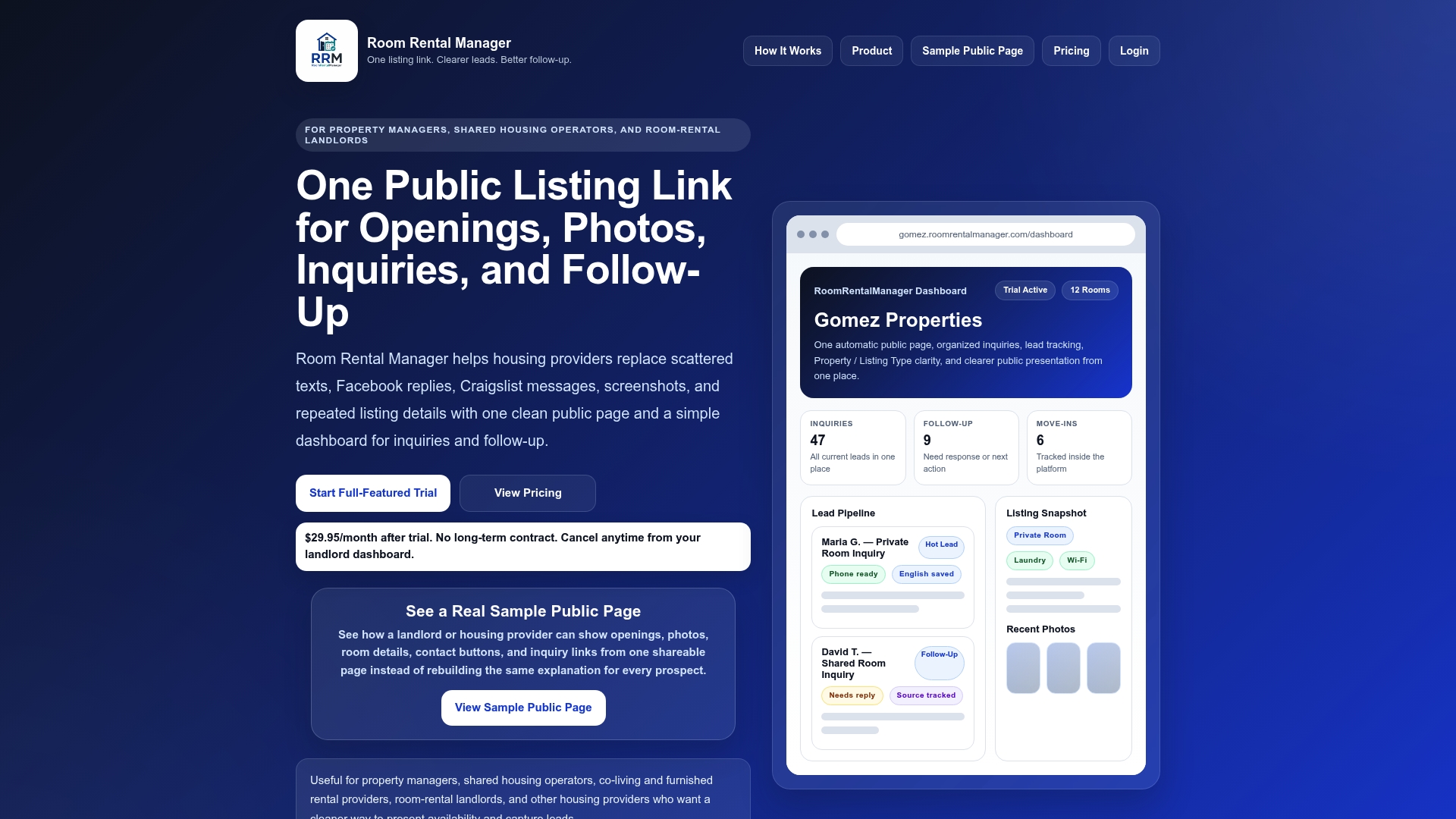
From room rental resources to a built-in inquiry tracking solution, Room Rental Manager gives property managers and landlords the tools to connect advertising spend to real lease outcomes. Stop guessing which channels work. Start knowing. Create your listing page today and bring your rental advertising ROI into focus.
Frequently asked questions
How do I calculate advertising ROI for rental properties?
Advertising ROI for rental properties is calculated by comparing ad spend to resulting lease revenue, factoring in vacancy and tenant turnover costs. As Investopedia explains, rental property ROI is more complex than net income alone, with vacancy and frequent turnover reducing rental income while fixed expenses continue.
Why shouldn't I use clicks or leads alone to measure ROI?
Clicks and leads alone can mislead because some channels provide higher volumes but poor lease quality or lower downstream conversion. RentVision notes that tracking only clicks or leads can cause misallocated spend because a channel may look efficient by CPL but produce worse leases in practice.
What metrics are most important for rental advertising ROI?
Lease conversion rate, quality of renters, vacancy duration, and cost per lead are key metrics for rental advertising ROI. RentVision emphasizes that you must incorporate lease conversion quality and revenue impact, not just CTR or CPC, to get a true picture.
How can I improve the ROI of my rental advertising?
Improve ROI by tracking upstream metrics like targeting and engagement, refining ad creative, and focusing on channels that deliver quality leases. RentVision recommends using upstream diagnostics to identify whether waste is coming from targeting or creative issues before optimizing downstream conversion.