

TL;DR:
- A structured rental inquiry management process with defined stages, fast automated responses, and unified tracking increases lease conversions and reduces vacancies. Speedy follow-up within five minutes, clear ownership, and automation of repetitive tasks are critical to preventing lead loss. Purpose-built software and disciplined operational practices improve efficiency and accountability across the leasing pipeline.
A rental inquiry management process is a structured workflow that captures every tenant lead, routes it through defined leasing stages, and converts it into a signed lease with the least possible delay. Most landlords lose tenants not because their units are undesirable, but because their follow-up is slow, scattered, or nonexistent. The difference between a vacant room and a signed lease often comes down to whether you have a repeatable system. This article breaks down exactly how to build one, from pipeline design and response speed to automation tools and funnel metrics that tell you where leads are slipping away.
What are the essential stages of a rental inquiry management process?
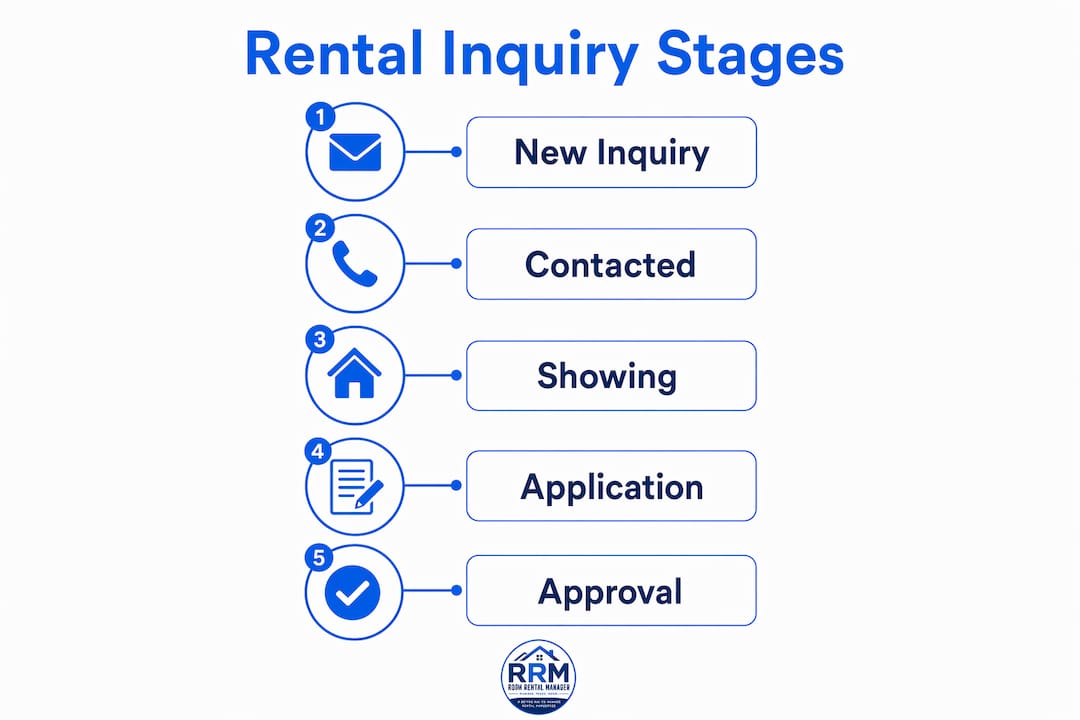
A rental inquiry management process works only when every stage has a clear name, a defined action, and an assigned owner. Without that structure, leads fall into the gap between "I got a message" and "I forgot to reply." Fuzen's pipeline model maps this out precisely: New Inquiry, Contacted, Visit Scheduled, Visited, Application, Approved, Lease Creation, Lease Signed, and Closed (Won or Lost). Each stage is a handoff point, and every handoff is a potential drop.
The table below shows what should happen at each stage and who owns it.
| Stage | Key action | Responsible role |
|---|---|---|
| New Inquiry | Log lead, send auto-acknowledgement | System or leasing agent |
| Contacted | Qualify prospect, confirm interest | Leasing agent |
| Visit Scheduled | Confirm showing time and property details | Leasing agent or coordinator |
| Visited | Collect feedback, send application link | Leasing agent |
| Application | Review submission, run screening | Property manager |
| Approved | Notify applicant, generate lease | Property manager |
| Lease Signed | Confirm move-in date, collect deposit | Property manager |
| Closed | Mark Won or Lost, log reason | Property manager |
Stage ownership matters because it creates accountability. When a lead sits in "Contacted" for five days with no movement, you know exactly who to ask. Without named owners, everyone assumes someone else followed up. The lead-to-lease pipeline treats each inquiry as a time-sensitive operational asset, not just a message to reply to eventually.
Scattered tracking is the most common failure mode. Landlords who manage inquiries across text messages, Facebook Messenger, email, and handwritten notes have no single view of where each lead stands. A prospect who visited last Tuesday and never received an application link is a lost lease, not a cold lead.
Pro Tip: Set a maximum time limit for each stage. If a lead stays in "Contacted" for more than 48 hours without moving forward, trigger an automatic reminder to the assigned agent. This single rule prevents the majority of dropped follow-ups.
How fast should you respond and follow up with rental inquiries?
Speed is the single biggest variable in whether a rental inquiry converts. Responding within 5 minutes makes a lead 21 times more likely to qualify than responding after 30 minutes, and after 24 hours most leads are effectively lost. That statistic from Solaia's 2026 Lead Response Index reframes the entire follow-up conversation. The question is no longer whether to respond quickly. The question is how to make fast response automatic.

The model that works is a two-step approach. First, an automated acknowledgement fires the moment an inquiry arrives, confirming receipt and setting expectations. Second, a human agent follows up within minutes to qualify the lead and move it to the next stage. The automated message buys time and keeps the prospect engaged. The human call or text closes the qualification gap.
Trigger-based follow-up workflows extend this logic across the full pipeline. SalesCaptain's workflow model uses event, time, and channel rules to send the right message at the right moment. A prospect who schedules a visit gets a confirmation text immediately, a reminder 24 hours before, and a follow-up message two hours after the showing. None of that requires manual effort once the rules are configured.
Channel selection also affects conversion. The priority order for rental inquiry follow-up is:
- SMS first: Open rates for text messages exceed 90%, and most prospects respond within minutes.
- Email second: Use email for longer messages, application links, and document delivery.
- Phone third: Reserve calls for high-intent prospects or when a text goes unanswered after 24 hours.
- Voicemail as backup: A brief, professional voicemail signals seriousness and often prompts a callback.
Pro Tip: Never rely on a single channel. If your first SMS gets no response within 24 hours, follow up by email. If email gets no response within 48 hours, call. Rule-driven multichannel follow-up prevents dropped leads caused by a prospect who simply missed one message.
What tools and automations optimize the rental inquiry management process?
The right software turns a manual, error-prone process into a predictable pipeline. A centralized property management CRM that connects units, leases, tenants, and inquiries in one place eliminates the data fragmentation that causes lead loss. Generic CRM tools built for sales teams miss property-specific logic like unit availability, lease dates, and screening workflows. Purpose-built platforms handle those connections natively.
The comparison below shows which automations matter most and what each one does.
| Automation | What it does | Impact |
|---|---|---|
| Lead capture | Pulls inquiries from listing sites into one dashboard | Eliminates missed messages |
| Auto-assignment | Routes new leads to the right agent by property or territory | Removes ownership gaps |
| Follow-up reminders | Alerts agents when a lead has been idle too long | Prevents dropped follow-ups |
| Self-scheduling | Lets prospects book showings without agent involvement | Increases visit conversion |
| Screening triggers | Sends application links automatically after a visit is logged | Speeds up qualification |
| Digital lease generation | Creates and sends lease documents from approved applications | Cuts days off the close |
Reducing manual handoffs is the core argument for automation. The average manual screening-to-lease process involves 18 steps and 8 handoffs, according to NARPM research cited by US Tech Automations. Each handoff is a delay point and a potential error. Automating even half of those steps compresses the timeline significantly.
AI voice and chat agents address the after-hours gap that most landlords ignore. SalesCaptain's AI agents handle rental inquiries around the clock, answering availability questions, collecting prospect details, and scheduling showings without any staff involvement. A prospect who submits an inquiry at 10 PM gets an immediate, intelligent response instead of waiting until morning. That response window is where many leads are won or lost.
Room Rental Manager takes a practical approach to this problem by giving landlords one shareable link that collects all inquiry details, tracks lead sources, and organizes follow-up from a single dashboard. Instead of managing texts, emails, and Facebook messages separately, everything flows into one place. You can explore rental inquiry tracking features built specifically for room rental landlords who need this kind of centralized visibility.
Pro Tip: Configure your automation rules to match your actual workflow before you go live. An automation that fires at the wrong stage or sends the wrong message creates confusion and damages trust. Map your process on paper first, then build the rules around it.
How to track and analyze rental inquiry funnel metrics to improve conversion
Measuring your rental inquiry follow-up workflow is how you find the leaks before they cost you a lease. Only 25% of rental inquiries convert into showings, according to Leasey.AI's multifamily funnel research. That means three out of four inquiries never make it past the first stage. The bottleneck is almost always in the middle of the funnel, not at the top.
The KPIs that matter most for a rental inquiry management system are:
- Response time: Average minutes from inquiry received to first contact. Target is under 5 minutes.
- Lead-to-visit rate: Percentage of inquiries that result in a scheduled showing. Industry benchmark is around 25%.
- Visit-to-application rate: Percentage of showings that produce a submitted application.
- Application-to-approval rate: Percentage of applications that pass screening.
- Approval-to-lease rate: Percentage of approved applicants who sign a lease.
Each rate tells you something specific. A low lead-to-visit rate means your initial follow-up is failing. A low visit-to-application rate means your showings are not converting, possibly because the unit presentation or the application process itself creates friction. A low approval-to-lease rate often signals a pricing or communication problem after approval.
Unified guest card tracking across inquiry, showing, application, and approval stages is the foundation of accurate funnel analysis. When each prospect has a single record that follows them through every stage, you can see exactly where they dropped and why. Fragmented records across multiple tools make this analysis impossible.
The operational payoff of centralized tracking is documented. Centralized leasing teams handling inquiry response for multiple properties achieve 33% higher lease conversion rates through improved lead-to-tour conversion. That result comes directly from having one team with one system and one view of every lead.
Two fixes address the most common funnel leaks. Self-scheduling tools let prospects book showings at their convenience, removing the back-and-forth that kills momentum. Pre-qualification questions filter out low-probability leads before a showing is ever scheduled, so your agents spend time on prospects who are actually ready to rent. Both tactics improve conversion efficiency without adding headcount.
Pro Tip: Review your funnel metrics weekly, not monthly. A single week of slow response times can cost you multiple leases. Weekly reviews let you catch and fix problems before they compound.
What common mistakes undermine a rental inquiry management system?
The most damaging mistake in rental inquiry handling is scattered communication. When prospects can reach you through Craigslist messages, Facebook comments, a contact form, and a personal cell phone simultaneously, no single channel gets consistent attention. Leads arrive in different places, get different response times, and often get no follow-up at all. The fix is a single intake point that funnels all inquiries into one trackable system.
Ownerless leads are the second most common failure. When no specific person is responsible for a lead, it moves slowly or not at all. This is especially common in small property management operations where everyone assumes someone else handled it. Assigning every new inquiry to a named person within minutes of arrival eliminates this problem entirely.
Relying on generic tools creates a third category of problems. Spreadsheets, general-purpose CRMs, and note-taking apps lack the property-specific logic needed to connect a lead to a unit, trigger a screening workflow, or generate a lease. They require manual steps that introduce delays and errors. Purpose-built lead management software for property managers handles those connections automatically.
Additional mistakes that cost landlords leases:
- Inconsistent screening: Applying different criteria to different applicants creates legal risk and unpredictable outcomes.
- No human escalation path: Full automation without a clear trigger for human intervention frustrates high-intent prospects who have specific questions.
- Skipping post-visit follow-up: Most prospects who visit but do not apply immediately need one more touchpoint to convert. Skipping it loses the lease.
Pro Tip: Schedule a quarterly process review with everyone involved in leasing. Walk through the pipeline stage by stage, identify where leads are stalling, and update your automation rules and response templates accordingly. The rental advertising automation that worked six months ago may need adjustment as your inquiry volume or property mix changes.
Key takeaways
A structured rental inquiry management process with defined stages, fast automated responses, and unified tracking is the most direct path to higher lease conversion and lower vacancy rates.
| Point | Details |
|---|---|
| Define your pipeline stages | Map every stage from New Inquiry to Closed with a named owner and a maximum time limit. |
| Respond within 5 minutes | Automated acknowledgement plus rapid human follow-up increases qualification probability by 21x. |
| Automate the repetitive steps | Lead capture, follow-up reminders, self-scheduling, and screening triggers remove the manual handoffs that cause delays. |
| Track stage-level conversion | Measure lead-to-visit, visit-to-application, and approval-to-lease rates weekly to find and fix funnel leaks. |
| Centralize all inquiry data | A single record per prospect across all stages gives you the visibility needed to prevent lead loss. |
Why operational discipline beats technology every time
I have watched landlords spend significant money on property management software and still lose leads at the same rate they did before. The technology was not the problem. The process was. They installed automation on top of a workflow that had no defined stages, no ownership rules, and no measurement. The automation just made the chaos faster.
The 5-minute response rule is a good example of where discipline matters more than tools. You can configure an AI agent to send an instant acknowledgement, but if the human follow-up still takes four hours, you have not solved the problem. The 5-minute target requires both the automated first touch and a rapid human qualification step. Most teams get the first part right and skip the second.
What I find most underrated in rental inquiry management is the post-visit follow-up. Everyone focuses on response speed at the top of the funnel, which is correct. But the visit-to-application conversion is where most landlords leave money on the table. A prospect who toured your unit yesterday and has not applied yet is not a cold lead. They are a warm lead who needs one more reason to commit. A single well-timed message referencing something specific from their visit converts a meaningful percentage of those prospects.
The trend toward AI-enabled inquiry handling is real and worth watching. After-hours AI agents that answer availability questions and book showings are no longer experimental. They are practical tools that close a gap most small landlords cannot staff around. But they work best when they sit inside a defined process, not as a replacement for one.
— JAMES
How Room Rental Manager simplifies your inquiry pipeline
Managing rental inquiries across texts, emails, and listing site messages is how leases get lost. Room Rental Manager gives you one shareable link that collects all prospect interest, tracks where each lead came from, and organizes follow-up from a single dashboard.
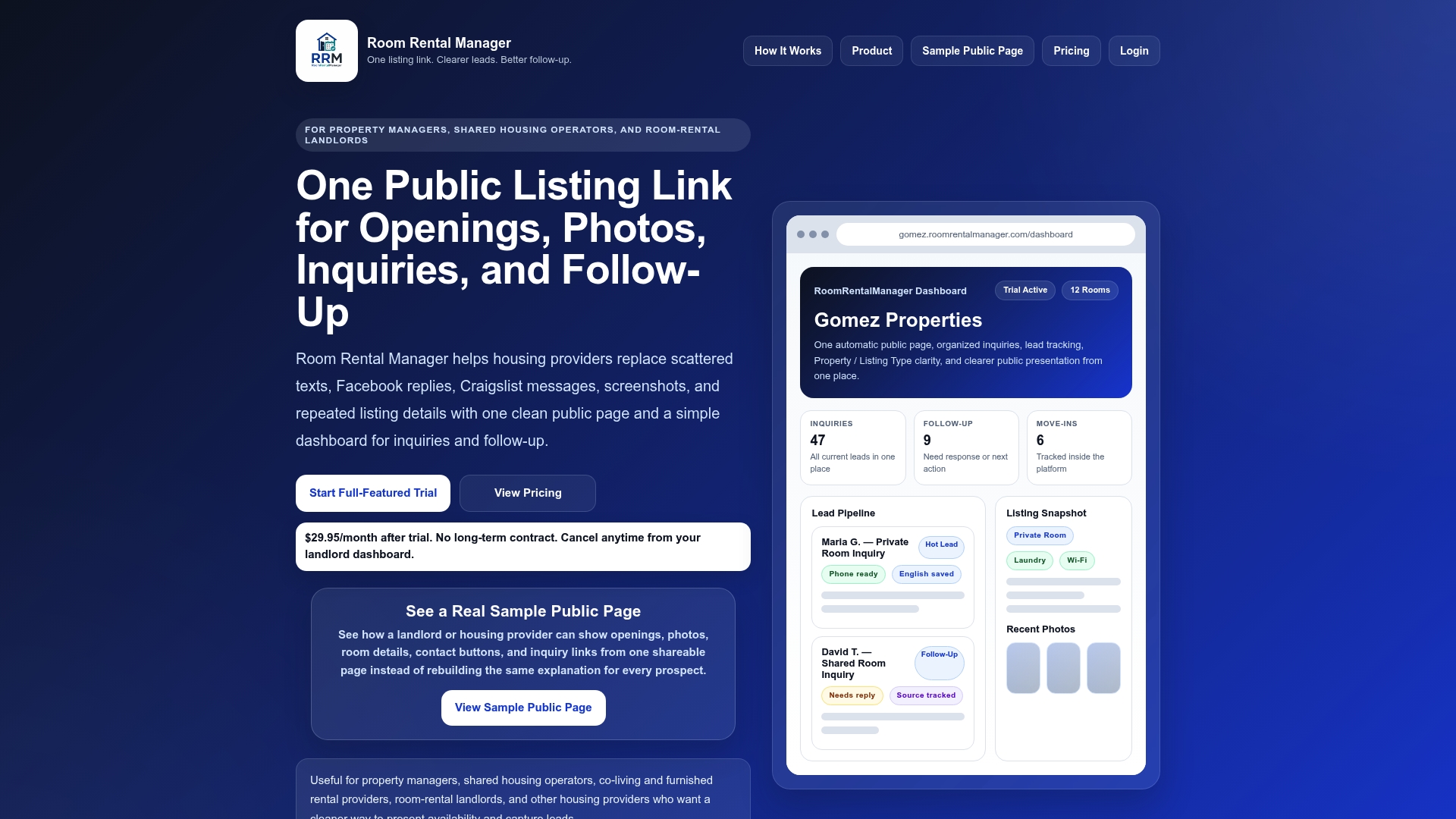
Instead of rebuilding your process from scratch, Room Rental Manager gives you the structure that prevents lead loss from day one. Landlords and shared housing operators use it to present listings professionally, capture inquiries consistently, and follow up without losing track of who said what. The landlord software tools are built specifically for room rentals and furnished units, not scaled-down enterprise platforms. If you want a cleaner, faster path from inquiry to signed lease, start there.
FAQ
What is a rental inquiry management process?
A rental inquiry management process is a defined workflow that captures tenant leads, assigns ownership, and moves each prospect through leasing stages from first contact to signed lease. The goal is to prevent lead loss through structured follow-up and clear accountability at every stage.
How quickly should landlords respond to rental inquiries?
Landlords should respond within 5 minutes of receiving an inquiry. Responding after 30 minutes reduces qualification probability by 21 times compared to a 5-minute response, and leads contacted after 24 hours are largely unrecoverable.
What metrics should I track in my rental inquiry funnel?
Track response time, lead-to-visit rate, visit-to-application rate, application-to-approval rate, and approval-to-lease rate. Stage-level conversion data reveals exactly where prospects are dropping so you can fix the right bottleneck.
What is the biggest cause of lost rental inquiries?
Most inquiry losses come from breaks between pipeline stages, not from low inquiry volume. Scattered communication, ownerless leads, and missing follow-up steps after showings are the three most common causes of lead loss in rental inquiry management.
Do I need specialized software for rental inquiry management?
Generic CRM tools and spreadsheets lack the property-specific logic needed to connect leads to units, trigger screening workflows, and generate leases automatically. Purpose-built rental inquiry management platforms handle those connections natively and reduce the manual steps that cause delays.