

TL;DR:
- Effective rental listings are specific, updated, and transparent, helping attract qualified tenants and filter out unsuitable inquiries. Including detailed descriptions, accurate photos, clear policies, and neighborhood info ensures renters find your listing findable and reliable. Utilizing lead management software streamlines responses, increases inquiries, and reduces vacancy periods.
Most landlords write their rental listing once, post it everywhere, and wonder why the inquiries they get are a bad fit. The problem is almost never the platform. It's the listing itself. Vague descriptions, missing fees, outdated photos, and absent policies turn what should be a filtering tool into a magnet for time-wasting messages. Strong rental listing detail examples show that when you answer every key question upfront, the right renters self-select, and the wrong ones move on before they ever hit "contact." This guide breaks down exactly how to build that kind of listing.
Table of Contents
- Key criteria for crafting effective rental listings
- Rental listing detail examples: real-world landlord showcases
- Comparing rental listing examples: what details drive engagement?
- Deciding the best rental listing details for your property and audience
- Why detailed, transparent rental listings are a landlord's secret weapon
- Streamline your rental listings and lead management with Room Rental Manager
- Frequently asked questions
Key Takeaways
| Point | Details |
|---|---|
| Update listings regularly | Review and refresh rental listings at least once a year and monthly for market changes to maintain relevance. |
| Include complete details | Provide full pricing, amenities, policies, and location specifics to improve renter trust and lead quality. |
| Use quality photos | High-quality, natural light photos and virtual tours significantly increase renter engagement. |
| Leverage listing tools | Use software to create listings, track inquiries, and schedule tours to streamline rental management. |
| Transparency boosts trust | Clear and comprehensive listing information attracts serious tenants and reduces vacancy time. |
Key criteria for crafting effective rental listings
Before you look at rental listing detail examples, you need to understand what separates a high-performing listing from one that just sits there collecting spam inquiries. The foundation is specificity. Not "great location" but "four blocks from the Orange Line, two minutes to Trader Joe's." Not "pets considered" but "one dog under 40 lbs allowed with a $300 pet deposit."
Here is what every listing must include to do its job:
- Accurate, updated description. Update your description at least once a year to reflect new amenities, current policies, and neighborhood changes. A listing from two years ago that still mentions a coffee shop that closed signals neglect.
- Complete pricing transparency. State your base rent, every monthly fee, the security deposit, and who pays which utilities. Renters who find out about a $150 parking fee after they've toured are not happy renters.
- Real, unit-specific photos. Not model unit shots. Not stock images. Photos of your actual space, shot in natural light. This is one of the fastest wins available in rental listing best practices.
- Clear policies upfront. Pet rules, lease length, guest policies, smoking restrictions. These belong in the listing, not in a follow-up email after three back-and-forth texts.
- Neighborhood context. Transit lines, walkability score, nearby schools, parks, grocery stores. This is what renters search for and what makes your listing findable.
- Specific, searchable language. "In-unit washer/dryer" beats "laundry available." "Central A/C" beats "climate controlled." Specific terms help with search filters and reduce ambiguous inquiries.
For a deeper look at rental listing best practices, it helps to see how these principles translate into complete, real-world listings.
Pro Tip: Before publishing, read your listing out loud as if you were a renter seeing it for the first time. Every question you ask yourself is a gap a competitor's listing might already answer.
Having reviewed the key listing criteria, let's examine detailed real-world rental listing examples demonstrating these best practices.
Rental listing detail examples: real-world landlord showcases
The fastest way to improve your listing is to study listings that work. What makes a strong listing isn't one magic element but a combination of detail, clarity, and completeness working together.
Consider this fully furnished home listing from AndreaRentals: a 4BR/3BA property in the Rockridge area that includes heated floors, solar panels, detailed furniture inventory, a specific pet policy, proximity data to transit and shops, and transparent one-year lease terms. That level of detail is not accidental. It answers 90% of a qualified renter's questions before they ever make contact. And it filters out renters who can't meet those terms.
What those listings do consistently:
- Use bullet points for amenities rather than burying them in paragraphs
- List the exact breed restrictions and pet deposit amount, not just "pets welcome"
- Name the nearest transit stop and its distance in minutes, not just "near transit"
- Specify parking as "one assigned covered space included" rather than "parking available"
- Note energy-saving features like solar or smart thermostats that renters increasingly search for
- Link directly to or describe the application process so renters know exactly what to expect
Here is a numbered breakdown of how to structure the content sections in your listing:
- Opening summary: Rent, bedrooms/bathrooms, address or neighborhood, availability date
- Unit features: Square footage, flooring, appliances, storage, laundry, natural light notes
- Building or property features: Parking, security, outdoor space, shared amenities
- Policies: Lease term, pet rules, smoking, guest policy, subletting
- Utilities and fees: What's included, what tenant pays, deposit amount
- Location highlights: Distance to transit, schools, grocery stores, parks
- Application process: Required documents, screening criteria, how to apply
Including sample rental house rules in your listing, or linking to them directly, removes a major source of post-tour confusion and tenant disputes.
Comparing rental listing examples: what details drive engagement?
Not all listing details carry equal weight. Some generate inquiries directly. Others prevent bad inquiries before they happen. Here is a side-by-side look at how key listing components affect renter behavior.
| Listing component | Low-detail example | High-detail example | Impact on engagement |
|---|---|---|---|
| Photos | 3 exterior shots | 15+ interior photos in natural light | Higher conversion rate |
| Pricing | "$1,800/mo" | "$1,800/mo + $75 parking, utilities not included, $2,700 deposit" | Fewer wasted inquiries |
| Pet policy | "Pets considered" | "One dog under 40 lbs, $300 deposit, no aggressive breeds" | Filters unqualified leads |
| Location | "Great area" | "0.4 mi to Green Line, walk score 88, 2 min to Whole Foods" | Attracts target demographic |
| Virtual tour | None | Embedded 3D walkthrough | 23x more leads generated |
| Application process | "Call to apply" | "Apply online, requires last 3 pay stubs, credit check, references" | Speeds up decision making |
| Listing freshness | Posted 6 months ago | Refreshed within last 14 days | Higher search ranking |
The data behind this is clear. Listings with real unit photos rather than model images convert at higher rates, and listings refreshed regularly see measurably more engagement.
Listing freshness deserves special attention because most landlords ignore it. Search algorithms on major platforms favor recently updated listings. If you haven't touched your listing in two months, you're competing against listings that were updated last week. A simple price adjustment or a new photo can reset that clock.
If you want to understand what's actually working across your listings, tracking maximizing rental listing ROI metrics like inquiry source, response rate, and days on market gives you real data to act on instead of guesses.
Deciding the best rental listing details for your property and audience
The right details for a shared housing room in a college neighborhood look different from the right details for a three-bedroom suburban single-family rental. Both need specificity, but the priorities shift based on who you're trying to reach and what they care about.
Use this framework when deciding what to include:
- Identify your renter's top filters. Pet policy, in-unit laundry, parking, and AC are the most common search filters. If your property qualifies, those need to be front and center, not buried in paragraph three.
- Adjust for seasonality. Refresh listings before peak seasons to match what renters care about right now. Highlight central air in June. Mention gas fireplaces and heated floors in November.
- Tailor shared housing listings differently. For rooms and shared spaces, renters prioritize flexible lease terms, house rules, quiet hours, and work-from-home setups. These deserve dedicated sections, not throwaway mentions.
- Use neighborhood data strategically. A young professional renter cares about bike lanes and coffee shops. A family renter cares about school ratings and park proximity. The neighborhood is the same, but the details you emphasize should match the audience you're targeting.
- Build in natural SEO. Use real estate SEO strategies to work relevant terms naturally into your listing. "Dog-friendly apartment near Midtown" outperforms "pet-friendly unit" for search discovery.
- Ask current tenants what they searched for. Their answer is a direct window into what your next tenant will search for. Use that language in your listing.
- Use software to track what's working. Rental software for landlords that tracks inquiries by source, response rate, and conversion lets you improve your listing based on data, not instinct.
Pro Tip: If you're getting high inquiry volume but low move-in conversions, your listing is attracting the wrong people. Review your pricing transparency and policy specifics first. That's where the mismatch usually hides.
Why detailed, transparent rental listings are a landlord's secret weapon
Here is what most landlord advice misses: a detailed listing is not just a marketing asset. It's a screening tool. And used correctly, it does more pre-qualification work than any phone call.
When your listing includes exact income requirements, the full fee breakdown, specific pet restrictions, and a link to your house rules, you are not just providing information. You are setting expectations. The renters who inquire after reading all of that are far more likely to be a real match. Complete upfront listing details reduce time wasted on unsuitable applicants and project a professional landlord image, which matters in competitive markets.
There's another dimension most landlords don't consider: a detailed listing protects you. When your lease terms, pet policy, and fee structure are published in writing before the first conversation happens, you have a paper trail. Disputes about what was "understood" become much harder to sustain.
The landlords who struggle longest with vacancies are usually not on the wrong platform. They're presenting incomplete information and then compensating with more follow-up, more messages, more calls. That's a labor-intensive approach to a problem that better listing detail solves once. Investing two hours in a thorough listing update pays dividends every time someone qualifies or disqualifies themselves before you spend a minute responding.
Filling vacancies faster consistently comes down to one thing: giving renters everything they need to make a decision, before they ever contact you.
Streamline your rental listings and lead management with Room Rental Manager
Building a detailed, accurate listing is only half the job. The other half is managing what happens after someone finds it. If you're currently pasting the same photos and property details into texts, emails, Facebook messages, and Craigslist replies, you're spending time you don't need to spend.
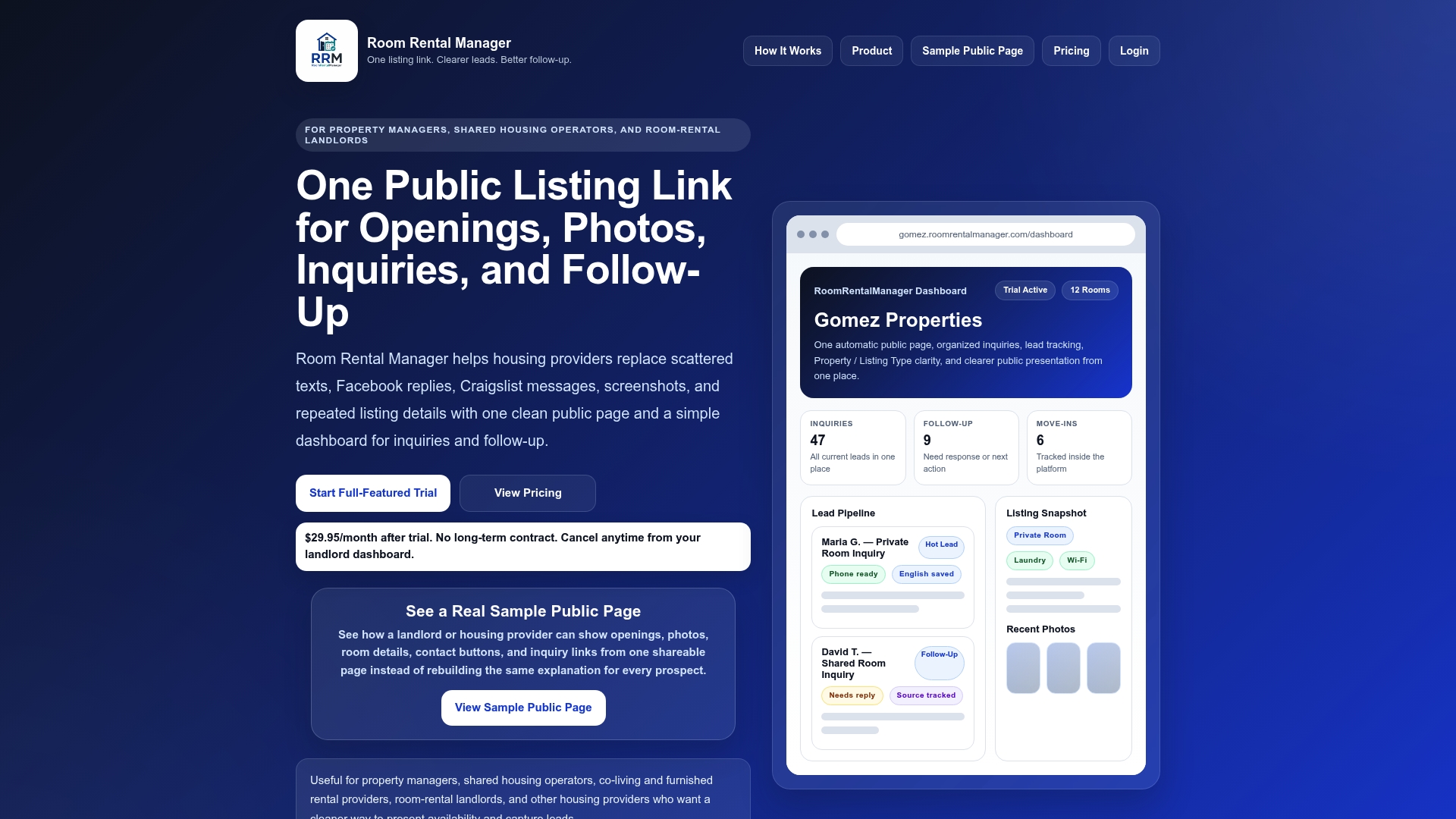
Room Rental Manager lets you build one clean public listing page with your photos, pricing, policies, amenities, and contact options, then share a single link everywhere. Inquiries come in through one place. Lead sources get tracked automatically. Follow-up doesn't fall through the cracks. You can access dedicated rental landlord resources built specifically for room and shared housing operators, and use the platform's rental lead management tools to respond faster and convert more of your best prospects.
Pro Tip: Use Room Rental Manager's lead tracking feature to see which platforms are sending your best inquiries, then focus your listing energy there.
Frequently asked questions
How often should I update my rental listing details?
Landlords should update listings monthly to capture changes like renovations, market shifts, or seasonal highlights, with a full review at least once a year.
What rental listing details most increase renter inquiries?
Clear pricing, real unit photos, detailed amenity lists, and specific location highlights drive the most inquiries. Actual unit photos and 3D tours push engagement even further.
What role do photos and virtual tours play in rental listings?
Natural-light photos of the actual unit build trust immediately, and 3D tours generate 23x more leads than listings without them.
What are effective ways to manage rental inquiries from listings?
Using lead tracking software and enabling online applications reduces friction. Direct applications and synced tour scheduling lift conversion rates three to four times over phone or email contact.