
TL;DR:
- Professional rental presentation involves accurate photos, clear descriptions, rapid responses, and legal compliance to build trust and increase conversions. High-quality, unit-specific photos and concise, structured descriptions attract qualified tenants, while fast communication enhances reputation and reduces cancellations. Maintaining current listings through regular audits and leveraging automation tools ensures consistent professionalism across all platforms.
Rental presentation professionalism is the practice of creating truthful, timely, and attractive rental listings that build trust and drive qualified inquiries from prospective tenants. For landlords and property managers, this means every photo, description, and response reflects the actual unit accurately and reaches prospects fast enough to matter. The gap between a professional and an amateur listing is measurable. Unit-level transparency achieves roughly an 80% tour closing rate by filtering out low-intent prospects before they ever walk through the door. Rental presentation professionalism explained properly covers four pillars: visual accuracy, description clarity, communication speed, and legal compliance.
What rental presentation professionalism really means
Professionalism in rental listings is not about making a property look better than it is. It is about presenting the property so accurately that a qualified renter can self-select in or out before contacting you. This distinction matters because misleading listings generate wasted tours, canceled applications, and negative reviews. The industry term for this standard is "unit-level accuracy," and it is the foundation every other presentation decision builds on.
Think of your listing as a pre-screening tool. When a renter sees the actual unit, reads the real price with all fees included, and gets a response within the hour, they arrive at the tour already 80% sold. When they see a stock photo, a vague description, and silence for two days, they arrive skeptical or not at all. Professionalism removes friction from both sides of that equation.
The importance of rental presentation goes beyond first impressions. It shapes your reputation across platforms like Zillow, Facebook Marketplace, and Craigslist, where renters leave reviews and share experiences. A single misleading listing can generate a pattern of negative feedback that follows your property for months.
How photos define your listing's credibility
Photos are the first judgment renters make about your property, and that judgment happens in seconds. Cover photos drive over 40% of rental listing click-throughs, making your hero image the single highest-leverage element in the entire presentation. Testing photo types weekly, as Airbnb's split-testing guidelines recommend, improves both click-through rates and platform rankings over time.
The specific photos you choose matter as much as their quality. Here is what professional rental presentations require from their visual assets:
- Actual unit photos only. Never use representative or model unit images. Show the specific unit being rented, including any imperfections that would be visible on a tour.
- High resolution, natural light. Blurry or dark photos signal neglect. A smartphone with good lighting beats a professional camera in a poorly lit room.
- Full room coverage. Photograph every room, including bathrooms, storage, and outdoor spaces. Omitting areas creates suspicion.
- Accurate staging. Remove personal items and clutter, but do not add furniture or decor that will not be present when the tenant moves in.
- Video walkthroughs. A raw, unedited walkthrough video builds more trust than a polished photo set because it is harder to manipulate.
The legal dimension of photo editing has sharpened considerably. Under California's 2026 disclosure rules, real estate licensees must disclose any digitally altered images that materially change the property's condition or layout. Providing side-by-side originals alongside enhanced versions is the safest compliance practice. Even outside California, AI-altered photos that misrepresent a unit expose landlords to claims of misleading advertising.
Pro Tip: Shoot a raw, unscripted walkthrough video on your phone the day before listing. Upload it alongside your photos. Renters who watch it arrive at tours with realistic expectations, which dramatically reduces the "this isn't what I expected" cancellations.
"Testable, high-resolution hero photos and thoughtful photo ordering are essential professionalism measures at the very top of the rental presentation funnel." — Airbnb First Photo Testing Playbook 2026
For a deeper look at photo selection and sequencing, the guide on rental listing photos covers what attracts tenants in 2026 specifically.
How to write rental descriptions that convert
A rental description has one job: give qualified renters enough accurate information to decide whether to contact you, and give unqualified renters enough information to disqualify themselves. Both outcomes save you time. Descriptions under 200 words with transparent pricing and clear rules consistently produce higher-quality inquiries than longer, vaguer alternatives. Brevity forces clarity.
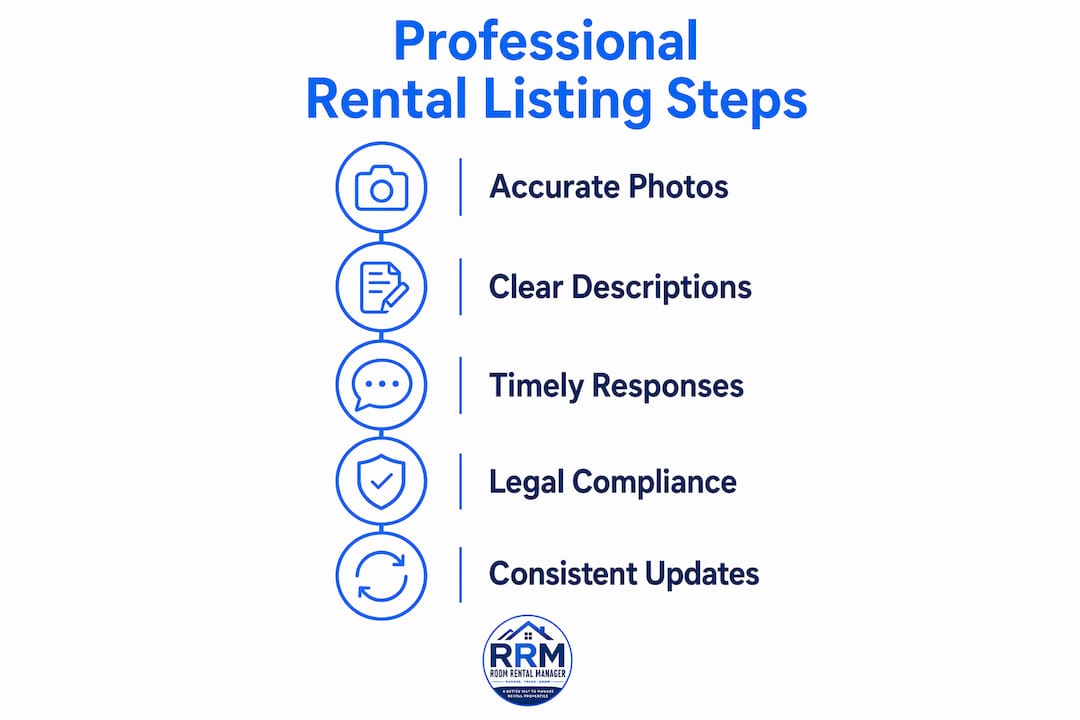
The structure of a professional description follows a predictable pattern. Start with the most important facts: rent, bedroom count, location, and availability date. Follow with the top three or four amenities that differentiate the unit. Close with key rules (pets, smoking, lease length) and a direct call to action. This structure respects the renter's time and signals that you operate with the same respect throughout the tenancy.
Here is a direct comparison of weak versus strong description practices:
| Element | Weak practice | Strong practice |
|---|---|---|
| Pricing | "$1,400/month" | "$1,400/month includes water and trash. $1,400 deposit required." |
| Amenities | "Nice kitchen, good location" | "Updated kitchen with stainless appliances, 3 blocks from Metro Line 7" |
| Rules | Omitted | "No pets. 12-month lease minimum. Background check required." |
| Call to action | "Contact for details" | "Text or call [number] to schedule a tour this week." |
| Length | 400+ words | Under 200 words |
Vivid, structured descriptions using AIDA principles (Attention, Interest, Desire, Action) increase click-through and conversions by up to 30%. That number reflects the difference between a description that informs and one that motivates. Applying AIDA does not mean writing marketing copy. It means leading with the most compelling fact, building interest with specific details, creating desire with honest amenity highlights, and closing with a clear next step.
Fair Housing compliance is non-negotiable in description writing. Avoid language that implies preference for or against any protected class. Phrases like "perfect for young professionals" or "quiet neighborhood" can trigger Fair Housing complaints depending on context and jurisdiction. Stick to property facts and let qualified renters draw their own conclusions.
Pro Tip: Use the strong rental description examples from Room Rental Manager's blog as a template baseline. Swap in your unit's specific details and keep the structure intact.
Why response speed is a professionalism standard, not a courtesy
Communication speed is where most landlords lose qualified renters they never knew they had. 62% of renters expect a response within one hour of submitting an inquiry, yet the industry average response time sits at 24 hours. That gap is not a minor inconvenience. It is the window in which your best prospects find another listing and commit.
Here is how to build a communication process that meets renter expectations without requiring you to be available around the clock:
- Set up an automated acknowledgment. An instant reply confirming receipt of the inquiry, with a clear timeline for your personal follow-up, satisfies the renter's immediate need for confirmation. Automated acknowledgments improve tenant satisfaction scores by 2.1 points on a 5-point scale, regardless of how long the final resolution takes.
- Define your response windows. Tell renters upfront when they can expect a call or text. "I respond to all inquiries within 2 hours between 8 a.m. and 7 p.m." is more trustworthy than a vague promise of fast responses.
- Route inquiries to a single channel. Scattered messages across text, email, Facebook, and Craigslist create delays and missed leads. A single inquiry dashboard prevents that.
- Follow a predictable call structure. Professional property managers keep calls focused and rarely exceeding 10 minutes by setting an agenda at the start. This signals competence and respects the prospect's time.
- Log every interaction. Tracking when inquiries came in and when you responded creates accountability and helps you identify bottlenecks in your process.
Pro Tip: If you manage more than three units, a dedicated inquiry tracking system pays for itself in the first vacancy it fills. Manual tracking across multiple platforms costs you leads you cannot see losing.
The operational insight here is that predictable communication processes outperform vague promises of 24/7 availability. Renters do not need you available at midnight. They need to know exactly when you will respond and trust that you will follow through.
Attractive vs. authentic: where professional presentations draw the line
The tension in professional rental presentations is between making a property look its best and making it look like something it is not. Strategic staging, good lighting, and thoughtful photo ordering are legitimate tools. Removing furniture to make a room look larger, using AI to paint over water stains, or photographing a renovated unit when the available unit has not been updated are not.
This comparison clarifies where the line sits:
| Practice | Professional | Problematic |
|---|---|---|
| Staging | Declutter and add neutral decor that will remain | Add furniture that will be removed before move-in |
| Photo editing | Adjust brightness and color balance | Remove structural damage, stains, or missing fixtures |
| Virtual staging | Disclose clearly and show original alongside | Present virtually staged images as actual unit condition |
| Unit selection | Photograph the exact available unit | Photograph a renovated unit when the available unit differs |
| Description language | "Cozy studio with city views" | "Spacious studio" for a unit under 400 square feet |
Accurate presentations reduce canceled tours by giving renters a realistic preview. When a renter arrives and the unit matches the listing, the tour becomes a confirmation rather than a discovery. That psychological shift is what drives the 80% tour closing rate associated with unit-level transparency.
Maintaining that accuracy over time requires a workflow, not just good intentions. Integrated data systems that connect your unit condition records with your listing platforms keep descriptions and photos current as units turn over. For smaller operators, a simple checklist before each listing goes live accomplishes the same goal: confirm photos match the current unit, verify pricing includes all fees, and update availability dates accurately.
The rental availability page approach, where each unit has its own dedicated listing with current photos and details, is the most reliable way to maintain unit-level accuracy at scale.
Key takeaways
Professional rental presentations succeed when visual accuracy, description clarity, communication speed, and legal compliance work together as a single system rather than isolated tactics.
| Point | Details |
|---|---|
| Unit-level accuracy drives conversions | Listings showing actual unit photos achieve roughly an 80% tour closing rate by filtering low-intent prospects. |
| Cover photos determine click-through | Hero images drive over 40% of listing clicks, making photo selection and testing a top priority. |
| Descriptions under 200 words perform better | Concise descriptions with full pricing transparency attract higher-quality inquiries and reduce wasted contact. |
| Response speed is a professionalism metric | 62% of renters expect replies within one hour; automated acknowledgments close the gap without requiring constant availability. |
| Legal compliance protects your reputation | AI-altered photos require disclosure under California's 2026 rules, and Fair Housing language standards apply nationwide. |
What I've learned about professionalism that most landlords find out too late
I have reviewed hundreds of rental listings across markets ranging from single-room operators to mid-size property management firms. The pattern is consistent: landlords who treat their listing as a marketing document struggle. Landlords who treat it as a legal and operational commitment to accuracy fill vacancies faster and deal with fewer disputes.
The most common mistake I see is the "representative photo" habit. A landlord photographs their nicest unit, uses those photos for every listing in the building, and wonders why tours result in disappointed prospects and low conversion. The fix is not better photography. It is a policy change: one listing, one unit, one set of photos taken within the last 30 days.
The second mistake is conflating speed with availability. New landlords often promise to be reachable at all hours, then burn out and become inconsistent. Consistent, defined response windows build more trust than erratic 24/7 claims. Renters remember the one time you did not respond at 11 p.m. more than the ten times you did.
Automation is not a shortcut for small operators. It is a professionalism tool. An instant acknowledgment message costs nothing to set up and immediately signals that you run a real operation. Combined with a single inquiry link that routes all platform messages to one place, it transforms how prospects perceive your business before you ever speak to them.
The landlords I have seen sustain high occupancy rates over years share one habit: they audit their listings every time a unit turns over. Photos get retaken. Descriptions get updated. Pricing gets rechecked against the current market. That discipline is what separates a professional rental operation from one that coasts on luck.
— JAMES
How Room Rental Manager helps you present rentals professionally
Room Rental Manager gives landlords and property managers one clean public listing page that holds your photos, unit details, pricing, availability, and contact options in a single shareable link. Instead of repeating the same information across Craigslist, Facebook Marketplace, texts, and emails, you share one URL and let the listing do the work.
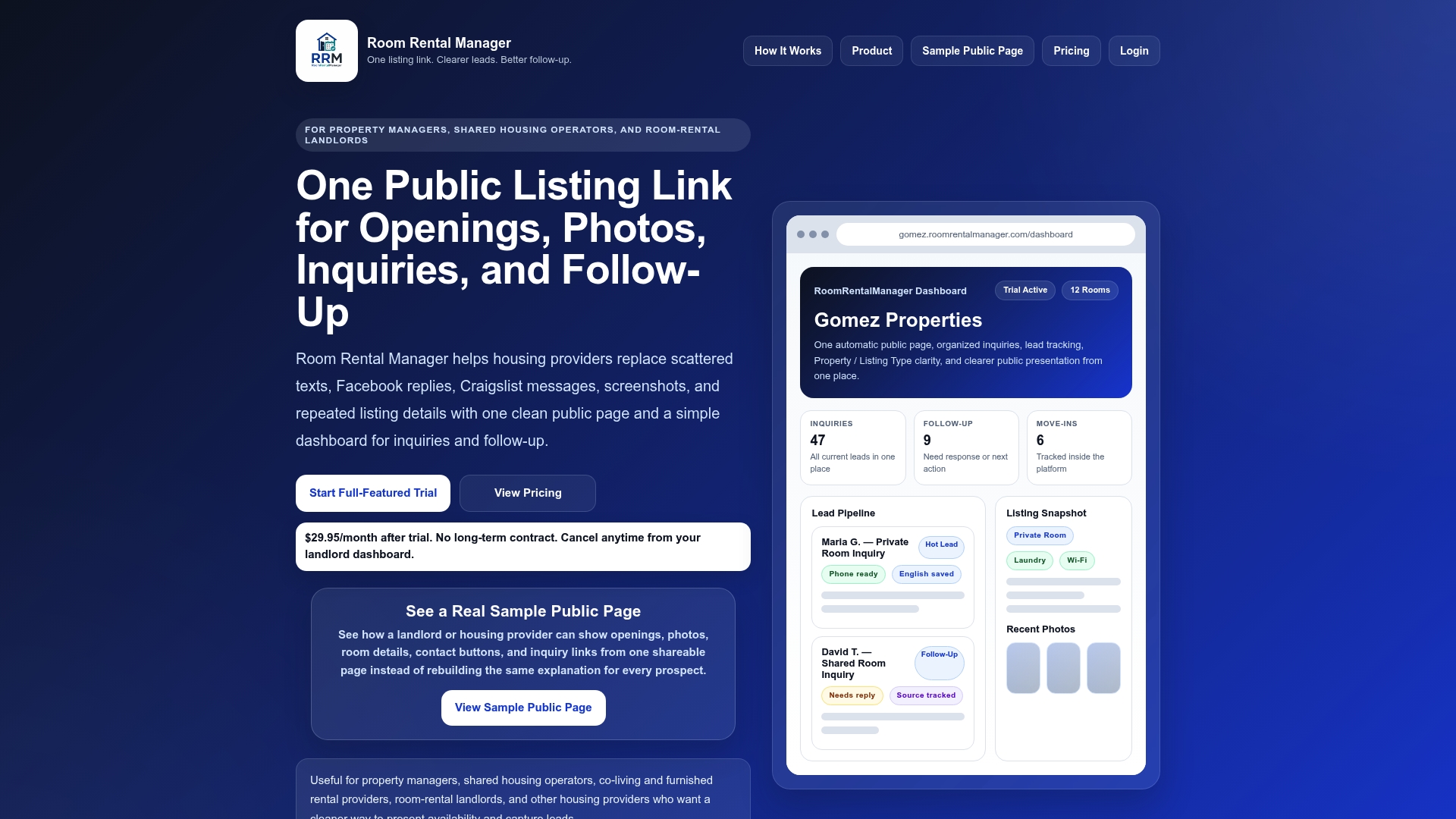
The platform's inquiry tracking tools log every lead by source, timestamp, and follow-up status, so you always know who contacted you, when, and through which channel. That visibility is what turns a scattered inbox into a measurable leasing process. For landlords managing multiple rooms or properties, the landlord resources hub includes templates, guides, and tools built specifically for room rental operators who want to present their vacancies with the same credibility as larger management companies.
FAQ
What does rental presentation professionalism mean?
Rental presentation professionalism means creating listings that accurately represent the physical unit through truthful photos, transparent pricing, clear descriptions, and fast communication. The standard is unit-level accuracy: what a renter sees in the listing matches what they find on the tour.
How many photos should a professional rental listing include?
A professional listing should include photos of every room, including bathrooms, storage areas, and outdoor spaces, using the actual available unit rather than representative images. High-resolution photos taken in natural light, combined with a short walkthrough video, produce the strongest results.
Why does response time affect rental presentation professionalism?
62% of renters expect responses within one hour, so slow replies signal disorganization regardless of how polished the listing looks. Automated acknowledgments close the gap and improve tenant satisfaction scores even before a human responds.
Are AI-enhanced listing photos legal?
AI enhancements that materially alter a property's condition or layout require disclosure under California law effective 2026, and similar standards are emerging in other states. Providing original photos alongside any enhanced versions is the safest practice for landlords and property managers nationwide.
How long should a rental description be?
Rental descriptions under 200 words with full pricing transparency, key rules, and a direct call to action consistently outperform longer alternatives. Brevity signals clarity and respects the renter's time, which attracts higher-quality inquiries.