

TL;DR:
- Most long vacant units result from weak advertising strategies rather than market conditions.
- Using multiple platforms, high-quality listings, and rapid responses significantly reduce vacancy durations.
When a unit sits empty, most landlords point to the market. Slow season, too much competition, wrong neighborhood. But rental vacancy advertising explained properly tells a different story. The channel you use, the quality of your listing, how fast you respond to inquiries, and whether you start marketing before the lease even expires all shape how long a room stays vacant. This guide breaks down exactly how modern vacancy advertising works, which tools and channels actually perform, and how to build a system that fills units faster without drowning in manual work.
Table of Contents
- Key takeaways
- Rental vacancy advertising explained: the fundamentals
- Channels for advertising vacant rentals
- What makes a rental ad actually convert
- Automation and technology in vacancy advertising
- Advanced strategies: timing, transparency, and avoiding mistakes
- My take on vacancy advertising as a system
- How Room Rental Manager makes vacancy advertising simpler
- FAQ
Key takeaways
| Point | Details |
|---|---|
| Vacancy is a marketing problem | Most long vacancies stem from weak advertising strategy, not slow market conditions. |
| Multi-channel reach matters | Advertising across multiple platforms simultaneously exposes your listing to far more prospective tenants. |
| Listing quality drives conversions | Professional photos, detailed descriptions, and transparent pricing convert inquiries at dramatically higher rates. |
| Speed of response is critical | Responding within 5 minutes yields a 68% showing booking rate versus 18% for delays over 2 hours. |
| Start advertising early | Pre-vacancy marketing at least 60 days before lease expiration reduces vacancy duration by 41%. |
Rental vacancy advertising explained: the fundamentals
Let's define what we're actually talking about. Rental vacancy advertising is the full process of promoting an available rental unit to attract qualified tenant applications. It covers every step from writing the listing and selecting platforms to managing incoming inquiries and converting those leads into signed leases.
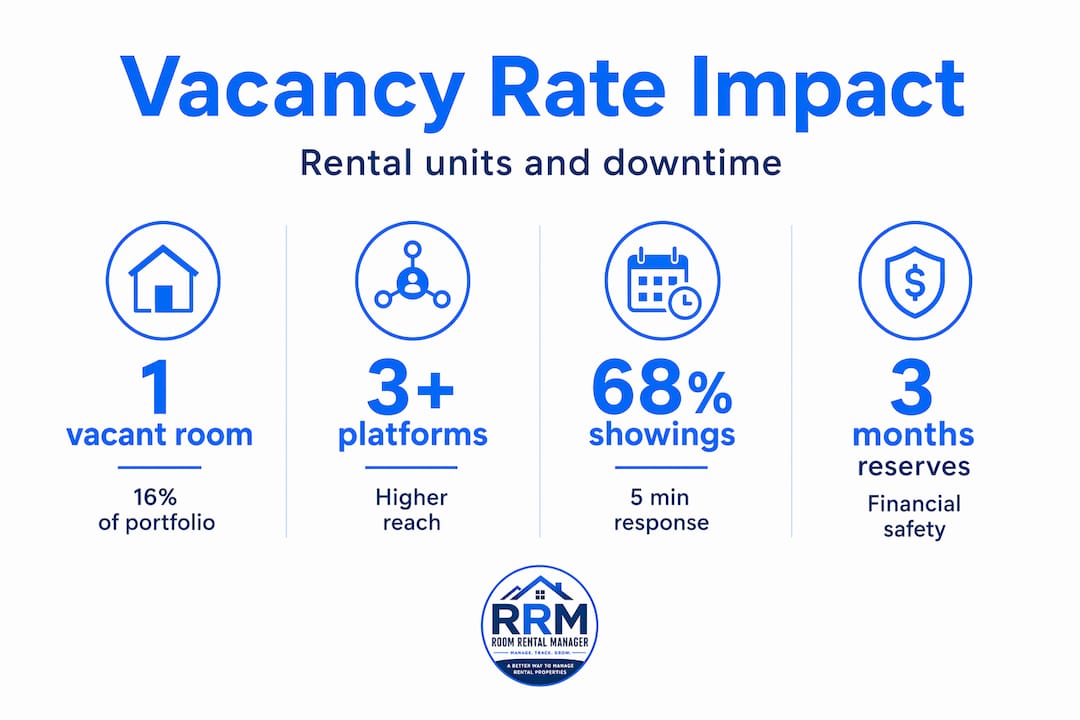
The vacancy rate is the percentage of your units sitting empty at any given time. Even one vacant room in a small portfolio creates a tangible income gap. A single empty room at $900 per month costs you $900 for every 30 days it stays unfilled. Extend that to 6 weeks and you're looking at $1,350 in lost revenue, plus ongoing costs for utilities, insurance, and maintenance that don't pause just because the tenant is gone.
Here's what most landlords underestimate: vacancy duration is far more sensitive to advertising quality than to market conditions. Landlords relying on few platforms or outdated ads consistently experience longer vacancy times than those running coordinated multi-channel campaigns. The market sets the floor. Your advertising determines how quickly you get above it.
Before a unit even becomes available, smart landlords are already thinking about the listing. That means:
- Scheduling photos and walkthrough videos while the current tenant is still in place
- Confirming pricing based on recent comparable listings in the area
- Drafting the full property description so it's ready to publish immediately
- Deciding which platforms will carry the listing on day one
Experts recommend keeping at least three months' rent in cash reserves to absorb vacancy periods without financial strain. That buffer gives you the space to advertise strategically rather than accepting the first applicant out of desperation.
Channels for advertising vacant rentals
Not all advertising channels are created equal, and understanding the rental marketing channel comparison is where most landlords leave money on the table. Room rental marketing channels explained simply: you have listing platforms, social media, your own direct listing page, and word of mouth. Each has a different reach, different audience, and different conversion behavior.
Here's how the main channels stack up:
| Channel | Reach | Cost | Best for |
|---|---|---|---|
| Listing platforms (Zillow, Apartments.com) | Very high | Free to paid | Broad tenant pool, quick volume |
| Facebook Marketplace | High | Free | Local reach, informal inquiries |
| Craigslist | Moderate | Low | Budget-conscious tenants |
| Direct listing page | Targeted | Low | Professional, shareable link |
| Word of mouth / referrals | Low | Free | High-trust, pre-screened leads |
The biggest mistake landlords make is picking one or two of these and calling it done. Vacancy problems arise primarily from marketing approaches that lack platform diversity and fail to adapt to changing renter search behavior. A tenant who didn't see your Craigslist post might find you on Facebook. A renter who scrolled past your Zillow listing might respond to a direct link a friend shared.

Multi-platform syndication solves this. Syndication tools post your listing to multiple platforms simultaneously from a single input. That's how rental advertising workflow explained at scale actually functions: you create the listing once, the system distributes it everywhere, and inquiries come back to one central inbox. Advertising rental properties across multiple platforms used to mean duplicating effort and manually updating every channel when the price changed. Automation eliminates that entirely.
A direct public listing page also plays a specific role that's easy to overlook. When someone texts you asking about a room, you can send one link instead of typing out the square footage, the pet policy, the utilities breakdown, and attaching five photos. That single shareable page becomes your entire rental vacancy announcement, accessible from any channel with zero repetition on your end.
Pro Tip: When a potential tenant reaches out through any channel, send your direct listing link immediately. It answers most common questions upfront and positions you as a professional, which filters out low-intent inquiries before they waste your time.
What makes a rental ad actually convert
Understanding how rental vacancy announcements work is one thing. Building one that actually converts inquiries into applications is another. The gap between a listing that gets 3 contacts a week and one that gets 20 comes down to a handful of specific elements.
-
Professional photos. This is non-negotiable. Listings with professional photos and virtual tours convert inquiries at 3.4 times the rate of basic listings. That stat comes from Apartments.com 2025 data, and it tracks with what any experienced landlord sees in practice. Dim, blurry, cluttered photos communicate that you don't care about the property. Clear, well-lit photos of every room signal professionalism and attract serious applicants.
-
Detailed, honest property descriptions. Generic descriptions hurt you. "Nice room in great location" tells a prospective tenant nothing. Specify the square footage, the floor level, window direction and natural light, in-unit versus shared laundry, parking details, and what utilities are included. If pets are allowed under certain conditions, say exactly what those conditions are. Specificity builds trust and filters out applicants who aren't a fit before the first inquiry.
-
Transparent pricing. List the exact monthly rent, the security deposit amount, and what's included. Vague pricing or "contact for price" creates friction and sends renters elsewhere. Open listings with transparent pricing reduce vacancy by exposing the unit to wider tenant pools while also meeting increasing regulatory expectations around pricing disclosure.
-
Floor plans and amenity tags. Platforms like Apartments.com allow you to tag specific amenities and upload floor plans. Use all of them. Tenants filter searches by features. If your listing doesn't have the right tags, it won't appear in relevant filtered searches regardless of how good the photos are.
-
Fast response systems. A great ad that takes 12 hours to respond to loses applicants. Responding within 5 minutes yields a 68% showing booking rate compared to just 18% for delays between 2 and 24 hours. This single factor has a larger impact on lease-up speed than almost any other variable.
Pro Tip: Write your listing description in plain language a prospective tenant would use when searching, not real estate language. "Bright room with walk-in closet near the Red Line" outperforms "Spacious accommodation featuring ample storage with proximate transit access."
Automation and technology in vacancy advertising
This is where rental vacancy advertising tools comparison gets genuinely interesting. The difference between managing vacancy manually versus using automation is not marginal. It's the difference between a 42-day average vacancy and a 27-day average vacancy. Automation reduces average vacancy days from 42 to 27 and saves landlords $8,400 to $14,200 annually per 10 units. For a small portfolio of 4 to 6 rooms, that's still thousands of dollars recovered every year.
Here's what an automated advertising workflow actually does for you:
- Syndication in minutes. Manual posting takes 2 to 4 hours per vacancy. Automation completes the same syndication in under 3 minutes and increases inquiry volume by 2.3x because listings go live on more platforms faster.
- Instant inquiry acknowledgment. When a tenant submits a question at 10 PM, an automated response confirms receipt, provides key details, and keeps them engaged until your business hours. This alone dramatically improves conversion rates.
- Centralized lead tracking. Instead of juggling texts, emails, Facebook messages, and Craigslist threads, a centralized dashboard shows every inquiry, its source, and its current status. You can see at a glance which platforms are delivering quality leads and which are generating noise.
- A/B testing for listing optimization. Some platforms and tools allow you to test different headline variations, photos, or pricing presentations to see which version generates more inquiries. Most landlords never do this. The ones who do fill vacancies consistently faster.
Rental advertising automation also removes a subtler problem: listing decay. When you manually post and then forget, listings go stale. Photos get outdated. Details become inaccurate. Automated systems refresh listings, flag needed updates, and maintain consistent visibility across platforms without requiring you to log in to five different websites every week.
Continuous visibility through standardized listings, automated updates, pre-set showing windows, and immediate lead follow-up can reduce vacancy days from 60 to 15 in professionally managed portfolios. That's not a marginal gain. That's the difference between a unit earning income most of the year and one sitting empty for months.
Advanced strategies: timing, transparency, and avoiding mistakes
Knowing how rental vacancy announcements work in theory is useful. Avoiding the specific mistakes that extend vacancy is what separates experienced landlords from frustrated ones. Let's get into the specifics.
Start marketing before the unit is empty. Pre-vacancy marketing starting 60 days before lease expiration reduces vacancy duration by 41%. This works because prospective tenants can plan their move-in date to align with your availability date, and you build a qualified applicant pipeline before you lose a single day of rent. Many landlords wait until the unit is empty to post a listing. By then, they've already lost the advantage.
Choose open listings over private deals. Private deals cause information asymmetry that harms both parties. When pricing and terms aren't publicly visible, you reach fewer tenants, take longer to fill the unit, and create confusion that reduces applicant trust. An open, public listing is always the better starting point for how rental vacancy announcements work.
Here are the most common advertising pitfalls and what to do instead:
- Unclear or missing pricing. List the full cost including deposit upfront. Renters who have to ask are renters who often don't bother.
- Low-quality or missing photos. Invest in one afternoon of good photography. A smartphone with good lighting in a clean, decluttered room works if professional photography isn't an option yet.
- Single-platform posting. Post on at least three to four channels from day one.
- Ignoring Section 8 applicants. Successful Section 8 marketing integrates early preparation, honest staging, and clear factual advertising to prevent lease-up delays. Excluding this pool without reason often extends vacancy unnecessarily.
- Listing before the unit is ready. Photos of a unit mid-renovation or with the previous tenant's belongings still visible destroy credibility immediately.
| Mistake | Impact on vacancy | Fix |
|---|---|---|
| Missing photos | Fewer inquiries, slower response | Professional or high-quality phone photos |
| Vague pricing | High abandonment rate | List rent + deposit upfront |
| Single platform | Limited reach | Syndicate to 3+ channels |
| Slow inquiry response | Lost applicants | Automate first response |
| Late listing launch | Extended vacancy duration | Start 60 days before move-out |
Operational readiness also matters. Before you publish any listing, confirm the unit will be rent-ready by the advertised available date. If it needs painting, cleaning, or repairs, account for that in your timeline. Listing a unit two weeks before it's actually available with an honest availability date is fine. Listing it as "available now" when it's not creates friction and erodes trust before the tenant even tours the space.
My take on vacancy advertising as a system
I've watched landlords treat vacancy advertising like a fire drill. The tenant announces they're leaving, and suddenly there's a scramble to post something, anywhere, as fast as possible. That reactive mode almost always costs more time and money than the work it took to avoid it.
What actually works is treating vacancy advertising as a continuous system rather than a one-time task. The property managers who reduced vacancy days dramatically in my experience didn't find some secret platform. They built routines. They tracked which channels produced applications versus which produced dead-end inquiries. They updated listing templates every quarter. They set up automatic responses so no lead sat unanswered overnight.
The transparency piece is something I feel strongly about. Landlords who list clean, detailed, honestly priced listings don't just fill units faster. They attract tenants who read what they agreed to and honor it. Vague listings attract tenants who fill in the blanks with their own assumptions, and those assumptions create conflict later. Clear advertising is a form of tenant screening.
Data tracking is underused at the small-portfolio level. You don't need a complicated system. A simple log of which platform each application came from, how many days the unit was listed, and what the accepted rent was gives you enough information to make smarter decisions for the next vacancy. After a few cycles, patterns emerge. You'll know whether your Facebook inquiries convert or just fill your inbox with low-quality leads. You'll know whether your listings underperform in winter versus spring and adjust your timing accordingly.
The landlords who figure this out stop treating each vacancy as a crisis and start treating it as a predictable operational event with a known playbook. That shift alone changes everything.
— JAMES
How Room Rental Manager makes vacancy advertising simpler
If you've been managing inquiries through text chains, email threads, and sticky notes, you already know what the cost is. It's not just wasted time. It's missed responses, lost applicants, and no visibility into which channels are actually working.
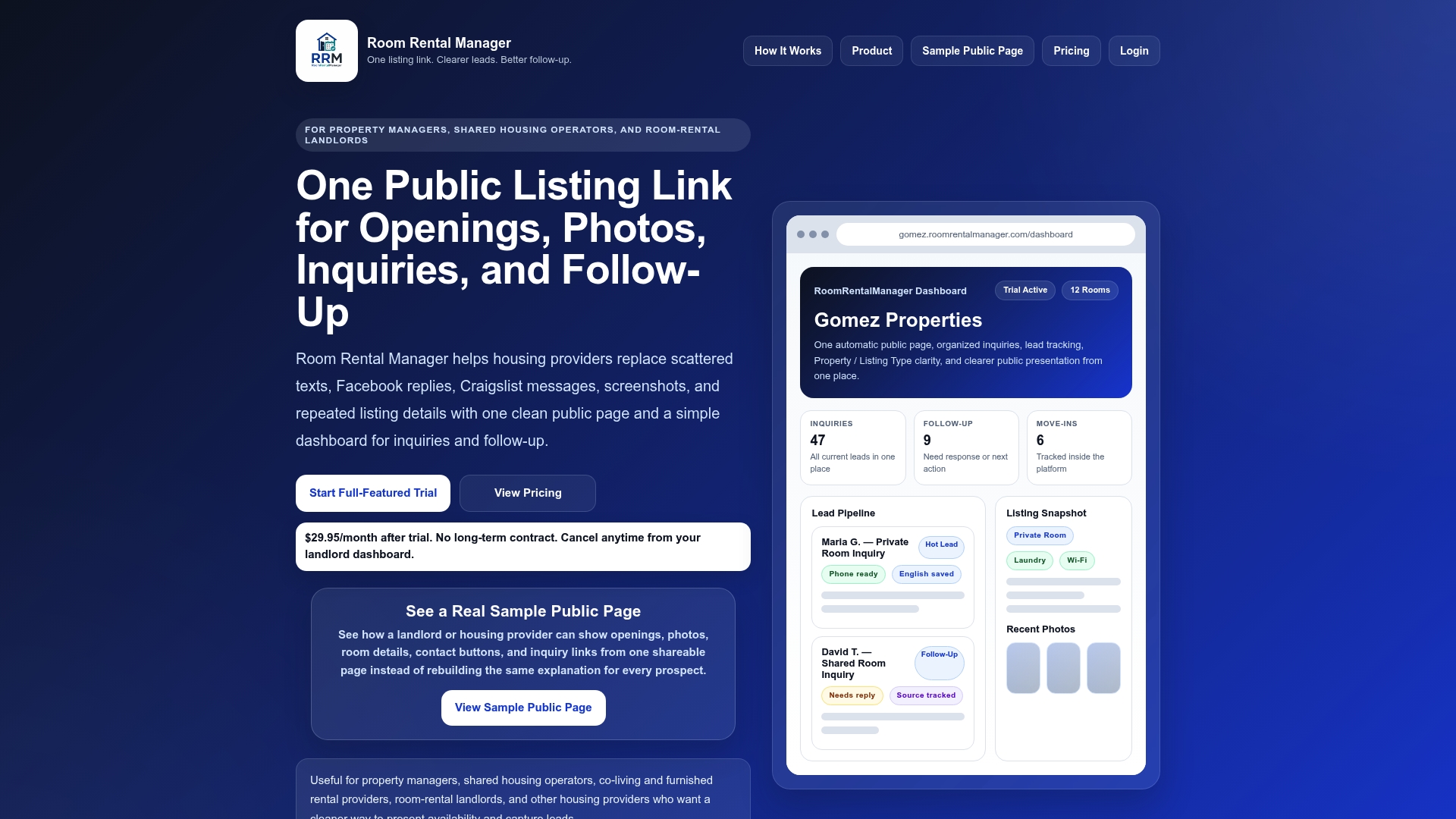
Room Rental Manager gives you one clean public listing page that you can share across every channel instantly. Post your room once, share one link everywhere, and collect all inquiries in a single dashboard. The platform tracks where each lead came from, so you stop guessing about which platforms deliver results. You can manage all your rental leads from one place instead of bouncing between apps. For landlords running shared housing, furnished rooms, or small multi-unit buildings, it handles the entire advertising workflow without the complexity of tools built for large property management companies.
If you're ready to stop repeating yourself across five platforms and start filling vacancies faster, explore Room Rental Manager's landlord tools and see how the dashboard handles everything from listing creation to lead follow-up. Additional guides and templates are also available through Room Rental Manager's landlord resources if you want to go deeper on specific advertising strategies.
FAQ
What does rental vacancy advertising actually mean?
Rental vacancy advertising is the process of promoting an available rental unit across multiple channels to attract qualified tenant applications. It includes writing the listing, selecting platforms, managing inquiries, and converting leads into signed leases.
How many platforms should I advertise on?
Advertise on at least three to four platforms simultaneously. Vacancy problems arise primarily from marketing approaches that lack platform diversity, and multi-platform syndication significantly increases inquiry volume.
When should I start advertising a vacant rental?
Start marketing at least 60 days before the lease expires. Pre-vacancy marketing at that lead time reduces vacancy duration by 41% by allowing prospective tenants to plan move-ins that align with your available date.
How fast do I need to respond to rental inquiries?
Responding within 5 minutes yields a 68% showing booking rate. Waiting 2 to 24 hours drops that rate to just 18%, so automated first-response systems are worth setting up even for small portfolios.
Does listing quality actually affect how fast I fill a vacancy?
Yes, significantly. Listings with professional photos, virtual tours, detailed descriptions, and amenity tags convert inquiries at 3.4 times the rate of basic listings, according to Apartments.com 2025 data.