

TL;DR:
- Effective room rental management relies on professional listings, individual leases, dynamic pricing, and responsive communication to maximize occupancy and tenant retention. Technology tools such as smart locks, noise monitors, and rental software significantly reduce workload and improve operational efficiency. Prioritizing early review accumulation and enforcing house rules consistently foster long-term tenant satisfaction.
Room rental business best practices are the operational and management standards that separate landlords who consistently fill rooms at strong rents from those who cycle through vacancies and tenant disputes. Renting rooms individually can increase gross income by 60% to 100% over a single-family rental. That income potential is real, but it comes with proportionally more management complexity. The landlords who capture it reliably are the ones who treat their properties as hospitality products, not passive assets. This guide covers every major practice area: listing quality, tenant screening, operations, pricing, and communication.

1. Room rental business best practices start with a tenant-ready room
A tenant-ready room is clean, functional, and presented with enough detail that a prospective renter can picture living there without asking follow-up questions. That standard sounds obvious, but most landlords fall short on one of three dimensions: cleanliness, functionality, or information density.
Cleanliness means professional-grade, not "good enough." Grout lines, window tracks, and baseboards are the details tenants notice on a walkthrough and photograph if they want to dispute a deposit later. Functionality means every fixture, outlet, lock, and appliance works on move-in day. A broken closet rod or a dead outlet is a small thing that signals larger neglect to a new tenant.
Information density is where most landlords lose bookings before a showing even happens. Professional photography and detailed amenity lists build the trust signal that converts a listing view into an inquiry. The first five images of your listing should show the room's character, natural light, storage, and any shared spaces a tenant will use daily. Listings with strong visual presentation and complete amenity details consistently outperform sparse ones at comparable price points.
Pro Tip: Write your amenity list from the tenant's perspective. Instead of "furnished room," write "queen bed, dresser with mirror, two-door closet, and blackout curtains." Specificity reduces back-and-forth messages and attracts tenants who are already pre-sold on the space.
- Photograph the room at peak natural light, ideally mid-morning
- List every included utility: Wi-Fi speed, water, gas, electric, trash
- Show shared spaces: kitchen, bathroom, laundry, and outdoor areas
- Include the neighborhood: walkability, transit access, nearby grocery stores
For a deeper look at what makes listing images convert, the rental listing photo guide from Room Rental Manager covers composition, equipment, and sequencing in detail.
2. Tenant screening and leasing practices that protect your investment
Effective tenant screening is the single most consequential decision in room rental management. One bad tenant in a shared house affects every other tenant's experience and your ability to retain them.
A thorough screening process covers four areas:
- Credit check via TransUnion, Equifax, or Experian to assess payment history and outstanding debt
- Background check through a service like RentSpree or Avail to flag criminal history and prior evictions
- Income verification requiring pay stubs, bank statements, or an offer letter showing at least 2.5x to 3x the monthly rent
- Reference checks from prior landlords, not just employers, to understand how the applicant behaves in a shared living environment
Individual leases for each tenant are non-negotiable in a room rental context. A group lease creates joint liability, which means one tenant's problem becomes every tenant's problem legally. Individual leases let you address or remove a problem tenant without disrupting the rest of the house.
House rules belong in the lease, not in a separate document that tenants can claim they never received. Cover noise curfews, guest policies, kitchen cleaning schedules, smoking and substance policies, and parking. When a rule is violated, enforce it progressively: a documented verbal warning, then a written notice, then a formal lease violation notice. This progressive enforcement approach protects you legally and keeps the process fair.
- Use the same screening criteria for every applicant to stay compliant with the Fair Housing Act
- Require a completed rental application before scheduling any showing
- Document every screening decision in writing, including why an applicant was declined
3. Operational strategies and technology tools that reduce your workload
The operational difference between a landlord managing three rooms and one managing fifteen is almost entirely a technology gap. Landlords who scale without burning out use tools that handle repetitive communication, access management, and lead tracking automatically.
Smart home technology is the most underused category in room rental operations. Smart locks with unique access codes eliminate the need to hand off physical keys, allow you to change codes between tenants instantly, and create an access log you can reference if a dispute arises. Noise monitors like Minut alert you to disturbances without recording audio, which keeps you compliant with privacy laws while giving you early warning of parties or lease violations. Budgeting for smart home tech per property pays back quickly in reduced management time and fewer emergency calls.
Automated messaging handles the communication volume that exhausts most landlords. Set up templated responses for inquiry acknowledgment, showing confirmations, move-in instructions, and rent reminders. These messages should feel personal but require zero manual effort after initial setup. Reserve your direct attention for situations that actually need judgment: maintenance issues, lease negotiations, and tenant conflicts.
Pro Tip: Set a personal rule for emergency responsiveness: within 30 minutes during the day and within one hour overnight for urgent issues like no heat, no water, or a security concern. Tenants who know you respond fast are far less likely to escalate small problems into formal complaints.
Room Rental Manager centralizes the piece most landlords handle the worst: lead management. Instead of tracking inquiries across text messages, Facebook Messenger, Craigslist replies, and email, you share one link that captures all interest in one place. That alone eliminates the most common reason good tenants fall through the cracks.
- Use a property management platform or dedicated room rental software for lease storage and rent tracking
- Set automated rent reminders three days before and one day before the due date
- Log every maintenance request and resolution in writing, even minor ones
4. Pricing strategies that maximize revenue without killing conversions
Pricing a room rental is not a set-and-forget decision. Static pricing leaves money on the table during high-demand periods and costs you occupancy during slow ones. Dynamic pricing tools can increase revenue by 10 to 40 percent versus static pricing. That range is wide because the gain depends entirely on how much demand variation exists in your market.
The variables that should move your price include local event calendars, university semester schedules, seasonal employment patterns, and competitor vacancy rates. Check competing listings on Zillow, Craigslist, and Facebook Marketplace weekly during your first year to calibrate where you sit in the market.
| Pricing factor | Impact on strategy |
|---|---|
| Local events and peak seasons | Raise price 10 to 20 percent during high-demand windows |
| New listing with few reviews | Price 10 to 15 percent below comparable listings to build occupancy fast |
| 30+ positive reviews | Price at or above market rate; conversion rate supports it |
| Cleaning and service fees | Keep below 15 percent of monthly rent to avoid suppressing inquiries |
Cleaning fees above 15% of rent suppress listing conversion rates by approximately 22 percent. That is a significant drag on occupancy, especially in a new listing's first year when every inquiry matters. Keep fees transparent and proportionate.
Early in your listing's life, prioritize review velocity over rent maximization. Listings with 30 or more positive reviews convert at roughly three times the rate of listings with fewer than five reviews at comparable prices. A slightly lower rent that fills the room in week one and generates a strong review is worth more than holding out for top dollar and sitting vacant for six weeks.
5. Building tenant satisfaction and retention through communication
Tenant retention is the most underrated lever in room rental profitability. Every turnover costs you at minimum one to two weeks of vacancy, plus cleaning, minor repairs, and the time to screen and onboard a new tenant. Keeping a good tenant for an extra six months is worth more than a small rent increase that pushes them to leave.
Treating the rental as a hospitality product rather than a passive asset is the mindset shift that separates landlords with high retention from those who constantly re-list. That means fast responses, respectful communication, and proactive maintenance rather than reactive fixes.
A digital tenant guidebook removes the most common friction points in the first 30 days of a tenancy. Include Wi-Fi credentials, trash and recycling schedules, appliance instructions, emergency contacts, and the process for submitting maintenance requests. Tenants who have this information on day one ask fewer questions, feel more settled, and are less likely to develop the low-grade frustration that leads to early move-outs.
"The landlords who retain tenants longest are the ones who make living there feel easy. That means clear information upfront, fast responses when something breaks, and house rules that are enforced consistently and fairly for everyone."
Set communication expectations explicitly at move-in. Tell tenants your preferred contact method, your typical response window for non-urgent messages, and what qualifies as an emergency. Tenants who understand the system are less likely to send a text at midnight about a dripping faucet. For more on attracting tenants who stay, the communication and onboarding practices covered in that guide apply directly to long-term room rentals.
House rules are only as effective as their enforcement. Apply them consistently across all tenants. A rule that is enforced for one tenant but ignored for another creates resentment and legal exposure. Document every warning and notice in writing, even when the conversation happens in person.
6. Building a professional listing presence across multiple channels
Multi-channel listing combined with transparent pricing and clear house rules establishes a trust-based landlord-tenant relationship before the first conversation even happens. Most landlords list on one platform and wonder why their inquiry volume is inconsistent. The answer is that any single platform has demand gaps, algorithm changes, and seasonal fluctuations that you cannot control.
Post your listing on Zillow, Craigslist, Facebook Marketplace, and any local housing groups relevant to your tenant profile. Each platform reaches a different demographic. Zillow skews toward tenants with stable employment and credit history. Facebook Marketplace reaches a broader local audience faster. Craigslist still drives volume in most markets, particularly for furnished rooms and short-term arrangements.
Your listing copy should do three things: describe the room accurately, explain the house dynamic honestly, and state your requirements clearly. Vague listings attract unqualified inquiries. A listing that says "quiet professional household, no smoking, income verification required" self-selects for the tenants you actually want and filters out the ones who would waste your time.
For guidance on professional rental presentation, including how to structure listing copy and set the right tone, that resource covers the full framework. Consistent presentation across every platform you use signals that you are an organized, serious landlord, which attracts organized, serious tenants.
Key takeaways
Successful room rental management requires combining professional listing standards, individual leases, dynamic pricing, and a hospitality-first communication approach to maximize occupancy and tenant retention.
| Point | Details |
|---|---|
| Individual leases protect landlords | Use separate leases per tenant to simplify enforcement and limit legal liability. |
| Pricing strategy drives occupancy | Dynamic pricing and keeping fees below 15% of rent prevent conversion losses. |
| Review velocity beats rent maximization early | Prioritize filling rooms and earning reviews before pushing for top-market rent. |
| Technology reduces management workload | Smart locks, noise monitors, and rental software cut repetitive tasks significantly. |
| Tenant retention beats constant re-listing | Fast responses, digital guidebooks, and fair rule enforcement keep good tenants longer. |
What I've learned running a room rental operation at scale
The biggest mistake I see landlords make is treating their first room rental like a passive income stream and their fifth like a small business. The mindset shift needs to happen at room one. Every decision you make early, from how you photograph the space to how you write the lease, compounds over time. A sloppy listing attracts sloppy tenants. A vague lease creates vague expectations. The landlords who struggle most are not the ones with bad properties. They are the ones who never built the systems.
The detail that surprises most people is how much listing presentation affects tenant quality, not just inquiry volume. A professionally photographed room with a detailed, honest description attracts tenants who read carefully and ask good questions. A phone-camera listing with a three-line description attracts whoever is desperate enough to inquire without knowing what they are getting into. You are not just marketing a room. You are filtering for the kind of tenant you want to live in your property.
Technology is not optional at any scale above two rooms. The landlords I have seen burn out are almost always the ones managing everything manually: texts on one phone, emails on another, a notebook for maintenance requests, and a spreadsheet for rent tracking. That system fails at three rooms and collapses at six. Investing in a purpose-built tool early is not a luxury. It is the difference between a business that grows and one that grinds you down.
The last thing I would tell any landlord starting out: your house rules are only as good as your willingness to enforce them. Write them clearly, put them in the lease, and apply them the same way to every tenant. The landlords who avoid conflict by ignoring violations create bigger conflicts later. Consistent, documented enforcement is not harsh. It is the foundation of a house where good tenants want to stay.
— JAMES
How Room Rental Manager supports your rental operations
Running a room rental business at a professional level means having one place where your listings, inquiries, and tenant communications live together.
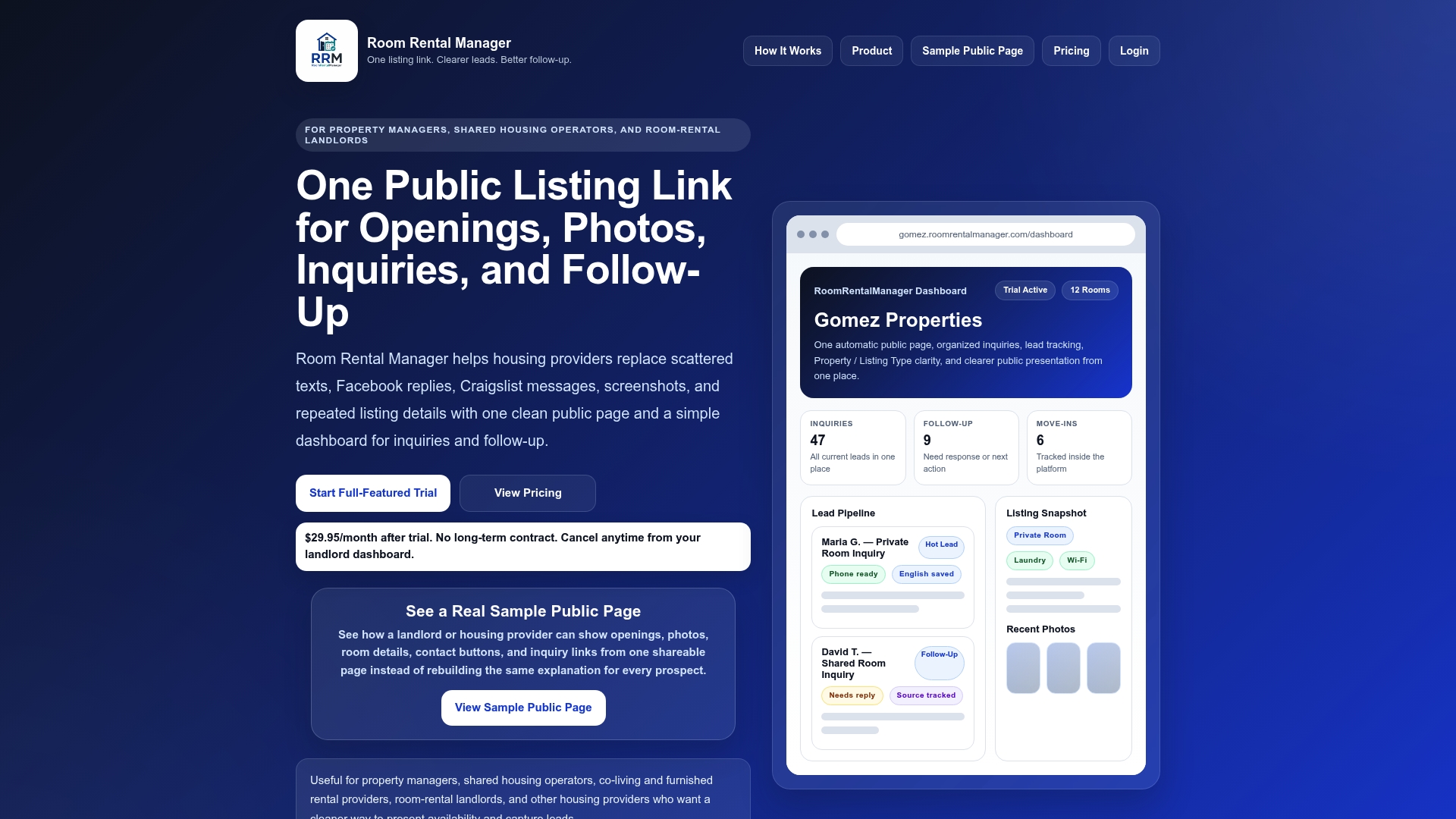
Room Rental Manager gives landlords a single shareable link that replaces the scattered texts, emails, and platform messages most operators juggle daily. Your listing page shows photos, room details, house rules, and contact options in one place. Prospective tenants submit inquiries through that page, and you track every lead from first contact to signed lease without losing anyone in a notification pile. The room rental software is built specifically for landlords managing individual rooms, not whole-unit rentals, which means the tools match the actual workflow. For landlords ready to build a more organized operation, the landlord resource hub covers the full toolkit.
FAQ
What are the most important room rental business best practices?
The highest-impact practices are individual leases per tenant, professional listing photography, dynamic pricing, and fast tenant communication. These four areas directly affect occupancy rates, legal protection, and tenant retention.
How do cleaning fees affect room rental bookings?
Cleaning fees above 15% of the monthly rent suppress inquiry conversion rates by approximately 22%. Keep fees transparent and proportionate to avoid losing prospective tenants before they even reach out.
Why should landlords use individual leases for room rentals?
Individual leases protect landlords from joint liability and allow targeted enforcement against a single problem tenant without affecting others in the house. Group leases create legal complications that are difficult and expensive to untangle.
How many reviews does a room rental listing need to convert well?
Listings with 30 or more positive reviews convert at roughly three times the rate of listings with fewer than five reviews at comparable prices. Prioritize filling rooms and generating reviews early, even at a slightly lower rent.
What technology tools help manage a room rental business?
Smart locks with unique access codes, noise monitors like Minut, automated messaging platforms, and dedicated room rental software like Room Rental Manager reduce manual workload and improve response times across all tenant interactions.