

TL;DR:
- A centralized rental page consolidates all listings and inquiries into one authoritative domain, enhancing SEO and operational efficiency. It streamlines lead management, increases visibility through domain authority, and reduces vacancy time with integrated inquiry and booking systems. Proper inquiry governance is essential for maximizing conversions and maintaining search relevance when properties change owners or management.
A centralized rental page is defined as a single, unified platform where landlords and property managers consolidate all listings, photos, inquiries, and lead tracking under one domain. The role of a centralized rental page extends far beyond a simple web presence. It functions as the operational hub that connects marketing, inquiry governance, and leasing execution into one controlled system. Tools like Room Rental Manager, Yardi, and AppFolio each address parts of this challenge, but the underlying principle is the same: one authoritative source replaces the fragmented chaos of texts, Craigslist posts, Facebook replies, and scattered notes that drain your time and cost you qualified tenants.
How does a centralized rental page improve listing visibility and SEO?
Search engine optimization is the most durable traffic channel available to rental businesses. Search engines deliver over 1,000% more traffic than social media platforms for rental businesses in 2026. That gap is not a rounding error. It means a landlord who invests in a content-rich, well-structured rental page will consistently outperform one who relies on Facebook Marketplace posts or Craigslist refreshes.
The mechanism behind this advantage is domain authority consolidation. When all your listings live on one domain, every page you publish, every inquiry you receive, and every backlink you earn strengthens the same root domain. Centralized digital presence consolidates domain authority and signals more credibility to search crawlers than fragmented individual property sites. A landlord running three separate websites for three properties splits that authority three ways. One centralized site accumulates it.
Structured content strategies amplify this further. Adding FAQ schema markup to your rental page increases the likelihood that AI tools like ChatGPT, Perplexity, and Google's AI Overviews will cite your content directly in search results. This is not a future trend. It is the current standard for high-performing rental pages in 2026. Pages that answer specific renter questions, such as "What is included in rent?" or "Is parking available?", capture both traditional search traffic and AI-generated answers.
The table below compares the two dominant approaches landlords use when structuring their digital presence.
| Factor | Centralized umbrella site | Individual property sites |
|---|---|---|
| Domain authority | Accumulates across all listings | Split across multiple domains |
| SEO maintenance | One site to update and optimize | Each site requires separate effort |
| Cross-property discovery | Renters see all available units | Renters see only one property |
| Brand consistency | Unified voice and design | Varies by property or manager |
| AI search visibility | Higher citation probability | Lower, fragmented signals |
| Operational overhead | Low, single platform | High, multiplied by property count |
Pro Tip: Add FAQ schema to your centralized rental page and target long-tail questions renters actually search, such as "rooms for rent near [city] with utilities included." These queries have lower competition and higher conversion intent than generic terms.
What operational efficiencies come from centralized rental management?
The operational case for a centralized page is built on one core problem: inquiries arrive from everywhere, and without a single collection point, leads fall through the gaps. A prospective tenant who messages you on Facebook, sends an email, and then texts you is three separate threads you have to track manually. Multiply that across five vacancies and the management burden becomes unsustainable.

A centralized rental page routes all inquiries into one inbox or CRM, regardless of where the renter found your listing. This is what property management platforms like Yardi and AppFolio call inquiry synchronization, and it is the operational foundation of faster lease-ups. Dedicated syndication tools accelerate lease-up times by 23% when paired with property management software. That acceleration comes directly from reducing the time between inquiry and response.
Poor follow-up governance is the single biggest conversion killer in rental management. Weak inquiry response systems cause a 51% drop in lead-to-lease conversion rates, even when the listing page itself performs well. This finding reframes the entire conversation. A beautifully designed rental page with no inquiry routing system is a leaky funnel. The page attracts traffic; the governance system converts it.
Pro Tip: Use a single-entry viewing booking page with direct calendar access embedded in your centralized rental page. Centralizing viewing requests removes navigation fatigue and measurably increases tour-to-lease conversions by reducing the clicks between interest and commitment.
The following features are the minimum standard for any centralized rental page that is built to convert leads, not just collect them:
- Unified inquiry inbox that captures leads from all syndication channels
- Automated acknowledgment messages sent within minutes of inquiry submission
- Lead source tracking to identify which platforms drive the highest quality applicants
- Viewing request calendar with direct booking access, no back-and-forth required
- Follow-up task reminders tied to each lead record
- Status tracking from inquiry through application to lease signing
Each of these features addresses a specific point where leads are lost in decentralized systems. Together, they create a closed-loop process from first contact to signed lease.
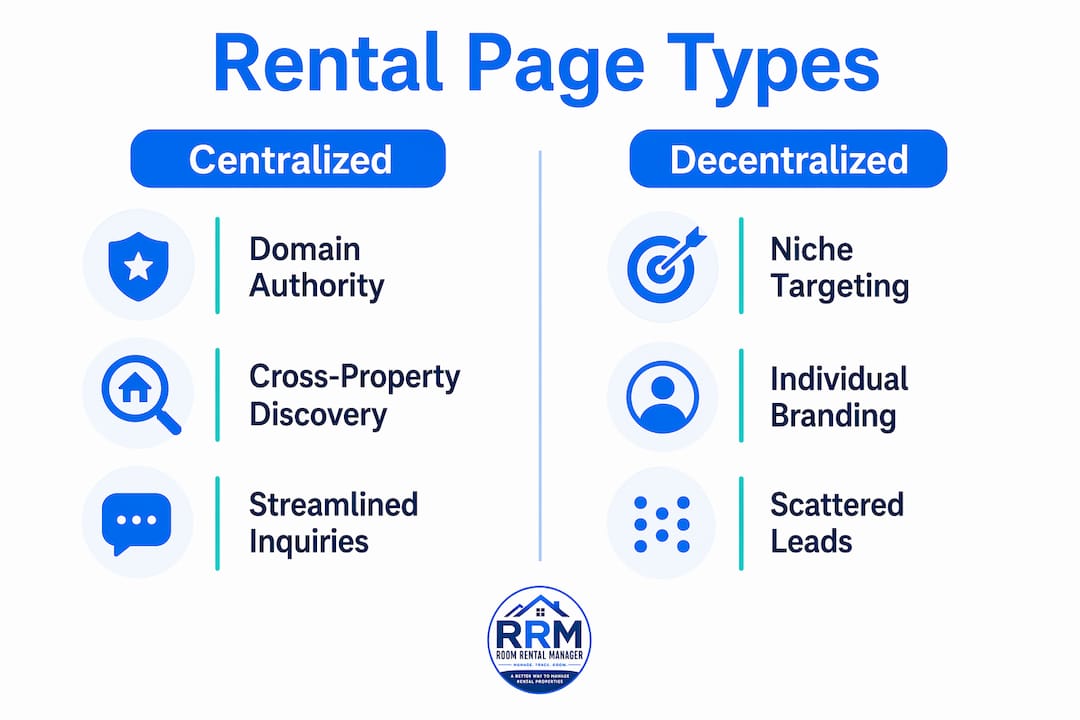
What are the key differences between centralized and decentralized rental pages?
The choice between a centralized rental page and individual property sites is not purely a technology decision. It reflects your portfolio size, your brand strategy, and how much operational capacity you have to maintain multiple digital assets simultaneously.
Decentralized individual property sites make sense in one narrow scenario: when each property targets a completely different renter demographic with no audience overlap. A luxury furnished apartment and a student housing unit may genuinely benefit from separate brand identities. Outside of that scenario, the maintenance overhead of running multiple sites almost always outweighs the perceived benefit of property-specific branding.
Centralized pages win on cross-property discovery. When a renter visits your page and finds that the unit they wanted is unavailable, they can immediately browse your other listings. That behavior is impossible on a single-property site. Centralized rental asset ownership also allows immediate rerouting of traffic to new properties or operators, preserving cumulative SEO value through domain control. When a property sells or changes management, a centralized site retains its search authority. An individual property site loses all of it.
| Decision factor | Centralized page | Individual property sites |
|---|---|---|
| Portfolio size | 2 or more units | Single flagship property |
| SEO strategy | Long-term authority building | Property-specific keyword targeting |
| Operational burden | Low, single platform | High, one site per property |
| Audience overlap | High, renters browse multiple units | Low, targeted single-property visitors |
| AI search citation | Stronger, consolidated content signals | Weaker, dispersed content |
| Tenant turnover impact | SEO preserved through domain control | SEO resets with each property change |
The AI search visibility column deserves special attention. As more renters use tools like ChatGPT and Perplexity to find housing, consolidated content signals on a single domain are cited more frequently than scattered individual pages. This is a structural advantage that compounds over time.
How to create a rental page that actually converts
Building a centralized rental page that performs requires more than uploading photos and a phone number. The architecture of the page determines whether visitors convert to inquiries, and the governance system behind it determines whether inquiries convert to leases.
Start with the page structure itself. High-performing rental pages prioritize high-intent calls to action above the fold while using progressive disclosure to reveal deeper details as the visitor scrolls. This means your contact button, availability status, and price range appear immediately. Floor plans, house rules, and application requirements appear further down. Visitors who are ready to inquire do not need to scroll past your entire lease agreement to find a phone number.
The content hierarchy should follow renter decision logic. Renters decide in this order: location, price, availability, photos, details, and then contact. Your page should present information in that sequence. A listing page built for quality leads filters out low-intent visitors and attracts renters who are ready to act, which reduces the volume of unqualified inquiries you have to manage.
Syndication is the distribution layer. Publishing your centralized page once and syndicating it to platforms like Zillow, Apartments.com, Facebook Marketplace, and Craigslist extends your reach without multiplying your management burden. Relying solely on property management software for syndication limits listing reach. Dedicated syndication automation layers extend to niche and emerging platforms to accelerate lease-ups beyond what standard PM software covers.
The following best practices and common pitfalls define the difference between a rental page that fills vacancies and one that collects traffic without converting it:
Best practices:
- Place your primary call to action in the first screen view, before any scrolling is required
- Include transparent pricing, availability dates, and pet or parking policies upfront
- Use real photos, not stock images. Renters who see accurate photos show up to viewings with correct expectations
- Connect your inquiry form directly to a CRM or lead tracking system, not just an email inbox
- Add FAQ schema markup to target AI search citations and long-tail organic queries
- Review and update listing content monthly to maintain search freshness signals
Common pitfalls to avoid:
- Listing a phone number as the only contact method. Many renters, particularly younger demographics, prefer form-based or message-based inquiry
- Omitting availability dates, which forces renters to contact you just to ask a basic question
- Using a generic contact form with no lead source tracking, which makes it impossible to measure which channels drive results
- Publishing the page and treating it as complete. Rental pages require ongoing governance, not one-time setup
- Separating your inquiry system from your listing page, which creates the exact fragmentation a centralized page is designed to solve
Key takeaways
A centralized rental page is the single most effective operational and marketing asset a landlord or property manager can build, but only when paired with an integrated inquiry governance system.
| Point | Details |
|---|---|
| SEO authority concentrates | One domain accumulates all search credibility instead of splitting it across multiple sites. |
| Inquiry governance drives conversion | Poor follow-up systems cause a 51% conversion drop regardless of page quality. |
| Syndication accelerates lease-ups | Dedicated syndication tools reduce vacancy time by 23% compared to manual posting. |
| Progressive disclosure improves UX | Showing price and availability first, then details, reduces abandonment and increases inquiries. |
| Centralized pages protect SEO through change | Domain control preserves cumulative search value when properties sell or change operators. |
Why most landlords underestimate the governance half of this equation
I have reviewed hundreds of rental pages over the years, and the pattern is consistent. Landlords invest real effort into the listing itself. Good photos, clear pricing, accurate descriptions. Then they connect it to a Gmail inbox and call it done. That is where the conversion falls apart.
The page is only half the system. The inquiry response workflow is the other half, and it is the half that most landlords treat as an afterthought. When a renter submits an inquiry at 9 PM on a Friday and receives no response until Monday morning, that lead is almost certainly gone. They have already toured two other units by then.
What I find most interesting is that this problem is not about effort. Most landlords genuinely intend to follow up quickly. The issue is that without a structured system, inquiries get buried, duplicated across channels, or simply forgotten during a busy week. A centralized page without a connected lead tracking system is like a well-designed storefront with no one working the register.
The landlords I have seen fill vacancies fastest are not necessarily the ones with the best-looking pages. They are the ones who respond within the hour, track every lead source, and know exactly where each prospect is in the process at any given moment. That discipline comes from having the right system, not just the right listing.
My honest recommendation: treat your inquiry response process as a product you actively manage and improve. Set response time targets. Track which lead sources convert. Review your follow-up sequence every quarter. The rental inquiry management process is where vacancies are actually filled, and it deserves the same attention you give to the listing itself.
— JAMES
How Room Rental Manager helps you centralize listings and leads
Room Rental Manager is built specifically for landlords and property managers who want one clean, professional page for all their rental openings, without the complexity of enterprise property management software.
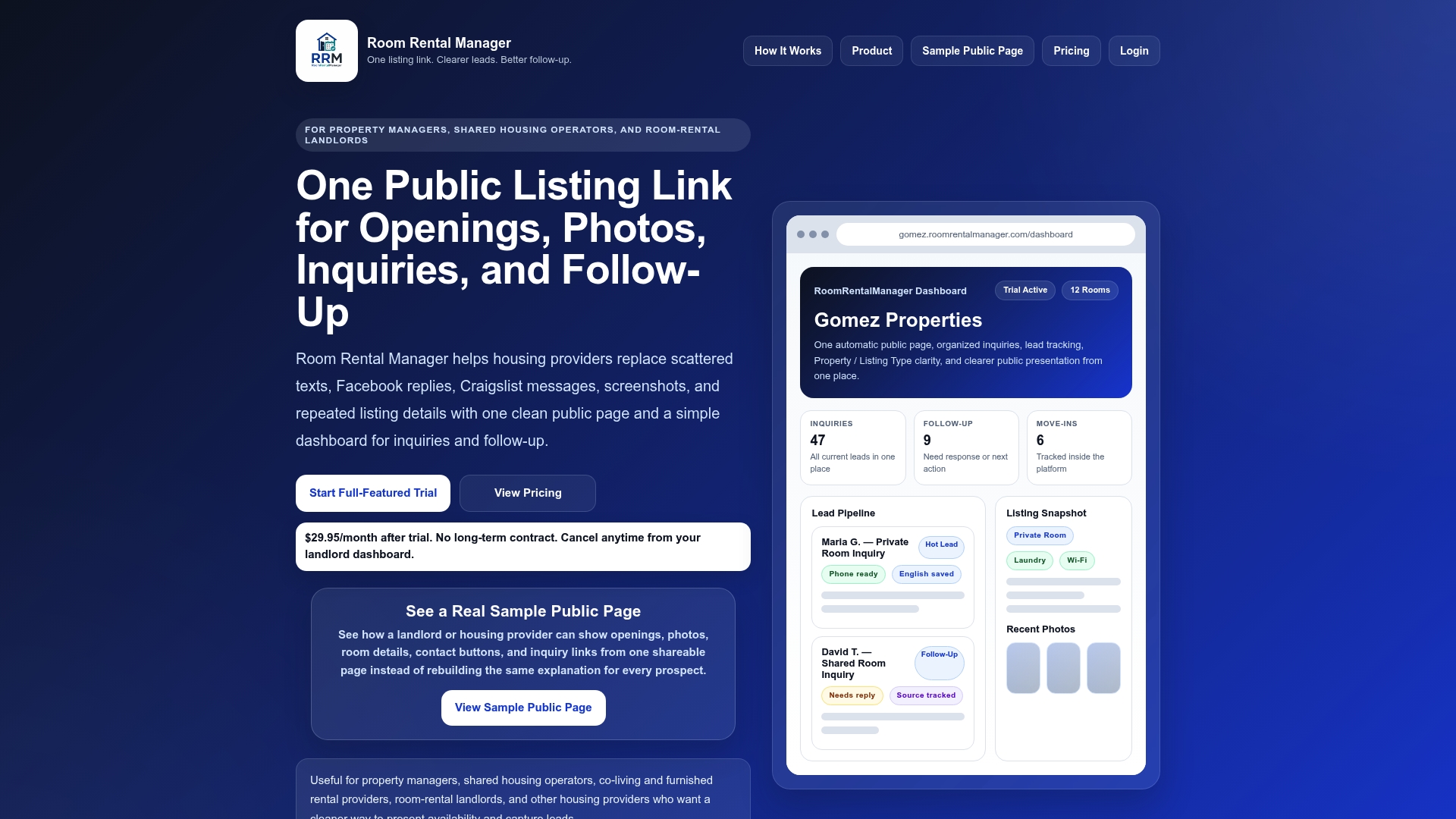
With Room Rental Manager, you create a single public listing page that includes photos, property details, availability, and a built-in inquiry form. Every lead is captured in one place, with lead source tracking that shows you exactly where your best applicants come from. Instead of managing Facebook messages, texts, and emails separately, you share one link and manage everything from a single dashboard. For landlords ready to stop repeating themselves and start filling vacancies faster, Room Rental Manager's software is the direct path from scattered listings to a system that actually works.
FAQ
What is a centralized rental page?
A centralized rental page is a single platform that consolidates all rental listings, photos, pricing, and inquiry forms under one domain, replacing fragmented posts across Craigslist, Facebook, and email threads.
How does a centralized page improve SEO for landlords?
Search engines deliver over 1,000% more traffic than social media for rental businesses, and a centralized page concentrates all domain authority in one place rather than splitting it across multiple property sites.
Why do centralized rental pages still fail to convert leads?
Poor inquiry governance causes a 51% drop in lead-to-lease conversion rates even when the listing page itself performs well. The page attracts traffic; a connected inquiry response system is what converts it.
How many listings do I need before a centralized page makes sense?
A centralized rental page is worth building from the moment you manage two or more units, because cross-property discovery and consolidated SEO authority both begin delivering returns immediately.
What features should a centralized rental page include?
At minimum, a centralized rental page needs a unified inquiry inbox, lead source tracking, a viewing booking option with direct calendar access, automated follow-up triggers, and FAQ schema markup for AI search visibility.