

TL;DR:
- Rental response management is a structured process for landlords to handle inquiries across multiple channels efficiently and consistently. Speed and tone of responses directly impact vacancy rates, lease conversions, and online reputation. Implementing automation, scripts, and clear workflows ensures timely, friendly, and compliant communication that boosts leasing success.
Rental response management is the structured system landlords and property managers use to receive, track, and reply to rental inquiries across every channel, from email and text to Zillow and Craigslist. The goal is consistent, timely communication that moves prospects from first contact to signed lease without losing leads in scattered inboxes or unanswered messages. Tools like property management CRMs, US Tech Automations workflows, and platforms such as Apartments.com Messages all support this process. Understanding what is rental response management is the first step toward closing the gap between what renters expect and what most landlords actually deliver.
What is rental response management and why does it matter?
Rental response management is the end-to-end process of handling prospect and tenant inquiries through defined workflows, automation, and standardized communication. The industry term for the broader discipline is inquiry lifecycle management, but rental response management describes the day-to-day practice most landlords recognize. It covers the moment a renter submits a question through the moment a lease is signed or a maintenance issue is resolved.
The urgency behind this process is real. 62% of renters expect a response to non-emergency inquiries within 1 hour in 2026, up from 38% in 2020. The current industry average response time sits at 24 hours. That 23-hour gap is not a minor inconvenience. It is a direct cause of lost leads, lower lease conversion rates, and negative online reviews.
The rental inquiry management process connects every touchpoint a prospect has with your property before signing. When that process is managed well, renters feel valued and informed. When it breaks down, they move on to the next listing within minutes.
Why response speed directly affects your vacancy rate
Speed is not just a courtesy. It is a business metric with a direct line to your bottom line. High-performing rental teams resolve 76% of issues at first contact and maintain lead-to-lease conversion rates of 2–5%. Teams that rely on slow, manual follow-up rarely hit those numbers.
The expectation gap created by slow responses has compounding effects:
- Lease conversion loss: A renter who waits 24 hours for a reply has likely already toured a competing property.
- Review damage: Slow or impersonal responses are among the top complaints in negative landlord reviews on Google and Yelp.
- Renewal risk: Tenants who experienced poor communication during the inquiry phase are less likely to renew, even if the property itself is excellent.
- Vacancy cost: Every additional day a unit sits empty has a real dollar cost. Faster responses shorten vacancy cycles.
The importance of rental response management becomes clearest when you look at the numbers. Vacancy utilization targets for high-performing teams run between 60–80%. Teams without a defined response process consistently fall below that range.
Speed matters, but tone matters just as much. Responses must remain friendly, helpful, and compliant with Fair Housing laws. A robotic auto-reply that feels cold or dismissive damages tenant trust more than a delayed response. The goal is fast and human, not fast or human.
Pro Tip: Set a personal SLA of under 30 minutes for initial inquiry responses during business hours. Even a brief acknowledgment that says "Got your message, I'll follow up within the hour" outperforms silence by a wide margin.
Manual vs. automated rental response management
Most landlords start with manual processes. One inbox, one phone, one spreadsheet. That works for one or two units. It breaks down fast at five units and becomes unmanageable at ten or more.
| Factor | Manual Process | Automated Process |
|---|---|---|
| Response time | Hours to days | Under 5 minutes |
| Lead tracking | Spreadsheets, notes | Centralized CRM dashboard |
| Consistency | Varies by person or mood | Standardized scripts every time |
| Scalability | Limited by hours in the day | Handles volume without added staff |
| Fair Housing compliance | Prone to inconsistency | Enforced through scripted templates |
| Lead source tracking | Rarely tracked | Automatic attribution by channel |
Manual handling of rental inquiries causes duplicated efforts, lost leads, and inconsistent tenant communication. The problem is not effort. It is architecture. A landlord checking three email accounts, a Facebook Messenger thread, and a Craigslist inbox is not running a system. They are running a reaction loop.
Automation solves this by creating layers. The first layer is an immediate acknowledgment sent within 60 seconds of any inquiry across text, email, or listing platforms. That acknowledgment reassures the prospect and buys time for a personalized reply. The second layer routes the inquiry to the right context, whether that is a showing request, a pricing question, or a maintenance issue. The third layer tracks the full conversation history so nothing falls through the cracks.
Property management CRMs improve lead visibility, follow-up consistency, and leasing velocity by managing prospect communication, tours, follow-ups, and reporting from one place. Platforms like RealPage and similar tools move prospects efficiently from inquiry to signed lease by automating the repetitive steps that eat up landlord time.
Pro Tip: Before buying any software, map your current inquiry flow on paper. Identify where leads go silent. That gap is exactly where automation should go first.
The goal of automation is not to remove the human element. It is to make sure the human element shows up at the right moment, with full context, instead of scrambling to remember which renter asked what question three days ago.
Best practices for rental response management
Effective rental response strategies share a common structure. They define what happens at every stage of the inquiry lifecycle, not just the first reply.
Build a standardized script library
Scripted responses covering 80% of common queries are a foundational best practice for rental management. Common queries include pricing, availability, pet policies, parking, application requirements, and showing schedules. Writing clear, compliant, and friendly scripts for each of these takes a few hours upfront and saves hundreds of hours over a year.
Scripts are not meant to feel scripted. They are starting points. A good script sounds like a knowledgeable person giving a clear answer, not a legal disclaimer.
Define your inquiry pipeline stages
A defined pipeline turns a chaotic inbox into a trackable process. The stages typically look like this:
- New inquiry received — Automated acknowledgment sent within 60 seconds.
- Qualified lead — Prospect has confirmed interest, budget fit, and move-in timeline.
- Showing scheduled — Tour confirmed via calendar link or direct message.
- Application submitted — Prospect moves to screening workflow.
- Lease signed — Lead converted, source tracked, pipeline updated.
Each stage should have a defined owner, a time target, and a next action. Without this structure, leads stall between stages and go cold.
Set response time slas
Standardized SLA targets for initial response under 30 minutes and urgent issue resolution within 24 hours are the industry benchmark. SLA stands for service level agreement, and it simply means a committed time target for each type of response. Writing these down and sharing them with any staff or co-managers creates accountability.
Create clear escalation paths
Not every inquiry is routine. A Fair Housing complaint, a maintenance emergency, or a dispute over a security deposit requires a different response than a question about parking. Escalation paths define who handles what and when. Without them, complex issues either get ignored or handled inconsistently, both of which create legal and reputational risk.
Track kpis continuously
The best practices for rental management are only as good as the data behind them. Track response time averages, lead-to-lease conversion rates, and inquiry volume by source. Centralized dashboards that consolidate inquiry sources and track full conversation history prevent duplicated efforts and maximize marketing ROI by showing which channels produce the best leads.
How to implement rental response management in your operations
Implementation does not require a large budget or a dedicated team. It requires a clear sequence of decisions and the right tools for your scale.
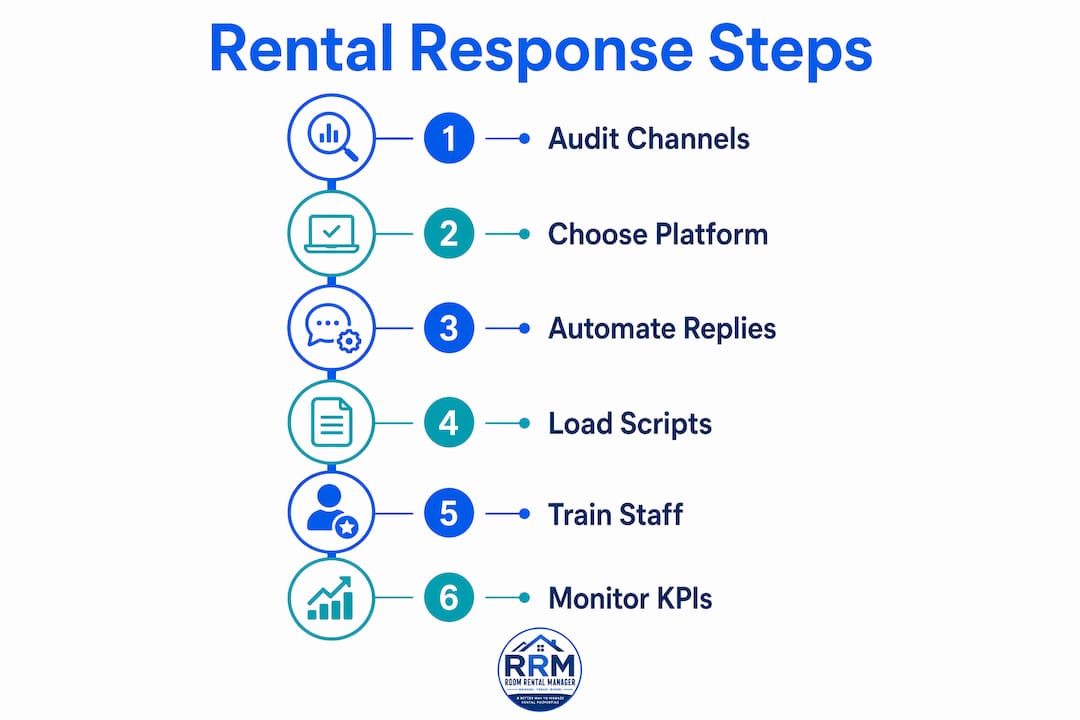
Step 1: Audit your current inquiry channels. List every place a renter can reach you today. Email, text, Craigslist, Zillow, Facebook, your website contact form. Most landlords find five to eight active channels, many of which they check inconsistently.
Step 2: Choose a central platform. Automation systems that monitor lead sources from websites, email, and Zillow parse inquiries, send immediate personalized replies, qualify prospects, book tours, and track outcomes. The right platform consolidates all channels into one dashboard so you never miss a message.
Step 3: Set up automated acknowledgments. The industry best practice is an automated acknowledgment sent within 60 seconds across all channels. This single step closes the most damaging part of the expectation gap. Renters who receive an immediate acknowledgment are far more likely to stay engaged while waiting for a detailed reply.
Step 4: Load your script library. Upload your standardized responses for the most common inquiry types. Most platforms allow you to tag inquiries by type and trigger the appropriate script automatically or with one click.
Step 5: Train on escalation. If you have staff or co-managers, walk through the escalation paths before they are needed. Role-play a Fair Housing scenario and a maintenance emergency so the response is practiced, not improvised.
Step 6: Monitor and adjust. Review your KPIs monthly. Look at average response time, conversion rate by channel, and the number of inquiries that went unanswered. Tracking lead attribution by source tells you which advertising channels are worth the spend and which are generating noise.
Learning how property managers handle inquiries effectively at scale comes down to this sequence. The tools change, but the logic stays the same: centralize, automate the routine, and reserve your attention for the decisions that actually require judgment.
Key takeaways
Rental response management works because it replaces reactive, scattered communication with a defined system that delivers consistent, fast, and compliant responses at every stage of the inquiry lifecycle.
| Point | Details |
|---|---|
| Define the process first | Map every inquiry channel before choosing software or writing scripts. |
| Speed closes the expectation gap | 62% of renters expect a reply within 1 hour; the industry average is 24 hours. |
| Automation handles volume | Automated acknowledgments within 60 seconds keep prospects engaged while you prepare a personal reply. |
| Scripts plus pipelines equal consistency | Standardized responses for 80% of queries, combined with defined pipeline stages, prevent leads from going cold. |
| Track KPIs to improve | Monitor response time, conversion rate, and lead source attribution monthly to find and fix weak points. |
The part most landlords skip until it's too late
I have watched landlords invest real money in listing upgrades, professional photos, and premium Zillow placements, then lose the lead because nobody replied for two days. The listing was not the problem. The response system was.
The uncomfortable truth about rental response management is that most landlords treat it as a personality trait rather than a process. They assume being a "responsive person" is enough. It is not. Responsiveness at scale requires architecture, not just intention. When you manage three units, checking your phone works. When you manage fifteen, it fails silently. Leads disappear and you never know they were there.
The other misconception I see constantly is that automation feels impersonal. Landlords worry that auto-replies will make them seem like a corporation. The opposite is true. A warm, well-written acknowledgment sent in 60 seconds feels more attentive than a personal reply that arrives 18 hours later. The renter does not care whether a human or a system sent the first message. They care that someone acknowledged them.
For 2026, the landlords pulling ahead are not the ones with the most units or the best properties. They are the ones who built a clean, centralized inquiry system early and now spend their time on showings and relationships instead of hunting through text threads. The rental vacancy advertising side of the business gets all the attention, but the response side is where leases are actually won or lost.
My recommendation: start with one change. Pick your highest-volume inquiry channel and set up an automated acknowledgment this week. Measure the difference in prospect engagement over 30 days. That single data point will tell you everything you need to know about whether a full system is worth building.
— JAMES
How room rental manager handles this for you
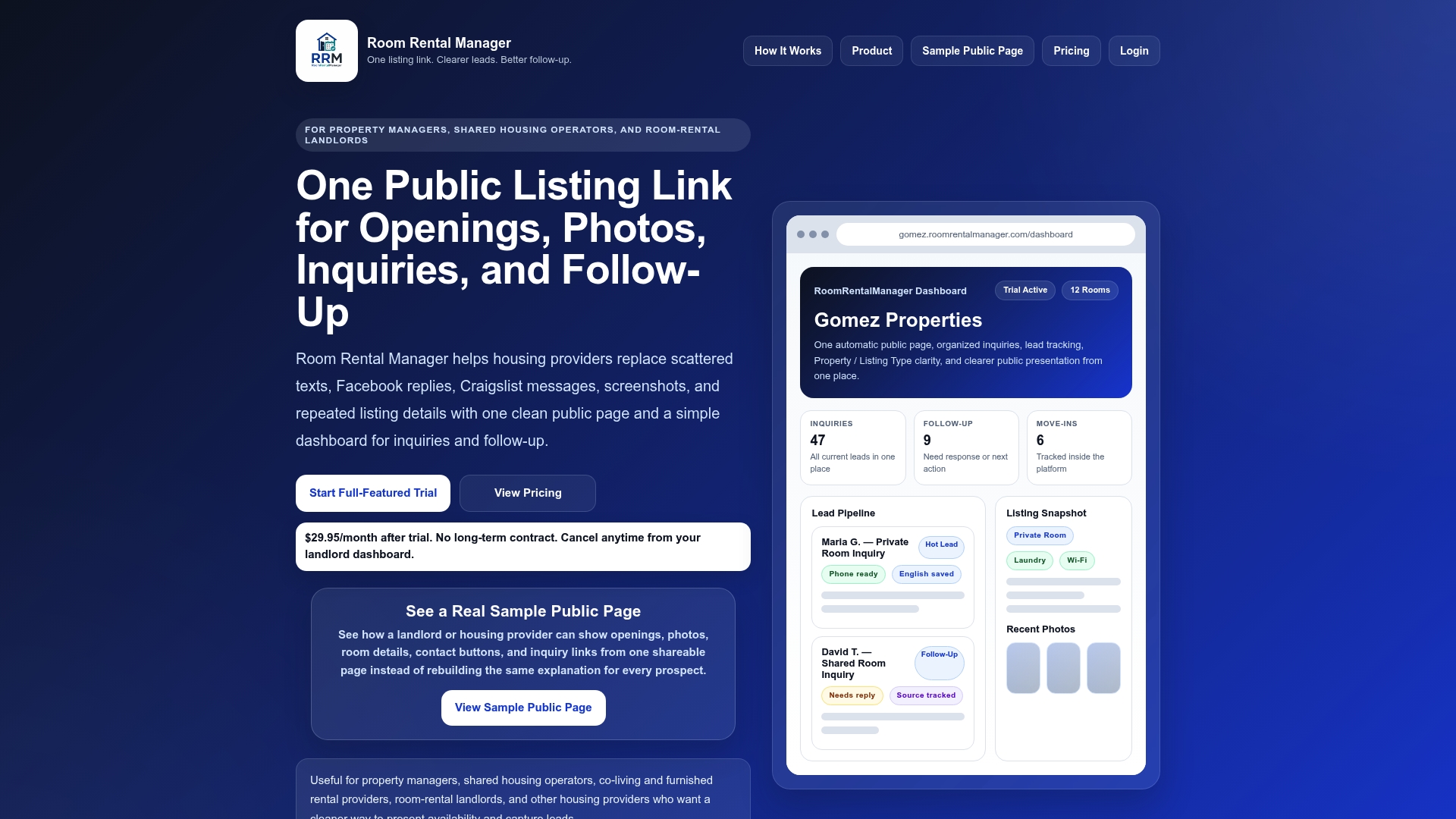
Room Rental Manager was built specifically for landlords who are tired of repeating the same information across texts, emails, Facebook replies, and Craigslist messages. You create one clean listing page with your property details, photos, and contact options. Prospects submit inquiries through that page. You track every lead, see where it came from, and manage follow-up from a single dashboard.
The rental inquiry tracking feature gives you the centralized source of truth that prevents lost leads and duplicated effort. For landlords ready to go further, the room rental lead management tools connect inquiry handling directly to your leasing workflow. Stop managing responses from five different apps. Start managing them from one.
FAQ
What is rental response management in simple terms?
Rental response management is the system landlords and property managers use to receive, track, and reply to rental inquiries in a consistent and timely way. It covers every channel from email and text to listing platforms like Zillow.
How fast should a landlord respond to a rental inquiry?
The industry best practice is an automated acknowledgment within 60 seconds and a personal reply within 30 minutes during business hours. Research shows 62% of renters expect a response within 1 hour in 2026.
What is the difference between manual and automated rental response management?
Manual processes rely on individual effort across scattered inboxes, which leads to slow responses and lost leads. Automated systems centralize all channels, send instant acknowledgments, and track every inquiry from first contact to lease signing.
What software supports rental response management?
Property management CRMs, platforms like RealPage, and tools like Room Rental Manager all support rental response management by centralizing inquiries, automating follow-ups, and tracking lead sources and conversion rates.
Why does rental response management affect lease renewals?
Tenants who experienced slow or inconsistent communication during the inquiry phase are less likely to renew, even if the property itself is well-maintained. First impressions set the tone for the entire landlord-tenant relationship.