

TL;DR:
- Managing rental listings is simplified with one rental link that centralizes property details and reduces errors. This approach enhances tenant trust, speeds up lease conversions, and streamlines lead management across multiple platforms. However, landlords must account for syndication delays and avoid maintaining parallel manual postings to maximize benefits.
If you're managing even two rental units, you already know the drill: post on Craigslist, update Facebook Marketplace, reply to the same questions for the tenth time, fix the typo on one listing but forget the other, and wonder why your inbox feels like a second job. Understanding why landlords need one rental link is not a philosophical exercise. It's the answer to a real operational problem that costs you hours every week and causes qualified renters to slip through the cracks because they got confused, got frustrated, or got a different price than the one you posted somewhere else.
Table of Contents
- Key Takeaways
- Why landlords need one rental link
- Benefits of one rental link for landlords
- Common pitfalls of the one link approach
- Putting the one rental link into practice
- Multi-platform posting vs. one rental link
- My take on the one link shift
- How Room Rental Manager puts this into practice
- FAQ
Key Takeaways
| Point | Details |
|---|---|
| One link, one source of truth | A single rental URL eliminates conflicting info across platforms and protects your credibility with renters. |
| Syndication cuts vacancy days | Distributing one listing to multiple portals creates a 12:1 lease conversion advantage compared to non-syndicated listings. |
| Delays are real, plan for them | Feed-based syndication can take 24 to 48 hours to update portals, so time your marketing communications accordingly. |
| Lead tracking becomes effortless | One rental link lets you trace exactly where inquiries originate and follow up faster from a single dashboard. |
| Setup is simpler than you think | Tools like Room Rental Manager let landlords build one public listing page and share it everywhere in minutes. |
Why landlords need one rental link
A single rental link is exactly what it sounds like: one URL that lives at the center of all your rental marketing. Every platform you post on, every text you send, every email you write points back to that one page. The page contains your photos, pricing, unit details, availability, contact options, and an inquiry form. When something changes, you update it once. Every renter who clicks your link sees the current, accurate version.
The concept has its roots in listing syndication, which is the practice of publishing a rental listing once and distributing it automatically to multiple rental portals. The technology has matured significantly, and rental advertising automation now makes this accessible to independent landlords, not just large property management companies.
Here is how the mechanics typically work:
- Direct posting: You manually create a listing on each platform. Changes require logging into every site separately and editing each entry individually.
- Feed-based syndication: Your property management software or listing tool generates a data feed. The feed pushes your listing to partner portals automatically. Updates flow from one source.
- Centralized listing page: A single public URL hosts your full property details. You share this link everywhere instead of sending renters to multiple platform listings. This is the core of the one rental link approach.
The difference between direct posting and syndication is not just speed. It's structural. When you rely on direct posting, you have no single source of truth. When you use a centralized listing page with feed-based distribution, every downstream listing is a reflection of your one authoritative record. That distinction matters enormously when pricing changes, a unit gets leased, or you add photos.
Room Rental Manager is built specifically for this model. Instead of logging into five different platforms to announce a vacancy, you update your one listing page and let the distribution handle itself.
Benefits of one rental link for landlords
The advantages of one rental link go beyond convenience. They translate directly into fewer vacancy days, higher-quality leads, and less time spent doing repetitive work.
-
You stop making errors. When you post the same unit across six platforms independently, inconsistencies are not a matter of if but when. A price you updated on one site sits outdated on another for days. Conflicting listing information erodes renter trust before they ever contact you. One link eliminates that problem entirely.
-
Your leads concentrate in one place. Instead of fielding messages across Facebook Messenger, Craigslist email, Zillow chat, and text, every inquiry funnels through your single listing page. You know where each lead came from, when they inquired, and what they asked. Follow-up becomes a manageable task instead of an archaeological dig through three inboxes.
-
You convert more renters. Listings that reach renters across multiple platforms through a consistent syndicated source create a significant conversion advantage compared to isolated manual postings. Renters see the same accurate information everywhere they look, which builds confidence and speeds up their decision.
-
Your availability updates automatically. When a unit leases, you mark it in your system and the change propagates out. No more forgetting to take down that Craigslist post and fielding calls for a unit that's been rented for two weeks. Listing feeds auto-update rental info on multiple platforms and remove leased units automatically.
-
Renters have a better experience. A renter who finds four different listings for your property with four slightly different descriptions starts to wonder what else is inconsistent. A single, clean, well-organized listing page communicates professionalism and builds the kind of trust that gets leases signed.
Pro Tip: When you share your one rental link on social media or in text messages, use a URL shortener or a branded domain redirect so the link looks clean and trustworthy. A long, parameter-heavy URL signals automation to renters. A short, clean link signals a landlord who has their act together.
The benefits of one rental link compound over time. As you build a history of leads through a single system, you start seeing patterns: which platforms send the most qualified renters, which times of year drive the most inquiries, which listing descriptions perform best. That data is invisible when your leads are scattered across platforms.

Common pitfalls of the one link approach
Understanding the advantages is only half the picture. The strategy has known failure points, and knowing them in advance keeps you from undermining your own system.
The most common challenge is syndication delay. Zillow can take up to 24 hours to process a direct listing, and feed-based syndication to other portals commonly runs 24 to 48 hours. If you announce a vacancy on social media and a renter clicks through to a portal before the update has propagated, they see stale information. That creates confusion and erodes trust in your listing.
- Avoid marketing new vacancies publicly until portal updates are confirmed. Give your syndication feed time to complete its cycle before driving traffic to the listing.
- Never use more than one feed source for the same unit. Duplicate listings from multiple sources cause rejection or delays on major portals. If your property management software is pushing a feed to Zillow, do not also manually create a Zillow listing for the same unit.
- Designate one system as your source of truth. Every change gets made there first. Every other platform is a downstream reflection. The moment you start making direct edits on individual portals, you break the chain.
- Communicate timing expectations to renters. If a renter finds your listing on a portal and the availability dates look off, a brief note in your listing itself explaining that details are updated in real time on your primary listing page will redirect them correctly.
- Audit your listings quarterly. Even with good syndication, orphaned listings from old posting methods sometimes linger. A quarterly check across your main platforms catches these before they cause problems.
Pro Tip: Treat your listing as "eventually consistent" rather than "instantly updated." Portal processing latency is a known, predictable constraint. Build your marketing timeline around it instead of against it.
The landlords who struggle most with the one link approach are the ones who maintain parallel systems during the transition. They set up a centralized listing page but keep manually posting to Craigslist out of habit. The result is exactly the kind of conflicting information the strategy was designed to prevent.
Putting the one rental link into practice
Knowing the theory is one thing. Executing it in your actual workflow is another. Here is a practical framework for adopting the one rental link approach without disrupting your existing operations.
Choose the right platform first
Not every property management tool supports true listing syndication. Look for software that gives you a public listing URL you can share, pushes updates to major rental portals automatically, and centralizes your lead tracking. Room Rental Manager was designed specifically for this workflow, giving you a single listing page that you can share across every channel while tracking inquiries from one dashboard.
Build your listing page to convert
The quality of your one rental link only matters if the page it points to is worth visiting. A well-built listing page includes high-resolution photos from multiple angles, a detailed and accurate description, clear pricing with any included utilities or fees specified, and an easy inquiry form that does not require renters to create an account. Research consistently shows that well-optimized listing pages fill vacancies faster because they give renters everything they need to make a decision without playing phone tag.
Connect to the major platforms
Once your listing page is set up, distribute it. The platforms worth prioritizing for most residential landlords include Zillow, Apartments.com, and Facebook Marketplace. Craigslist remains useful in many markets despite its age. Listing on the A-du Manager Marketplace is worth considering for landlords managing room rentals and shared housing specifically, as it connects you with renters actively looking for that format.
Use analytics to refine your approach
| Feature | Manual multi-platform posting | One rental link with syndication |
|---|---|---|
| Time per listing update | 30 to 60 minutes | 2 to 5 minutes |
| Lead source visibility | None or fragmented | Centralized and trackable |
| Risk of outdated information | High | Low |
| Duplicate listing risk | High | Low if managed correctly |
| Renter experience | Inconsistent | Consistent and professional |
| Availability updates | Manual on each platform | Automatic via feed |
The data tells the story clearly. Landlords using syndicated listings experience fewer vacancies and attract more qualified applicants because their information reaches more renters with less effort and greater consistency.
Multi-platform posting vs. one rental link
Most landlords start with multi-platform posting because it feels like more coverage. More listings must mean more leads, right? The math breaks down quickly in practice.
When you post manually to five platforms, you have five separate listings to update, five separate inboxes to monitor, and five different versions of your property description that will drift apart over time. A renter who sees your listing on two platforms with different prices will not call you to ask which one is correct. They will move on to the next option.
Open listings with consistent, transparent pricing improve market trust and actually reduce vacancy days because renters do not feel like they are negotiating against hidden information. The one rental link approach enforces that consistency by design.
The time investment comparison alone makes the case. Manually maintaining listings across five platforms typically costs a landlord 30 to 60 minutes per update. With one rental link and syndication, the same update takes two to five minutes. Over the course of a year, with regular pricing reviews, photo updates, and availability changes, that difference adds up to dozens of hours you get back.
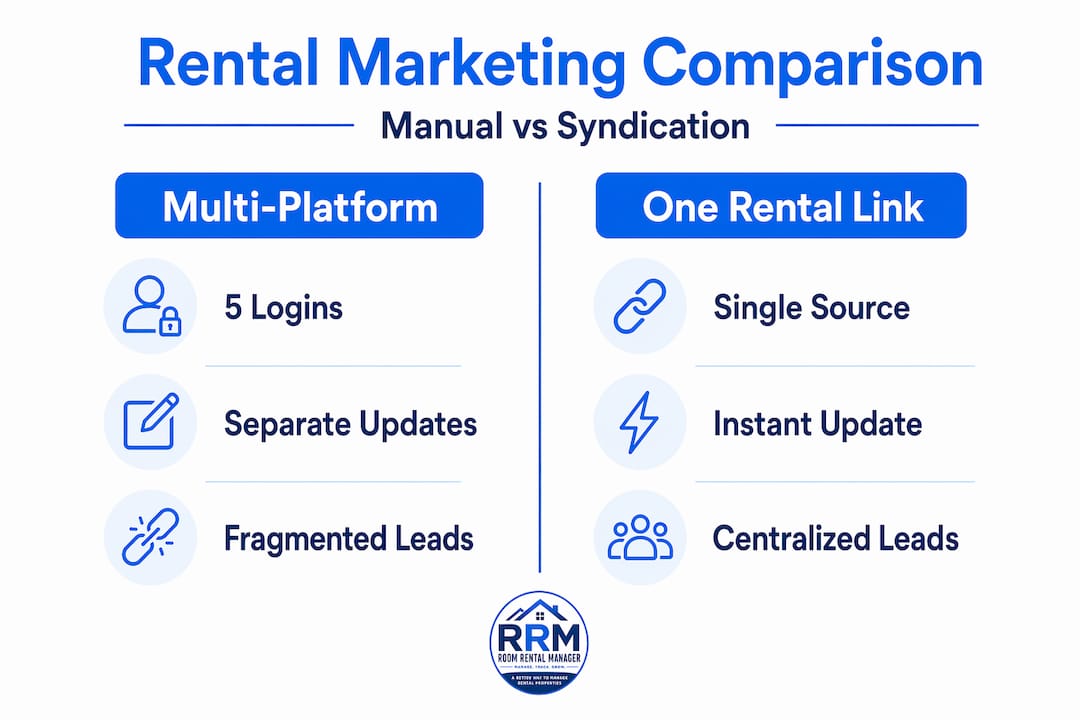
For room-rental landlords specifically, the stakes are even higher. Managing individual rooms within a shared property means more units, more turnover, and more frequent updates. Understanding why room-rental landlords need one link becomes obvious when you are tracking six different room listings across three platforms simultaneously. The complexity compounds fast and the one link approach scales with you instead of against you.
My take on the one link shift
I have spent years watching landlords approach rental marketing the same way they approach home improvement projects: add more until it works. More platforms, more posts, more messages. And the frustration they feel when leads dry up or good renters ghost them is real. But in my experience, the problem is almost never reach. It is almost always consistency.
The landlords I have seen fill units fastest are not the ones posting everywhere manually every day. They are the ones who built a single, well-maintained listing presence and pointed every channel toward it. When a renter sees the same clean, accurate page three times from three different sources, it does not feel like spam. It feels like evidence that this landlord is organized and trustworthy.
What I have also learned is that most landlords underestimate the hidden cost of fragmented marketing. It is not just the time it takes to update six platforms. It is the mental overhead. The "did I remember to update that one?" anxiety. The renter who texts you at 9pm because the price on Craigslist does not match the one on Zillow. Those small frictions accumulate into a baseline level of stress that feels normal but is not inevitable.
I do think there are legitimate cases where one link needs customization. A landlord with both short-term furnished units and long-term unfurnished rooms may need two distinct listing pages, each with their own link, targeted to different renter types. That is not a failure of the strategy. It is an application of the principle: one source of truth per audience, not one source of truth across wildly different product types.
The bigger picture here is that small-scale independent landlords have more to gain from marketing tools that reduce vacancy than they do from any other lever in their business. One well-optimized rental link, shared consistently, does more for cash flow than doubling your platform list while maintaining manual posting habits.
— JAMES
How Room Rental Manager puts this into practice
If you manage rooms, shared housing, or small residential rentals, Room Rental Manager was built for exactly this workflow. You create one public listing page for each property or unit, add your photos, pricing, availability, and contact options, and then share that single URL everywhere you market.
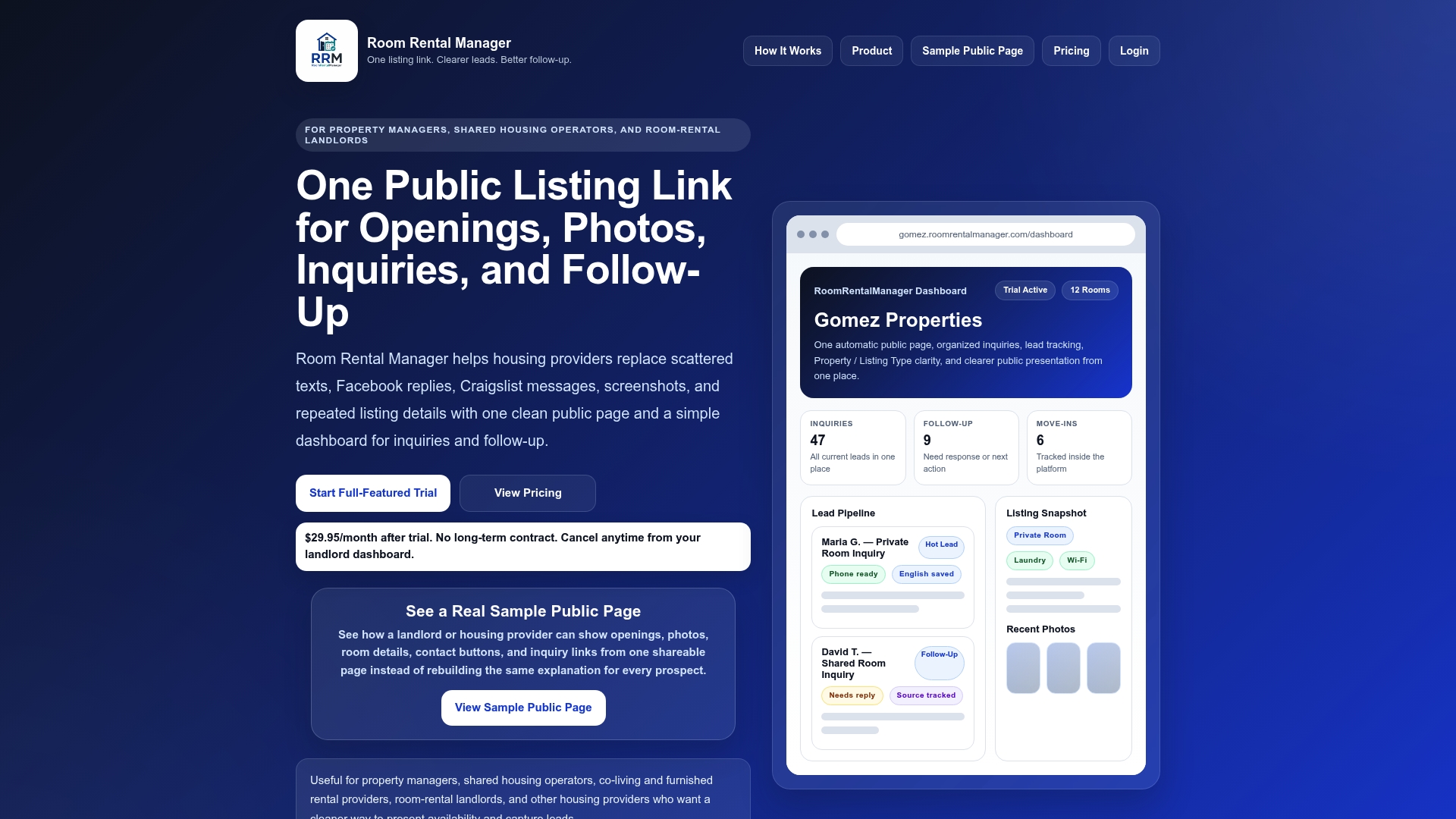
Leads come into your dashboard with their source tracked, so you know which platforms are sending real renters versus which ones are just noise. You follow up from one place, keep notes, and never lose an inquiry in a messenger thread again. The platform connects with major rental portals, giving you the distribution benefits of syndication without the enterprise software price tag. Whether you are managing one room or twelve, explore the landlord tools and resources at Room Rental Manager or go straight to the main listing platform to see how quickly you can get your first one rental link live. Most landlords have their listing page ready to share in under 20 minutes.
FAQ
What does "one rental link" actually mean for landlords?
One rental link means a single public URL that contains all your property details, photos, pricing, and inquiry options. Instead of sending renters to different platform listings, you share one link everywhere and update it in one place.
How long does it take for a rental listing update to appear on all platforms?
Syndication updates typically take 24 to 48 hours to propagate across portals after you make a change to your source listing. Plan your marketing communications around this window to avoid showing renters stale information.
Can one rental link really reduce vacancy days?
Yes. Listings distributed through a centralized syndication approach create a significant lease application conversion advantage compared to non-syndicated listings, primarily because consistent information across platforms builds renter confidence faster.
What is the biggest mistake landlords make with the one link approach?
The most common mistake is maintaining manual postings on individual platforms at the same time as using a syndicated feed. Duplicate listings from multiple sources can cause portal rejections and create exactly the kind of conflicting information the strategy is designed to prevent.
Is the one rental link approach only for large property managers?
No. Independent landlords managing even a single unit benefit from the consistency and lead tracking that a single rental link provides. Tools like Room Rental Manager are specifically designed for small-scale and room-rental landlords who need professional-grade inquiry tracking and lead management without enterprise complexity.