

TL;DR:
- Pricing models for room rentals include cost-plus, market-rate, dynamic, hybrid, and value-based strategies aimed at maximizing income and minimizing vacancy. Dynamic pricing generally outperforms static methods by 15–35%, especially for portfolios with three or more properties, and requires automation tools to save time. The most effective approach combines a cost-based floor, regular market benchmarking, and adaptable models tailored to portfolio size and market demand.
Room rental pricing models comparison is the practice of evaluating cost-plus, market-rate, dynamic, hybrid, and value-based strategies to find the approach that maximizes income and minimizes vacancy for a given portfolio. A private room costs about 40–60% of a comparable studio apartment in major U.S. cities, which means landlords who price incorrectly leave real money on the table. The right model depends on your portfolio size, local demand patterns, and how much time you can invest in management. This guide breaks down each strategy with data, trade-offs, and situational guidance so you can choose with confidence.
1. What are the most common room rental pricing models?
Five core pricing models define how landlords and property managers set room rents. Each operates on a different logic, and understanding that logic is the first step toward choosing the right one.
Cost-plus pricing starts with your total monthly costs, adds a target profit margin, and sets rent at that number. It is simple and predictable, but it ignores what the market will actually bear. Cost-plus pricing is common among small portfolio owners yet often misaligns rents with market demand, causing vacancies or lost revenue.
Market-rate pricing anchors your rent to comparable listings in the same zip code or neighborhood. You pull comps from Zillow, Craigslist, or Facebook Marketplace, identify where your room sits in the range, and price accordingly. This method keeps you competitive but requires regular updates to stay accurate.
Dynamic pricing uses algorithms to adjust rates automatically based on demand signals: local events, seasonal trends, competitor availability, and booking velocity. Tools like PriceLabs, Wheelhouse, and Beyond Pricing power this approach for short-term and mid-term rental operators.
Hybrid pricing blends short-term rental rates during peak demand periods with monthly rates during slower seasons. The goal is to capture premium revenue when demand is high without leaving the room vacant during off-peak stretches.
Value-based pricing sets rent based on what a specific renter segment will pay for a specific set of amenities or location benefits. A furnished room near a major hospital, for example, commands a premium from traveling nurses regardless of what nearby unfurnished rooms cost.
- Cost-plus: best for landlords who want simplicity and predictability
- Market-rate: best for staying competitive in stable, data-rich markets
- Dynamic: best for short-term and mid-term rentals with variable demand
- Hybrid: best for seasonal markets or event-driven locations
- Value-based: best for differentiated rooms with clear renter personas
Pro Tip: Before choosing a model, calculate your break-even rent first. Knowing your floor prevents you from pricing below cost no matter which strategy you adopt.
2. How do dynamic pricing models compare to static pricing models?
Dynamic pricing consistently outperforms static pricing on revenue, but the gap depends on portfolio size and market volatility. Dynamic pricing typically increases revenue by 15–35% for portfolios with three or more properties compared to static manual pricing. That lift is not automatic. It requires the right tool, accurate market data, and at least a basic understanding of how the algorithm weights demand signals.

The operational difference is significant. Manual static pricing requires 3–5 hours weekly to research comps, adjust listings, and respond to market shifts. Automated dynamic tools reduce that to about 30 minutes per week for minor tweaks. That time savings compounds across a larger portfolio.
| Factor | Static pricing | Dynamic pricing |
|---|---|---|
| Setup time | Low | Moderate |
| Weekly management time | 3–5 hours | ~30 minutes |
| Revenue lift potential | Baseline | 15–35% higher |
| Best portfolio size | 1–2 units | 3+ units |
| Tools required | None | PriceLabs, Wheelhouse, Beyond Pricing |
| Market responsiveness | Manual | Automated |
PriceLabs offers granular control over pricing rules, making it a strong choice for experienced operators. Wheelhouse emphasizes fast onboarding, which suits landlords new to dynamic pricing. Beyond Pricing balances both, with a clean interface and solid automation defaults.
One metric that dynamic pricing surfaces clearly is Revenue Per Available Night, known as RevPAN. RevPAN shifts focus from the nightly rate alone to total revenue per available rental unit, accounting for occupancy risk. A room priced at $80 per night with 90% occupancy outperforms a room priced at $100 per night with 65% occupancy. Static pricing rarely captures this nuance.
The hidden cost of dynamic pricing is operational overhead. Short-term rentals carry hidden costs like increased cleaning and turnover labor that can offset higher gross revenue if not managed carefully. Beginners often underestimate this and see net profitability fall even as gross revenue rises.
3. What are the pros and cons of cost-plus, market-rate, and value-based pricing?
These three models represent the traditional end of the rental pricing strategies comparison. Each has a legitimate use case, and each has a ceiling.
Cost-plus pricing
Cost-plus pricing is transparent and easy to defend to yourself and your accountant. You know exactly why you set the rent at a given number. The problem is that your costs have no relationship to what renters will pay. A landlord in Austin who sets rent at $950 because that covers the mortgage plus a 15% margin will lose the room to a competitor charging $1,100 if the market supports it, or will overprice the room if the market only supports $850.
Most landlords default to cost-plus pricing, which often ignores market demand and competitor absorption rates, leading to revenue loss or vacancies. The fix is simple: use cost-plus to set your floor, not your ceiling.
- Pros: simple to calculate, predictable cash flow, easy to explain
- Cons: ignores demand, misses revenue upside, causes vacancies in competitive markets
Market-rate pricing
Market-rate pricing corrects the biggest flaw in cost-plus by anchoring rent to what the market actually supports. Experts recommend landlords use market-rate benchmarks quarterly at minimum to stay competitive. Quarterly updates are the minimum. Monthly updates are better in fast-moving markets like Denver, Nashville, or Phoenix.
The limitation of market-rate pricing is that it makes you a price-taker, not a price-setter. You match the market but never lead it. If every landlord in your area underprices, you underprice too.
- Pros: competitive, data-driven, reduces vacancy risk
- Cons: requires regular research, makes you reactive rather than proactive
Value-based pricing
Value-based pricing is the most sophisticated of the three. It asks a different question: not "what does this room cost?" or "what are others charging?" but "what is this room worth to the specific renter who needs it most?" A furnished room with fast Wi-Fi and a private bathroom near a university is worth more to a graduate student on a short lease than a bare room across town.
Anchor pricing is a related tactic. You list a premium room at a higher price to make your standard rooms look like strong value by comparison. Anchor and value-based pricing help landlords differentiate and increase perceived value without racing to the bottom on price.
Pro Tip: List your best room first on any platform. Renters who see the premium option first perceive all your other rooms as better value, which speeds up inquiries on your mid-tier listings.
4. Which pricing models fit different portfolio sizes and rental strategies?
Portfolio size is the single most reliable predictor of which pricing model will serve you best. The right approach for a landlord with one house is not the right approach for an investor managing 12 rooms across four properties.
Small portfolios (1–2 units)
Landlords with one or two rooms typically do best with a combination of cost-plus and market-rate pricing. Cost-plus sets the floor. Market-rate comps set the ceiling. You pick a number in between based on your room's condition, location, and amenities. This approach requires no software and takes about an hour per month to maintain.
The risk at this scale is complacency. Many small landlords set a rent once and leave it for 12–24 months. Markets move faster than that. A room priced correctly in January 2025 may be underpriced by $75–$150 per month by January 2026 in a growing market.
Medium portfolios (3–6 units)
Three units is the natural tipping point to adopt automated dynamic pricing software for better revenue and less manual work. At this scale, the time cost of manual pricing becomes significant, and the revenue upside from dynamic pricing justifies the software subscription. PriceLabs starts at around $19.99 per month per listing. The revenue lift from even one additional booking per month typically covers that cost.
"Scaling above three properties is where manual pricing starts costing you more in time and missed revenue than any software subscription will ever cost you." This is the point where treating pricing as a passive task becomes a real liability.
Large portfolios (7+ units)
At seven or more units, dynamic pricing is not optional. It is the only way to manage pricing at scale without a dedicated staff member. Tools like Guesty combine property management with dynamic pricing in one platform, which reduces the number of systems you need to manage.
Hybrid models become more relevant at this scale too. You can assign some rooms to short-term rental platforms during peak seasons and shift them to monthly rentals during slow periods. Hybrid pricing models can increase overall revenue but require careful calendar management to avoid missed revenue windows from scheduling conflicts.
Seasonal and event-driven markets
If your property sits near a university, a major sports venue, a hospital district, or a convention center, hybrid pricing is worth serious consideration regardless of portfolio size. You can charge short-term rates during graduation weekends, conference weeks, or playoff seasons, then shift to monthly rates to fill the calendar between events. The operational complexity is real, but so is the revenue upside.
For landlords managing listings across multiple platforms, tools like Room Rental Manager's rental inquiry tracking help you stay organized when demand spikes and inquiries multiply.
Key takeaways
The most effective room rental pricing strategy combines a cost-plus floor, regular market-rate benchmarking, and dynamic or value-based pricing to capture the full revenue potential of your portfolio.
| Point | Details |
|---|---|
| Cost-plus sets your floor | Use it to calculate break-even rent, not to set your final price. |
| Dynamic pricing lifts revenue 15–35% | Portfolios with 3+ units see the strongest return from automated tools like PriceLabs. |
| Market-rate benchmarks need quarterly updates | Stale comps cause underpricing or vacancy in fast-moving markets. |
| Hybrid models require calendar discipline | Missed transitions between short-term and monthly rates create revenue gaps. |
| Value-based pricing beats racing to the bottom | Anchor pricing and amenity differentiation increase perceived value and justify higher rents. |
Why I stopped treating pricing as a set-it-and-forget-it task
I spent years watching landlords make the same mistake. They set a rent number at move-in, collect checks, and revisit the price only when a tenant leaves. By then, they have often left $1,000 or more on the table over the course of a lease. The market does not wait for your lease to expire.
The shift that changed how I think about this was moving from a rate-first mindset to a RevPAN mindset. A room that sits vacant for two weeks because you held firm on a price that was $50 too high costs more than the $50 you were protecting. That math is obvious once you see it, but most landlords never run it.
I have also seen hybrid pricing go wrong more often than it goes right. The idea is sound. The execution is where landlords struggle. You need a clear calendar, a firm policy on minimum stay lengths, and a realistic view of your own capacity to manage turnover. If you cannot handle the operational load of short-term rentals, the revenue premium disappears fast.
My honest recommendation for anyone managing more than two rooms: stop pricing manually. The tools available in 2026 are affordable, accurate, and far less time-consuming than the spreadsheet approach most landlords still use. The best pricing models for rentals are the ones you will actually maintain consistently, and automation makes consistency far easier.
The landlords I have seen grow their rental income most reliably are not the ones with the most sophisticated pricing formulas. They are the ones who check their market data regularly, adjust without ego, and use technology to reduce the friction of doing so.
— JAMES
How Room Rental Manager helps you manage pricing and listings in one place
Choosing the right pricing model is only half the equation. Executing it consistently across multiple listings, platforms, and inquiries is where most landlords lose time and revenue.
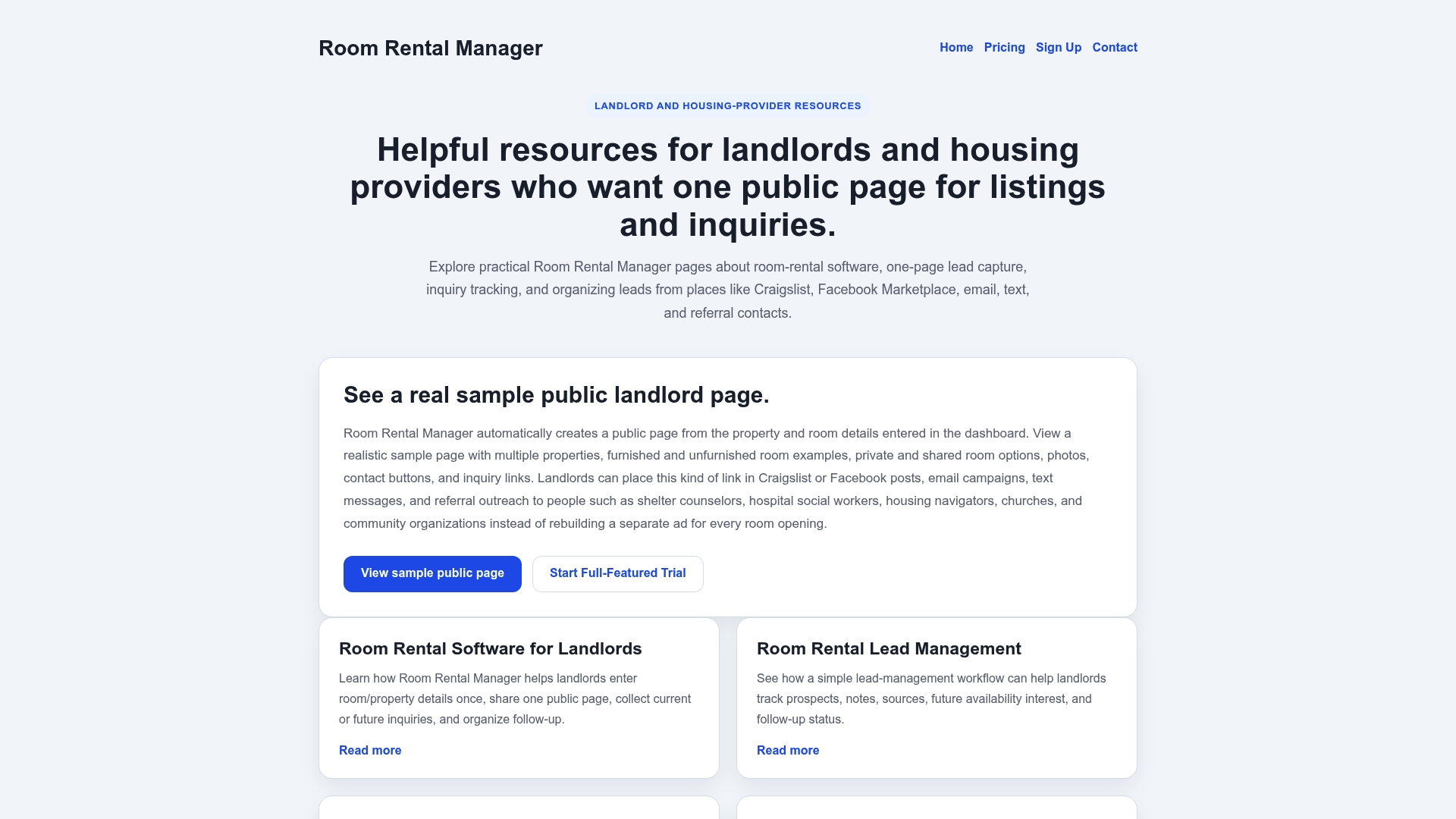
Room Rental Manager gives you one clean public listing page for your rooms, photos, property details, and contact options. Instead of repeating the same pricing and availability information across texts, emails, Facebook replies, and Craigslist messages, you share one link. Inquiries come in through a single dashboard where you can track lead sources, manage follow-up, and present your rentals professionally. For landlords testing dynamic or hybrid pricing models, that kind of organized lead management is what keeps revenue from slipping through the cracks. Explore room rental software built specifically for landlords managing shared housing at any scale.
FAQ
What is the best pricing model for a single room rental?
For a single room, a combination of cost-plus and market-rate pricing works best. Use cost-plus to set your minimum rent and market comps to find the competitive ceiling.
How much more revenue does dynamic pricing generate?
Dynamic pricing generates 15–35% more revenue than static manual pricing for portfolios with three or more units. The lift is strongest in markets with seasonal or event-driven demand.
When should a landlord switch from static to dynamic pricing?
Three units is the standard tipping point. At that scale, the time savings and revenue lift from tools like PriceLabs or Wheelhouse outweigh the subscription cost.
What is RevPAN and why does it matter for room rentals?
RevPAN stands for Revenue Per Available Night. It measures total revenue against all available rental nights, not just occupied ones, which gives a more accurate picture of pricing performance than nightly rate alone.
How often should landlords update their market-rate benchmarks?
Landlords should update market-rate benchmarks at least quarterly. Monthly updates are better in high-growth markets where rents shift quickly.