

TL;DR:
- A group home listing is a verified record that documents a licensed community residence offering supervised living and personal care services. These listings include core data such as facility name, license status, capacity, services, and contact information, but do not typically show pricing or vacancy details. Families should verify listings through official state databases, assess staff and care quality directly, and involve the prospective resident in decision-making to ensure a good fit.
A group home listing is a verified catalog or database entry that documents a licensed, community-based residence offering supervised living and personal care services for individuals who cannot live independently. These listings are the primary tool families, social workers, and care providers use to identify, compare, and evaluate residential options. A typical group home houses 4 to 16 residents in a home-like setting, providing supervision and supportive services without the clinical intensity of a hospital or nursing facility. Understanding what a group home listing contains, where to find one, and how to read it correctly is the difference between a good placement and a costly mistake.

What is a group home listing and what does it include?
A group home listing is the industry term for a structured record, either in a state licensing database or a public directory, that describes a licensed group home's key attributes. These records exist so that families, discharge planners, and social workers can assess a facility before ever visiting it. The listing is not a marketing brochure. It is a regulatory and operational snapshot.
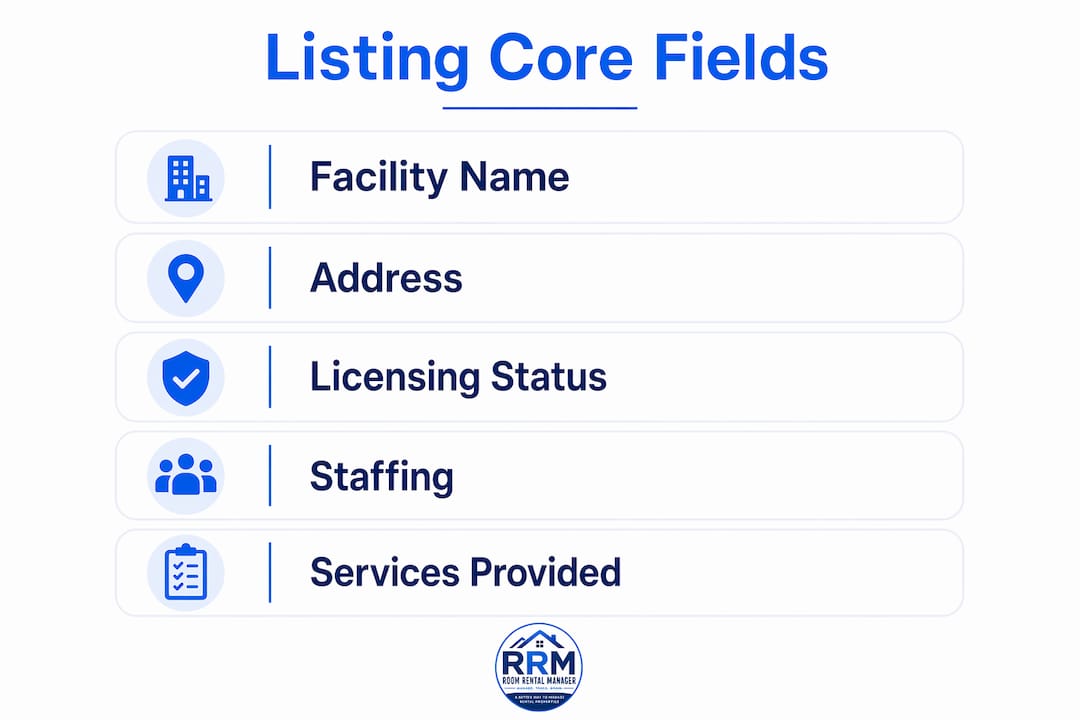
Core data fields in every listing
Most verified group home listings contain the following information:
- Facility name and physical address — the legal operating name and street address, which you can cross-reference against state licensing records
- Licensing status — whether the home holds a current, active license from the relevant state authority, and the license expiration date
- Licensed capacity — the maximum number of residents the home is approved to serve, typically between 4 and 16
- Resident demographics — the population the home is designed for, such as adults with intellectual disabilities, individuals in mental health recovery, or seniors with dementia
- Services offered — a group home services description covering supervision level, personal care assistance, medication management, and any specialized programming
- Operating agency — whether the home is run by a nonprofit, a private operator, or a government-contracted provider
- Accessibility features — wheelchair access, adapted bathrooms, and other physical accommodations
- Contact information — the name of the administrator or intake coordinator, phone number, and sometimes an email address
The services section is the most important field for families. It tells you whether the home provides 24-hour awake staff, assistance with activities of daily living (ADLs) like bathing and dressing, or only daytime supervision. Two homes with identical addresses and similar names can offer very different care levels based on this field alone.
What listings typically do not include
Most listings do not publish pricing, current vacancy status, or detailed staffing ratios. Families often expect a listing to function like a hotel booking page. It does not. Think of it as a regulatory record that confirms a home exists, is licensed, and serves a specific population. You gather the rest by calling the facility directly.
| Field | Typically Listed | Typically Not Listed |
|---|---|---|
| Facility name and address | Yes | — |
| Licensing status | Yes | — |
| Resident capacity | Yes | — |
| Services description | Yes | — |
| Current vacancy | No | Requires direct contact |
| Pricing or fees | No | Requires direct contact |
| Staffing ratios | Rarely | Varies by state |
How to find reliable group home listings
State licensing databases and health department websites are the most reliable sources for verified group home listings. These government-maintained records include facility names, addresses, and regulatory status. They cover homes that have no website, no social media presence, and no Google listing.
Start with official state sources
Every state that licenses group homes maintains a searchable database. In most states, this falls under the Department of Health, the Department of Developmental Services, or the Department of Social Services. Search the state agency's website for terms like "residential facility search," "licensed care homes," or "community residential services." The results will include homes that a standard Google search would never surface.
Many small, owner-operated group homes do not maintain websites or engage in any online marketing. This is not a sign of poor quality. It reflects the reality that small providers often run lean operations with direct caregiver involvement by the owners themselves. State databases fill this gap by listing every licensed facility regardless of its digital footprint.
Use local agencies and discharge planners
Area Agencies on Aging (AAAs), hospital discharge planners, and county social service offices maintain their own local knowledge of available homes. These professionals often know which homes have current openings, which operators are responsive, and which facilities have had recent regulatory issues. A discharge planner at a regional hospital can often provide a shortlist of vetted options within 24 hours.
- Contact your state's licensing agency and request a current list of licensed group homes in your county.
- Call your local Area Agency on Aging or county social services office for referrals.
- Ask the hospital discharge planner or case manager for homes they have placed residents in recently.
- Cross-reference any referral against the state licensing database to confirm active status.
- Check whether the home accepts Medicaid waiver programs for funding, since many families are unaware these programs can cover group home costs.
Pro Tip: When using a group home directory or aggregator website, always verify each listing against the official state database before contacting the facility. Third-party directories can contain outdated or incomplete records.
Key criteria to evaluate when reviewing group home listings
A listing tells you a home exists and is licensed. It does not tell you whether the home is a good fit. These are the criteria that matter most when moving from a listing to a decision.
Staffing and supervision
The most critical factor is 24/7 staffing and supervision. A home that provides only daytime staff is fundamentally different from one with awake overnight staff. The listing may describe this as "24-hour supervision," "awake overnight staff," or "on-call staff." These are not equivalent. Ask the operator directly what overnight coverage looks like on a typical Tuesday.
Services and care plan structure
Strong group homes provide personalized care plans for each resident. These plans document assistance with ADLs, medication management protocols, behavioral support strategies, and goals for community integration. A home that cannot describe its care planning process during your first call is a home that likely does not have a strong one.
Key service standards to look for in a listing or during your follow-up call:
- Personalized care plans reviewed at least annually
- Documented medication management with trained staff
- Assistance with ADLs including bathing, dressing, and meal preparation
- Safety protocols for emergencies, including fire drills and medical response
- Opportunities for community activities and skill-building
Cultural fit and resident involvement
Successful placement depends more on cultural fit and personal interaction than on amenities or location. A home with a newer building and a longer services list is not automatically better than a smaller, older home where the resident feels comfortable and respected. Involve the prospective resident in every step of the review process. Their comfort with the staff and the other residents is the single strongest predictor of a successful placement.
Pro Tip: Schedule an unannounced visit after your initial tour. The way staff interact with residents when they are not expecting an evaluation tells you far more than any listing or brochure.
How do group homes compare to other residential care options?
Group homes differ from assisted living and nursing homes primarily in their service focus. Group homes prioritize supportive environments, life skills development, and community integration. They are not medical facilities. Families who expect nursing-home-level medical care from a group home will be disappointed. Families who want a home-like setting with consistent support will often find group homes the best fit.
The table below summarizes the key differences across four residential care types.
| Care Type | Typical Size | Medical Focus | Independence Level | Best For |
|---|---|---|---|---|
| Group home | 4–16 residents | Low | Moderate to high | Adults with disabilities, mental health recovery |
| Assisted living | 20–200+ residents | Moderate | Moderate | Seniors needing daily assistance |
| Nursing home | 50–300+ residents | High | Low | Individuals needing skilled nursing care |
| Supported independent living | Individual apartment | Very low | High | Adults who need minimal support |
Assisted living facilities are larger, more medically oriented, and typically serve seniors. Nursing homes provide skilled nursing care around the clock and are licensed as medical facilities. Supported independent living places individuals in their own apartments with visiting support staff. Group homes occupy the space between supported independence and assisted living, serving people who need consistent daily support but do not require clinical medical care.
The licensing and regulatory requirements also differ significantly. Group homes are licensed by state developmental services or mental health agencies. Assisted living facilities are licensed by health departments under different standards. Nursing homes are federally regulated under Medicare and Medicaid certification requirements. When you search a group home directory, you are searching a different regulatory category than when you search for assisted living or nursing facilities.
Key Takeaways
A group home listing is a verified regulatory record, not a marketing page, and reading it correctly requires knowing what it includes, what it omits, and where to find authoritative sources.
| Point | Details |
|---|---|
| Definition of a listing | A group home listing is a licensed facility record in a state database or directory, not a promotional profile. |
| Best sources | State licensing databases and health department websites provide the most complete and verified listings. |
| What listings omit | Pricing, vacancy status, and staffing ratios require direct contact with the facility. |
| Evaluation priority | Cultural fit and staff interaction matter more than amenities when choosing from a shortlist. |
| Financial options | Medicaid waiver programs can fund group home care; families should verify eligibility early in the search. |
What I have learned from watching families search for group homes
The biggest mistake I see families make is treating a group home listing like an apartment listing. They filter by location, scan the services description, and call the top three results. That approach works for finding a studio apartment. It does not work for finding a home where someone will live for years.
The listings that matter most are often the ones hardest to find. Group homes are frequently small, owner-operated businesses where the owner is also the primary caregiver. These operators do not run Google ads. They do not update their listing on third-party directories. They show up in the state licensing database and nowhere else. Families who rely only on what appears in a standard web search miss a significant portion of the available options.
The second mistake is confusing licensing status with quality. A current license means a home meets minimum regulatory standards. It does not mean the home is a good fit for your family member. I have seen beautifully maintained homes with attentive staff that were not right for a particular resident, and I have seen modest homes with worn furniture where a resident thrived because the staff genuinely knew and cared about them.
The third mistake is leaving the prospective resident out of the process. Families often make placement decisions based on logistics, cost, and location without ever asking the person who will actually live there what they think. Involving the prospective resident in reviewing options significantly increases successful placement outcomes. This is not just a best practice. It is the single most underused step in the entire process.
My practical advice: start with the state licensing database, build a list of 8 to 10 licensed homes, cross-reference with your local Area Agency on Aging, and then visit your top three with the prospective resident present. Watch how staff greet them. Notice whether residents look engaged or withdrawn. Ask the operator what a typical Tuesday looks like. The answers to those questions will tell you more than any listing ever could.
— JAMES
How Room Rental Manager helps group home operators manage listings
Group home operators and small housing providers face the same challenge as any small landlord: too many inquiries coming in through too many channels, with no central place to track them. Room Rental Manager solves this by giving operators one clean public listing page for their property details, photos, contact options, and intake inquiries.
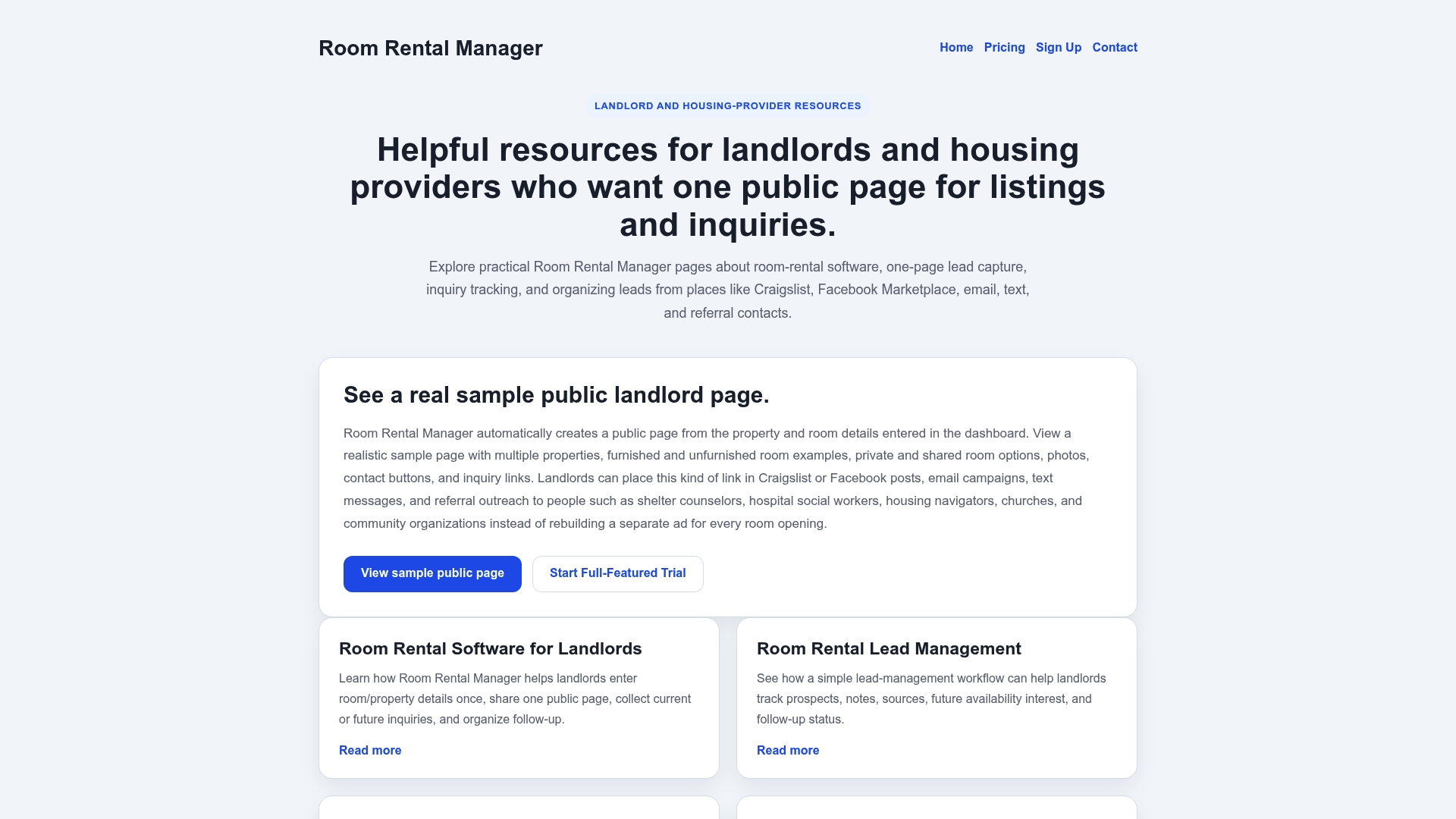
Instead of answering the same questions across phone calls, emails, and Facebook messages, operators share one link. Families and referral coordinators submit their interest through a single form. Room Rental Manager's inquiry management tools keep every lead organized in one dashboard, so nothing falls through the cracks. The tenant application tracking feature lets operators monitor where each applicant stands in the intake process without maintaining a separate spreadsheet. For operators managing more than one location, the shared housing management software handles multiple listings from a single account.
FAQ
What is a group home listing?
A group home listing is a verified record in a state licensing database or residential care directory that documents a licensed group home's name, address, capacity, services, and regulatory status. It is a regulatory snapshot, not a marketing profile.
How do I find group homes in my area?
Search your state's Department of Health or Department of Developmental Services website for a licensed facility database. Local Area Agencies on Aging and hospital discharge planners also maintain current referral lists that include homes not found through standard web searches.
What services does a group home typically provide?
Group homes typically provide 24-hour supervision, assistance with activities of daily living, medication management, personalized care plans, and community integration support. They do not provide skilled nursing care at the level of a nursing home.
How is a group home different from assisted living?
Group homes are smaller (typically 4–16 residents), focus on supportive and life-skills services, and serve adults with disabilities or mental health needs. Assisted living facilities are larger, more medically oriented, and primarily serve seniors needing daily personal care.
Can Medicaid pay for group home care?
Medicaid waiver programs can cover group home residential care for eligible adults. Many families are unaware of this option, so contacting your state Medicaid office early in the search process is the best way to confirm eligibility and available funding.