

TL;DR:
- A property listing page is a dedicated website showcasing a single property with photos, key facts, a description, and a contact form, serving as the main marketing tool. Its structure, following buyer psychology, guides visitors from curiosity to inquiry, emphasizing professional visuals, accurate data, and strategic layout. For effective marketing, content quality, accurate MLS data, and active management are essential to reduce days on market and generate qualified leads.
A property listing page is a dedicated digital webpage that presents a single property for sale or rent, structured with photos, key facts, a description, and a contact form to attract and convert buyers or renters. This is the standard industry term used by real estate professionals, and it sits at the center of modern property marketing. Understanding what a listing page does, how it differs from an MLS record or a listing agreement, and what makes one perform well is knowledge every property owner and real estate professional needs. Whether you manage one room or a portfolio of rentals, your listing page is your most visible sales tool.
What does a listing page mean in property marketing?
A property listing page is the consumer-facing marketing presentation of a specific property. It is not a legal document, not a database record, and not a general search results page. It is one page, built around one property, designed to move a visitor from curiosity to inquiry.

The page pulls together everything a buyer or renter needs to make a decision: photos, price, size, location, and a way to get in touch. According to property website design patterns, effective listing pages follow a fixed sequence designed to match buyer decision stages. That sequence matters because buyers do not read listing pages the way they read a report. They scan, react emotionally to images, then look for data to confirm what they already feel.
For landlords renting rooms or shared housing, the same logic applies. A well-built listing page replaces the scattered back-and-forth of texts, emails, and Craigslist messages with one clean link that answers every question upfront.
What key elements define an effective property listing page?
The structure of a listing page is not arbitrary. Successful listing pages implement a sequence that mirrors buyer decision psychology, turning digital browsing into qualified leads. Each content block serves a specific role in that process.
The six core content blocks
- Hero image gallery. The first thing a visitor sees. Professional photos here determine whether someone stays or leaves within seconds. Poor images signal a poorly maintained property before a single word is read.
- Key facts strip. Price, number of bedrooms, bathrooms, square footage, and listing status. This block answers the most immediate filtering questions. If the price is not visible immediately, many visitors leave.
- Benefits-oriented description. A narrative of 150–250 words that connects features to buyer or renter benefits. "Large south-facing windows" becomes "natural light all afternoon." This is where listing copy should use natural language targeting buyer intent and local search terms for SEO.
- Floor plan. Buyers use floor plans to mentally place their furniture and assess flow. According to NAR's 2024 Profile of Home Buyers and Sellers, 31% of buyers rank floor plans among the top features they value on a listing page.
- Neighborhood map and location context. Proximity to transit, schools, and amenities is often a deciding factor. A static map with labeled points of interest adds real value.
- Contact form or inquiry option. The conversion point. It should be visible without excessive scrolling and require minimal effort to complete.
Pro Tip: Place your contact form both at the top and bottom of the page. Buyers who scroll to the end are highly motivated. Make it easy for them to act the moment they decide.
The table below shows what buyers actually prioritize when they land on a listing page.
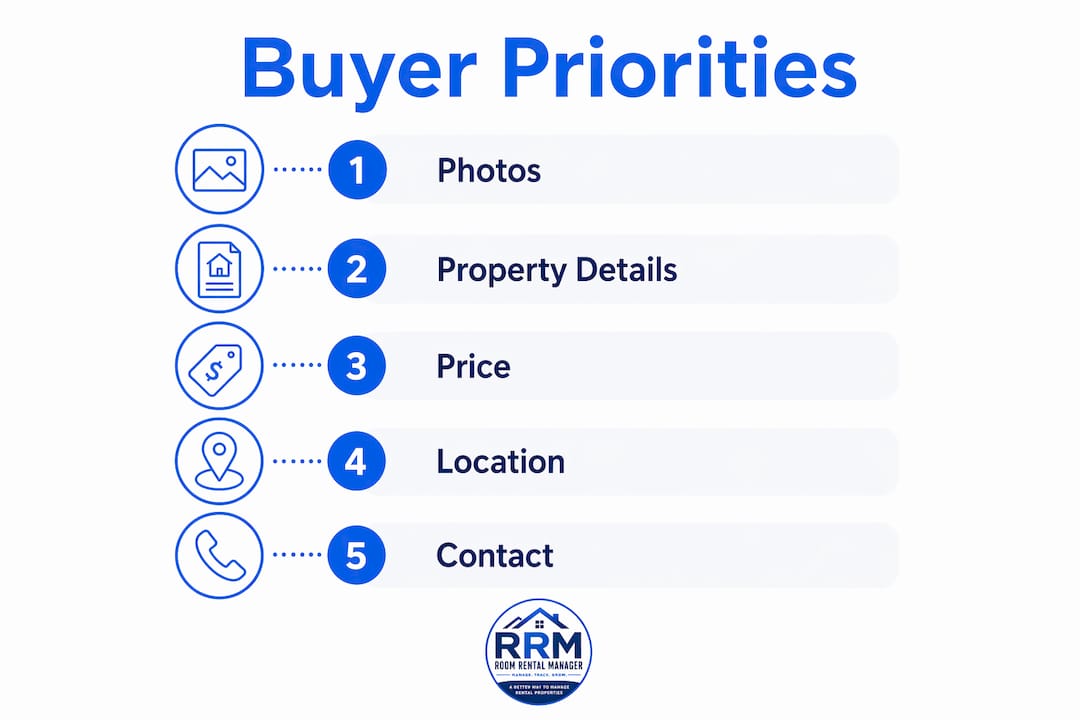
| Content element | Buyer priority (NAR 2024) |
|---|---|
| Photos | 41% rank as top feature |
| Detailed property info | 39% rank as top feature |
| Floor plans | 31% rank as top feature |
| Neighborhood map | High value for location context |
| Contact/inquiry form | Required for conversion |
The sequence matters as much as the content itself. Listing pages designed as conversion landing pages guide visitors from emotional engagement with images to rational confirmation with data, then to action with a contact form. Reversing that order, or skipping blocks, breaks the psychological flow and reduces inquiries.
How does a listing page differ from a listing agreement and MLS data?
Three terms get confused constantly in real estate: the listing agreement, the MLS listing, and the listing page. They are related but serve completely different functions.
A listing agreement is a legal contract between a property owner and a brokerage. It authorizes the broker to market the property and defines commission terms. Most listing agreements run 3–6 months and include clauses protecting the broker's commission even after expiration. This document never appears on a public webpage. It is the legal foundation, not the marketing tool.
The MLS, or Multiple Listing Service, is the authoritative database that syndicates property data to public portals and listing pages. MLS data accuracy and completeness determine search matching and buyer discovery. When a buyer searches Zillow or Realtor.com, they are seeing data pulled from MLS records. The MLS is the engine. The listing page is the storefront.
The listing page is what the public actually sees. It takes the data from the MLS and presents it in a visual, readable format designed to attract and convert. Here is how the three components relate:
- The listing agreement authorizes marketing and defines broker responsibilities.
- The MLS record stores and distributes the property data to search portals.
- The listing page presents that data publicly in a format built for buyer engagement.
"The listing page is the consumer-facing marketing display of a property. The MLS is the professional database behind it. Confusing the two leads to poor decisions about where to invest time and money in property marketing."
One critical point: incorrect MLS data entry causes listings to not appear in buyer searches, effectively hiding properties from view. Fields like address, property type, and school district must be correct to avoid exclusion from filtered search results. A beautifully designed listing page means nothing if the underlying MLS data is wrong and buyers never find it.
For landlords who operate outside the MLS, such as room-rental owners and shared housing operators, the listing page itself carries even more weight. There is no MLS syndication to fall back on. The page has to do all the work.
Why does content quality on a listing page affect marketing success?
Content quality on a listing page is not a cosmetic concern. It directly affects how long a property sits on the market and the quality of inquiries it generates.
Days on Market averages 58 days nationally. Properties with extended DOM face buyer skepticism because a long time on market signals perceived issues with the property, the price, or both. That skepticism compounds. The longer a listing sits, the harder it becomes to generate fresh interest without a price reduction or a complete marketing overhaul.
Vague descriptions, placeholder images, and missing data are the fastest way to extend DOM. Content omissions and vague listing details negatively affect buyer trust and perceived property value. A buyer who cannot find the square footage, the parking situation, or the lease terms will not call to ask. They will move to the next listing.
Pro Tip: Read your listing description out loud. If it sounds like a form letter or uses words like "cozy" without explaining why, rewrite it. Buyers decode vague language as a warning sign.
Professional photography has a measurable impact on how quickly a property moves. Research on real estate photos and Days on Market shows that professional imagery directly influences buyer engagement and market timing. A listing with dark, low-resolution phone photos communicates neglect before a buyer reads a single word.
The risks of poor content quality break down clearly:
- Missing photos or low-quality images signal a property the owner is not proud of.
- Incomplete key facts force buyers to contact you for basic information, filtering out those who will not bother.
- Generic descriptions fail to differentiate the property from dozens of similar listings.
- Outdated status or pricing destroys trust and wastes everyone's time.
- No contact form or unclear contact options eliminate conversions at the final step.
Listing pages function as dynamic tools optimized for buyer conversion, not static brochures. Treating them as a one-time upload and forgetting them is a common and costly mistake.
What practical steps create a high-performing listing page?
Building a listing page that generates quality inquiries requires deliberate choices at every step. Here is the process that works.
- Enter MLS data accurately and completely. Every field matters. Address, property type, school district, and status must be correct. Errors here remove your listing from filtered searches before any buyer sees it.
- Write a description that connects features to benefits. State what the property has, then explain why it matters to the renter or buyer. "Private entrance" becomes "come and go without disturbing housemates." Aim for 150–250 words with natural language that reflects how local buyers search.
- Hire a professional photographer or use high-quality equipment. Photos are the first filter. Shoot during daylight, stage the space, and include every room. For rental listing photos, wide-angle shots of common areas and natural light in bedrooms consistently outperform dark, cluttered images.
- Include a floor plan. Even a simple hand-drawn floor plan scanned cleanly outperforms no floor plan. Buyers and renters use them to confirm the space works for their life before they schedule a visit.
- Structure the page in buyer decision order. Gallery first, key facts second, description third, floor plan fourth, map fifth, contact form last and also near the top. This is not a suggestion. It is the sequence that matches buyer psychology.
- Keep status and pricing current. A listing marked "available" that is already rented generates wasted inquiries and damages your credibility with serious prospects.
- Monitor Days on Market and act early. If inquiries drop off after two weeks without a lease, adjust the price or refresh the photos before DOM becomes a liability. Proactive management of DOM is key to sustaining listing attractiveness and avoiding forced price reductions.
Pro Tip: Track where your inquiries come from. If most leads arrive from one source, double down on it. If a channel produces zero inquiries after two weeks, cut it and redirect that time. Room Rental Manager's inquiry tracking tools make this visible at a glance.
For landlords managing rooms or shared housing, a single well-structured listing page replaces the need to repeat the same information across every platform. One link, shared anywhere, answers every question and captures every inquiry in one place.
Key Takeaways
A property listing page is the most important marketing asset a landlord or real estate professional controls, and its quality directly determines how fast a property rents or sells.
| Point | Details |
|---|---|
| Definition of a listing page | A dedicated digital page presenting one property with photos, facts, description, and a contact form. |
| Structure follows buyer psychology | The sequence of hero image, key facts, description, floor plan, map, and contact form mirrors how buyers decide. |
| MLS accuracy drives visibility | Incorrect MLS data fields hide listings from buyer searches before anyone sees the page. |
| Content quality affects time on market | Vague descriptions and poor photos extend Days on Market and reduce inquiry quality. |
| Active management is required | Updating status, pricing, and photos proactively prevents DOM from becoming a buyer concern. |
The part most landlords get wrong about listing pages
I have reviewed hundreds of rental listings over the years, and the single most common mistake is treating the listing page as a task to complete rather than a tool to manage. Landlords spend an hour building the page, post it, and then walk away. Six weeks later they wonder why the phone is not ringing.
The second mistake is confusing activity with performance. Posting to five platforms feels productive. But if every platform shows a different price, different photos, and a different description, you are not running a marketing campaign. You are running five inconsistent ones. Buyers and renters notice the discrepancies, and it erodes trust before they ever contact you.
What actually works is simpler than most people expect. One clean page with accurate information, professional photos, and a clear way to get in touch outperforms a scattered multi-platform presence almost every time. The listing details that generate quality leads are not complicated. They are just specific, honest, and current.
Small landlords have a real advantage here that they rarely use. A large property management company runs dozens of listings and cannot personalize any of them. You can write a description that speaks directly to the kind of tenant you want, use photos that show the actual space honestly, and respond to inquiries the same day. That combination beats a generic corporate listing more often than you would think.
The listing page is not where you close the deal. It is where you earn the right to have a conversation. Treat it that way.
— JAMES
How Room Rental Manager helps you build and manage listing pages
Room Rental Manager gives landlords, shared housing operators, and room-rental owners one clean public page that handles everything a listing page needs: photos, property details, pricing, availability, and a built-in inquiry form. Instead of repeating the same information across texts, emails, and social media replies, you share one link and collect every inquiry in one place.
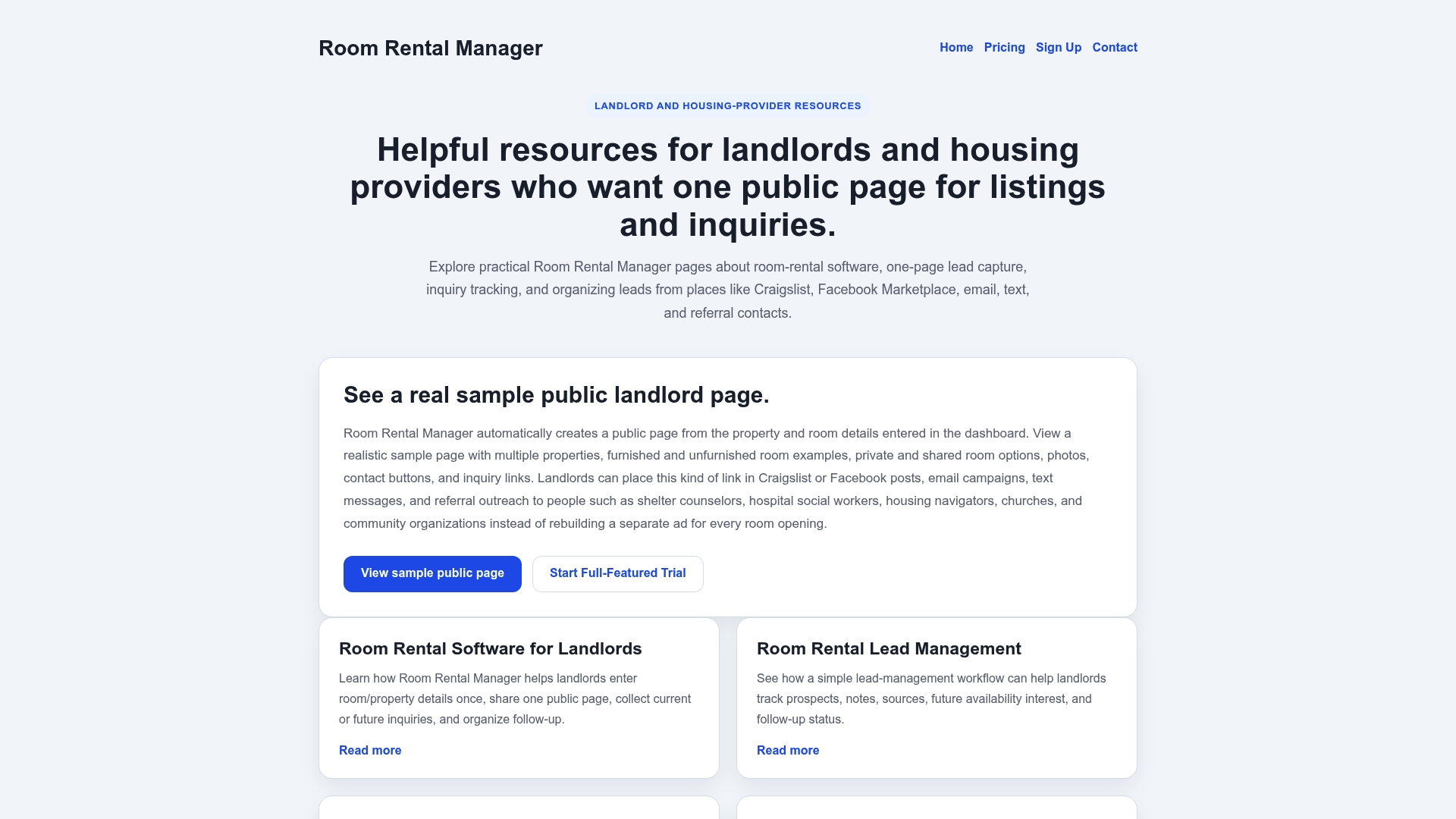
The platform tracks where your leads come from, so you know which channels are working and which are wasting your time. For landlords managing multiple rooms or housing types, rent-by-the-room software makes it straightforward to keep each room's listing current without rebuilding everything from scratch. If you are ready to present your rentals more professionally and stop losing leads to disorganized follow-up, explore the full toolkit at Room Rental Manager.
FAQ
What is a property listing page?
A property listing page is a dedicated digital webpage that presents a single property for sale or rent, featuring photos, key facts, a description, and a contact form. It is the public marketing display of a property, distinct from the MLS database record or the legal listing agreement.
How does a listing page differ from an MLS listing?
An MLS listing is a database record that syndicates property data to search portals. A listing page is the consumer-facing webpage that presents that data visually to buyers and renters. The MLS is the source; the listing page is the storefront.
What content should every property listing page include?
Every listing page should include a hero photo gallery, a key facts strip with price and size, a benefits-oriented description, a floor plan, a neighborhood map, and a contact form. According to NAR's 2024 data, 41% of buyers rank photos as the top feature, followed by detailed info at 39% and floor plans at 31%.
Why does Days on Market matter for a listing page?
Days on Market averages 58 days nationally. When a listing sits significantly longer, buyers interpret it as a sign of problems with the property or the price. Monitoring DOM and refreshing photos or pricing proactively prevents that perception from taking hold.
Can a landlord use a listing page without the MLS?
Yes. Landlords renting rooms or shared housing typically operate outside the MLS entirely. In that case, the listing page carries all the marketing weight on its own, making content quality, photo standards, and a clear inquiry process even more critical to filling vacancies.