

TL;DR:
- Room rentals offer significant cost savings and greater lease flexibility compared to apartments. They involve shared living spaces with lower upfront costs and more informal management, but require managing household dynamics and shared responsibilities. The choice depends on individual lifestyle preferences, financial situation, and desired level of privacy and control.
Room rentals are private bedrooms within shared homes that cost significantly less and offer more flexible terms than traditional apartment leases. The core distinction matters because it shapes your budget, your daily lifestyle, and how much control you have over your living space. Understanding why room rentals differ from apartments helps you make a smarter housing decision, not just a cheaper one. This guide breaks down the real differences in cost, lease terms, privacy, and management so you can match the right option to your actual situation.
Why room rentals differ from apartments in cost
Cost is the most immediate reason people choose a room rental over an apartment. A private room in a shared house costs about 40–60% of a comparable studio apartment in major U.S. cities. That translates to roughly $650 per month in savings, or about $7,800 per year.

That number alone changes the math on a lot of life decisions. But the savings go deeper than base rent.
Utilities and internet: included vs. added on
Room rentals frequently bundle utilities and internet into the monthly price. Apartments do not. Combined utility costs for a standalone apartment can reach $300 per month beyond base rent. That is electricity, gas, water, and internet stacked on top of what you already pay.
When you rent a room, those costs are typically split among housemates or absorbed into the flat rate. You pay one number and move on. With an apartment, you manage multiple accounts and variable bills every month.
Upfront costs: furniture and deposits
The upfront cost gap between the two options is wider than most people expect. Apartments require higher upfront costs including security deposits and furniture. Furnishing a one-bedroom apartment from scratch costs $2,000 or more before you sleep your first night there. Room rentals almost always come furnished, so that expense disappears entirely.
Security deposits also tend to be lower for rooms. An apartment deposit is typically one to two months' rent. A room deposit is often just a few hundred dollars. For someone moving to a new city or managing a tight budget, that difference is real money.
Pro Tip: Calculate your total cost of occupancy, not just base rent. Add utilities, internet, renter's insurance, and any furniture purchases to get an honest monthly number for both options before you decide.
Monthly cost comparison
| Cost component | Room rental | Apartment |
|---|---|---|
| Base rent | $700–$1,000 | $1,400–$2,000 |
| Utilities | Often included | $150–$300 extra |
| Internet | Often included | $50–$80 extra |
| Furniture | Usually provided | $2,000+ upfront |
| Security deposit | $300–$700 | $1,400–$4,000 |
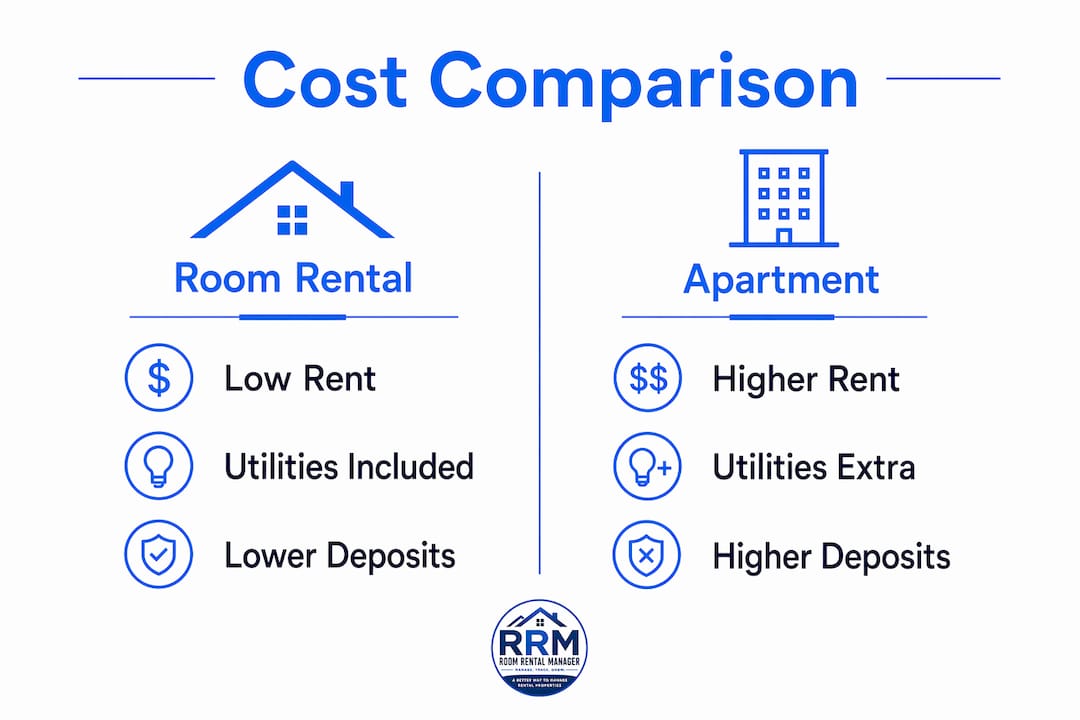
The table shows that the financial gap between room rentals and apartments is not just about monthly rent. It is about the full picture of what you spend to move in and stay there.
How do lease terms and flexibility vary between the two?
Lease structure is where room rentals and apartments diverge most sharply in practical terms. Room rentals offer more flexible leases, including month-to-month and 3–6 month options, compared to the standard 12-month apartment lease. That flexibility is not a minor perk. It is a structural difference that affects how you plan your life.
Here is what that difference looks like in practice:
- Month-to-month room rentals let you leave with 30 days' notice. You are not locked in for a year if your job changes, your relationship changes, or you simply want to move.
- Short-term room leases (3–6 months) suit people in transition: new graduates, people relocating for work, or anyone testing a new city before committing.
- Standard 12-month apartment leases offer stability but come with early termination fees that can cost one to two months' rent if you need to leave early.
- Apartment deposits are harder to recover. Room rental deposits are smaller and typically returned faster with fewer disputes.
- Renewal terms in apartments often include rent increases baked into the new contract. Room rental renewals are frequently negotiated directly with the landlord.
The flexibility of room rentals is especially valuable in a tight rental market. With national vacancy rates at historically low levels, locking into a 12-month apartment lease carries real risk if your circumstances shift mid-term.
One caution worth noting: some room rentals operate on informal or verbal agreements. Some room rentals lack formal leases or registered addresses required for visa or employment verification. If you need a formal lease for immigration status, a bank account, or a job background check, confirm the lease type before you sign anything.
What lifestyle differences arise between renting a room and an apartment?
The lifestyle gap between a room rental and an apartment is the factor most people underestimate before they move in. An apartment gives you a fully private, self-contained space. A room rental gives you a private bedroom inside a shared home. Everything outside that bedroom is negotiated territory.
Shared common spaces offer community but require effort to manage household norms. That effort is real. It includes conversations about cleaning schedules, noise levels, guest policies, and kitchen use. None of that exists in an apartment.
The social upside of shared living
For many renters, especially those new to a city, the social dimension of room rentals is a genuine benefit. Social support in shared housing is a significant non-financial advantage for newcomers, promoting connections that apartments simply do not facilitate. You share meals, you meet people organically, and you build a local network faster than you would living alone.
This matters more than it sounds. Moving to a new city in a private apartment can be isolating. A shared home puts you in daily contact with people who are often in similar life situations.
The privacy cost of shared living
The tradeoff is real. You do not control the common areas. A loud housemate, a messy kitchen, or a disagreement over the thermostat affects your daily life in ways that never happen in a private apartment. Renting a room requires managing shared space etiquette, acting as a hidden accommodation role that apartment tenants never take on.
Professional room rentals have responded to this tension. Private digital locks, cleaning services, and furnished common areas are now standard in many managed room rental properties. These features reduce the friction of shared living without eliminating the cost savings. You can explore the different types of shared housing arrangements to find the model that fits your tolerance for shared space.
Pro Tip: Before signing a room rental agreement, ask to meet your potential housemates and walk through the common areas at a time when everyone is home. The vibe you get in 20 minutes tells you more than any listing description.
Here is a practical breakdown of the lifestyle factors to weigh:
- Privacy level. Apartments offer complete privacy. Room rentals offer private sleeping space with shared kitchens, bathrooms, and living areas.
- Social interaction. Room rentals create daily contact with housemates. Apartments require active effort to build social connections.
- Household management. Room renters share responsibility for common areas. Apartment tenants manage their own space entirely.
- Noise and disruption. Housemate behavior directly affects your experience in a room rental. In an apartment, neighbors are separated by walls and floors.
- Amenity access. Many room rentals include furnished common areas, fast internet, and cleaning services. Apartments require you to set up and pay for everything yourself.
How do management structures differ between room rentals and apartments?
The management model behind your rental shapes how problems get solved and how much autonomy you have day to day. Room rentals are often managed by individual landlords or tenants, offering direct relationships compared to institutional apartment management. That directness is a double-edged situation.
On the positive side, a direct relationship with a small landlord means faster communication. You text your landlord and get a response the same day. A broken faucet gets fixed because you asked, not because a work order cleared a queue. For landlords managing these properties, tools like rent by the room software help keep communication and tenant tracking organized without the overhead of a property management company.
Apartment management works differently. Large property management companies like Greystar, AvalonBay Communities, or Equity Residential operate with formal processes. Maintenance requests go through a portal. Lease renewals come with standardized terms. Communication is professional but impersonal. You are a unit number, not a name.
Here is how the two management models compare across key dimensions:
- Maintenance response. Individual landlords often respond faster but have fewer resources. Property management companies have dedicated maintenance teams but slower ticket systems.
- Lease formality. Apartments use standardized leases with full legal protection. Room rentals vary widely, from formal contracts to informal agreements.
- Tenant autonomy. Room rental landlords often allow more flexibility on small customizations, guests, or lease adjustments. Apartment management companies enforce policies uniformly.
- Dispute resolution. Apartment tenants have clear escalation paths through property management. Room rental disputes often depend on the landlord's willingness to engage.
- Accountability. Institutional apartment management is regulated and audited. Individual room rental landlords operate with less oversight, which can work in your favor or against you.
Understanding shared housing presentation helps renters evaluate whether a room rental is professionally managed or informally run. The difference matters when something goes wrong.
The trade-off between control and cost savings is the central factor in this decision. Apartments give you more control and formal protection. Room rentals give you lower costs and more flexibility, but with less institutional structure behind them.
Key takeaways
Room rentals and apartments serve different needs, and the right choice depends on your financial situation, lifestyle preferences, and how much stability you require from your lease.
| Point | Details |
|---|---|
| Cost savings are substantial | Room rentals cost 40–60% of a comparable studio, saving roughly $7,800 per year. |
| Flexibility favors room rentals | Month-to-month and short-term leases make room rentals better for people in transition. |
| Privacy favors apartments | Apartments offer fully self-contained living; room rentals require shared common spaces. |
| Upfront costs are lower for rooms | Furnished rooms and smaller deposits reduce move-in costs by $2,000 or more. |
| Management style varies widely | Room rentals offer direct landlord access; apartments provide formal but impersonal processes. |
The honest calculus I've seen renters get wrong
Most people frame the room rental vs. apartment decision as a money question. It is not. It is a lifestyle question with financial consequences attached.
I have watched renters choose apartments they could not afford because they equated privacy with adulthood. They stretched their budgets, skipped savings, and ended up stressed every month. The apartment gave them control over their space, but it cost them control over their finances. That is a bad trade.
On the other side, I have seen people move into room rentals without asking a single question about their housemates, the lease terms, or whether the landlord was reachable. They saved money for three months and then spent it all on an emergency move because the living situation collapsed.
The renters who make this decision well do one thing differently: they separate the financial analysis from the lifestyle analysis and run both honestly. They calculate the real monthly cost of each option, including utilities, furniture, and deposits. Then they ask themselves whether they actually want to share a kitchen with strangers, or whether they need a private space to function well.
Newcomers to a city often underestimate how much the social dimension of room rentals helps them. You land in a new place with built-in neighbors who know the area, the restaurants, and the transit routes. That has real value that does not show up in a spreadsheet.
My honest recommendation: if you are under financial pressure or in a transitional period, a well-managed room rental is almost always the smarter move for the first 6–12 months. Use the savings to build a cushion. Then decide whether an apartment is worth the premium once you know the city and your situation better.
— JAMES
How Room Rental Manager helps landlords manage shared housing
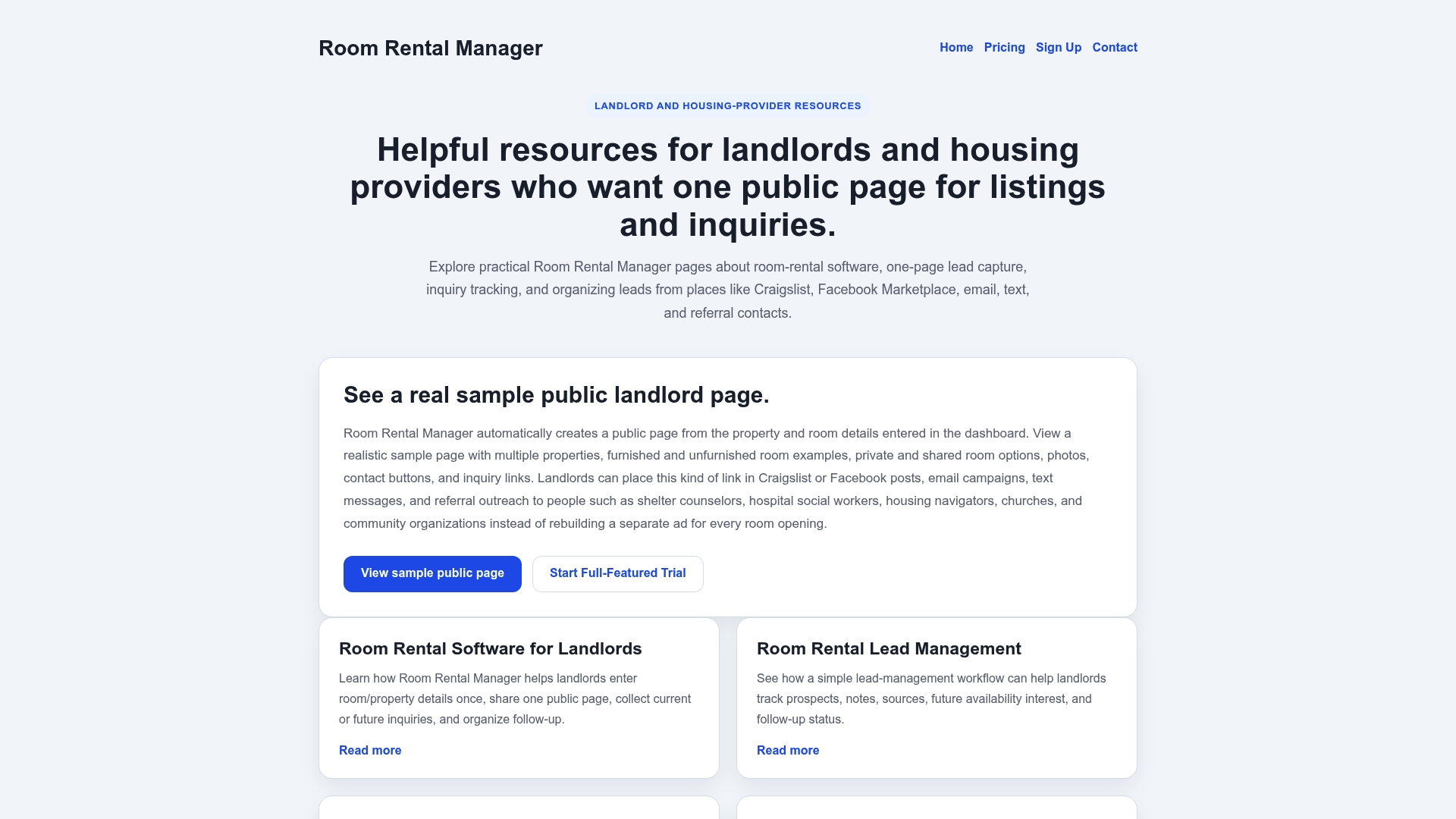
Managing a room rental property is more complex than managing a single apartment. You are tracking multiple tenants, fielding inquiries from different channels, and trying to keep your listing information consistent across texts, emails, and social posts. Room Rental Manager solves that problem with one clean public listing page that handles photos, property details, contact options, and inquiries in one place. Landlords can use the room rental application form to collect renter interest without chasing messages across platforms. The shared housing management software keeps lead tracking and follow-up organized from a single dashboard, so nothing falls through the cracks.
FAQ
What is a room rental, exactly?
A room rental is a private bedroom within a shared home where tenants split common areas like kitchens and bathrooms. It differs from an apartment because it is not a self-contained unit.
How much cheaper is renting a room vs. an apartment?
Renting a private room costs about 40–60% of a comparable studio apartment, saving roughly $650 per month or $7,800 per year in major U.S. cities.
Do room rentals come with formal leases?
Many do, but not all. Some room rentals use informal or verbal agreements that may not satisfy requirements for visa verification or employment background checks, so always confirm the lease type before committing.
Are utilities included in room rentals?
Utilities and internet are frequently included in room rental pricing, while apartment renters pay these separately. Combined utility costs for apartments can add up to $300 per month beyond base rent.
Who manages room rentals vs. apartments?
Room rentals are typically managed by individual landlords with direct communication, while apartments are usually run by property management companies with formal maintenance and lease processes. For landlords managing multiple rooms, the landlord application dashboard from Room Rental Manager provides a structured way to track applicants and follow up efficiently.